
Racking and Shelving Provider in the UAE: Why Businesses Choose Planet Racking Steel and Basic Steel Products Trading LLC
Most warehouses don’t have a space problem. They have a layout problem that looks like one. Pallets stacked on the floor, shelves that can’t take the load, and aisles too narrow for a forklift: all of these cost money every day, and most are never itemised on a budget.
This guide explains what a good racking and shelving provider should deliver, which systems suit which operations, and how to judge the return before you commit. It also covers what Planet Racking Steel and Basic Steel Products Trading LLC supplies and installs for warehouse storage solutions in the UAE.
Why Choose Planet Racking Steel for Your Warehouse Storage Needs
A racking provider is not just a steel supplier. The steel is the easy part. The value is in specifying the right system for your pallets, your handling equipment and your throughput, then installing it safely so it performs for years.
Planet Racking Steel works as a single point of responsibility across the whole job:
- Supply: pallet racking systems, shelving, cantilever racking and related steel products.
- Design: warehouse space planning based on your load data and operating flow, not a catalogue guess.
- Installation: professional steel racking installation for new builds and existing sites.
- Support: help after handover, because a racking system is a long-term asset.
Having one accountable partner matters more than it sounds. When the supplier, designer and installer are separate companies, problems fall between them. A beam that doesn’t match an upright becomes an argument rather than a fix.
Types of Racking Systems We Supply and Install
The question we hear most is: which racking is best for my warehouse? There is no single best system. There is only the best fit for your product, handling equipment and stock profile. This table compares the main options.
| System | Best for | Key advantage | Main trade-off |
|---|---|---|---|
| Selective pallet racking | Mixed SKUs, frequent picking | Direct access to every pallet | Lower density than deep-lane systems |
| Drive-in / drive-through racking | Large volumes of few SKUs | High storage density | Limited selectivity; stock rotation is harder |
| Cantilever racking | Pipes, timber, profiles, long items | Unobstructed loading of long loads | Not suited to standard pallets |
| Industrial shelving | Cartons, spare parts, small items | Flexible, low-cost, manual access | Lower load capacity per bay |
| Heavy-duty storage systems | Heavy or bulky goods, high-bay stores | High capacity and stability | Needs careful engineering and floor checks |
| Retail shelving solutions | Stores, showrooms, back-of-house stock | Customer-facing presentation and quick restocking | Designed for lighter loads |
As a rule of thumb, selective racking suits most distribution operations that handle many product lines. Drive-in systems earn their place when you store large quantities of the same product, such as beverages or seasonal goods. Cantilever systems are the clear answer for long, awkward materials that would otherwise lie on the floor.
Custom Racking Solutions for Different Industries and Applications
Standard configurations rarely match real operations. A trading company, a food distributor and a fabrication workshop all use pallets, but they handle them differently. Here is how requirements typically differ:
- Logistics and 3PL: fast access, adjustable beam levels, and layouts that can change as client contracts change.
- Construction and steel trading: cantilever racking and heavy-duty systems for pipes, bars, sheets and profiles.
- Retail and e-commerce: retail shelving solutions and picking-friendly shelving that keep fast movers at ergonomic height.
- Manufacturing: work-in-progress storage, spare parts shelving, and racking arranged around production flow.
- FMCG and food: high-density systems with clear stock rotation and clean, safe floor space.
Custom does not mean expensive. It means specifying the right bay width, beam capacity and frame height for your actual loads, rather than paying for capacity you will never use or buying too little and creating a safety risk.
The Hidden Costs of Poor Warehouse Storage Planning
Poor storage rarely shows up as one large expense. It leaks out through many small ones. Here are the warning signs that your current setup is inefficient:
- Pallets or cartons stacked on the floor, blocking aisles or access.
- Pickers walking long distances because fast-moving items sit far from dispatch.
- Frequent product damage from crushed lower layers or forklift collisions.
- Stock that is “somewhere in the warehouse” but cannot be found quickly.
- Shelving that bows, leans, or has been loaded beyond its rated capacity.
- Paying for extra external storage while your own building has unused height.
Each one has a cost: lost labour hours, damaged goods, slower dispatch and higher safety risk. Many businesses respond by renting more space. That is often the most expensive fix, when the cheaper one is using the cubic volume they already pay for.
If two or three of these signs sound familiar, a short layout review is usually worth more than another lease. Request a free storage assessment and we will show you where the waste is.
Our Racking Installation and Support Process
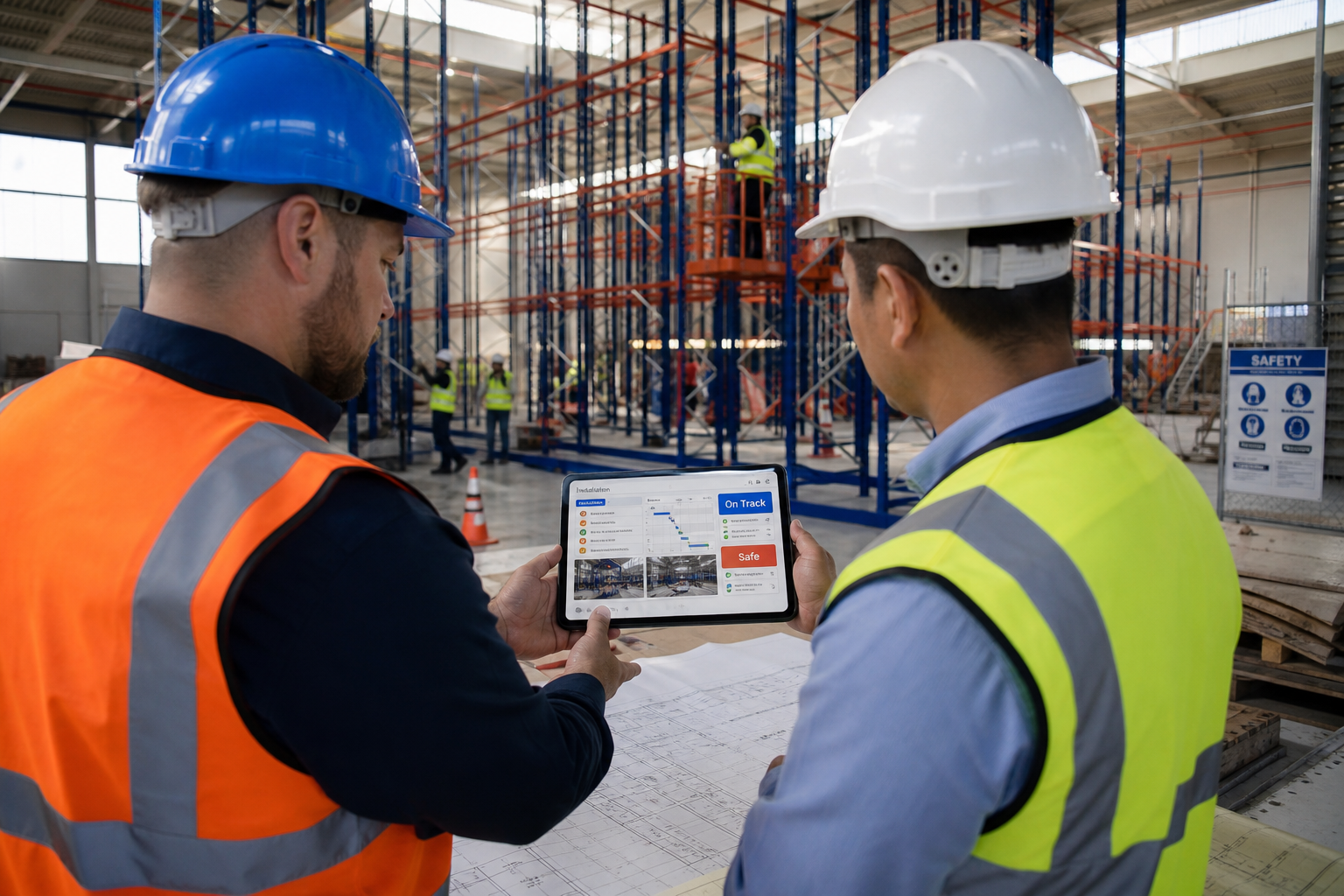
Clients ask for a typical timeline. It depends on project size and whether components are in stock or made to order. The sequence is consistent, and the durations below are indicative for a standard project:
- Site review and data gathering (days): we measure the space, check floor conditions and clear heights, and collect pallet dimensions, weights and SKU profiles.
- Layout and specification (about one to two weeks): we draw the layout, select the system and capacities, and send a clear quotation with drawings.
- Approval and supply (varies): stock components can ship quickly. Custom items take longer, and we confirm lead times before you commit.
- Installation (days to weeks): steel racking installation is scheduled around your operation, with the aim of keeping disruption low.
- Inspection and handover: we check alignment, anchoring and load signage, and brief your team on safe use.
- After-sales support: we help with extensions, reconfiguration and replacement of damaged components.
Can Planet Racking Steel handle both new installations and retrofits? Yes. Retrofitting an occupied warehouse is often the harder job, because you must work around live stock and existing structures. We plan these installations in phases, so you can keep operating while the new layout comes online.
How to Select the Right Racking Provider for Your Business
Most advice on choosing a provider stops at “compare quotes”. That is the wrong starting point, because two quotes for different designs cannot be compared on price. We suggest the LF³ test: Load, Flow, Footprint, Future. A good provider should be able to answer all four.
- Load: Do they ask for pallet weights, dimensions and beam loads, and state the rated capacity per bay in writing?
- Flow: Do they ask how goods move in, through and out, including forklift type, aisle width and pick rates?
- Footprint: Do they use your full height and floor area, with safe clearances, rather than just fitting standard bays?
- Future: Can the system be extended or reconfigured when your range or volumes change?
Beyond LF³, check these practical points:
- Quality: material grade, coating or finish, and compliance with recognised design standards.
- Reliability: stated lead times and a track record of keeping to them.
- Installation competence: trained crews, correct anchoring, and proper handover.
- After-sales support: who you call when a upright is damaged, and how fast they respond.
A common objection: “A cheaper supplier will do the same job.” Sometimes the steel is similar. The difference is usually in the engineering, the installation quality and the support. A rack that is under-specified or badly installed costs far more once you factor in downtime, damaged stock and a safety incident.
Proven ROI: Space Efficiency and Operational Gains with Modern Racking
How much can proper racking reduce costs? The honest answer is that it depends on where you start. We can show the mechanics with an illustrative example, using typical industry assumptions rather than a specific client result.
Consider a 1,000 m² warehouse storing standard pallets of about 1.2 m² each. Stacked on the floor two high, with aisles and working space taking around 40% of the area, it holds roughly 1,000 pallets. Fitted with selective racking five levels high, using around 40% of the floor for the racking footprint, it holds roughly 1,650 pallet positions. That is about 65% more capacity from the same building, with every pallet accessible.
The gains beyond capacity are just as practical:
- Warehouse inventory management: defined locations make counts, rotation and picking faster and more accurate.
- Less damage: pallets no longer bear the weight of the ones above them.
- Safer operations: clear aisles and rated, labelled bays reduce incidents.
- Deferred expansion: using vertical space can postpone a move or lease extension.
Treat these figures as a method, not a promise. The real number comes from measuring your own building, stock profile and handling equipment, which is exactly what an assessment does. This is the core of warehouse optimization: find the capacity you already own before paying for more.
Get Your Free Warehouse Storage Assessment
If you suspect your warehouse is working harder than it should, the quickest way to know is to measure it. Our racking specialists will review your space, your stock and your handling methods, then show you where space and cost can be recovered. There is no obligation to proceed.
Schedule a free warehouse storage assessment with our racking specialists to identify how much space and cost you could save.
Whether you are fitting out a new facility, retrofitting an operating site or simply need a reliable industrial shelving supplier, the team at Planet Racking Steel and Basic Steel Products Trading LLC is happy to talk through your requirements. Contact us to start the conversation.
