

Mobile Shelving Warehouse Inventory Management Workflow: Setup, Operations & Operator Training
A mobile shelving warehouse inventory management workflow is the set of daily routines that govern how stock is put away, picked, counted and protected on shelving carriages that move along floor tracks. Teams open one aisle at a time, confirm it is clear, lock it, work it, then close it. Inventory locations are scanned and recorded in a WMS, and operators are trained to treat aisle movement as a controlled safety event, not a convenience. This guide covers each step for teams new to the topic.
What Is Mobile Shelving and How It Fits Into Warehouse Operations
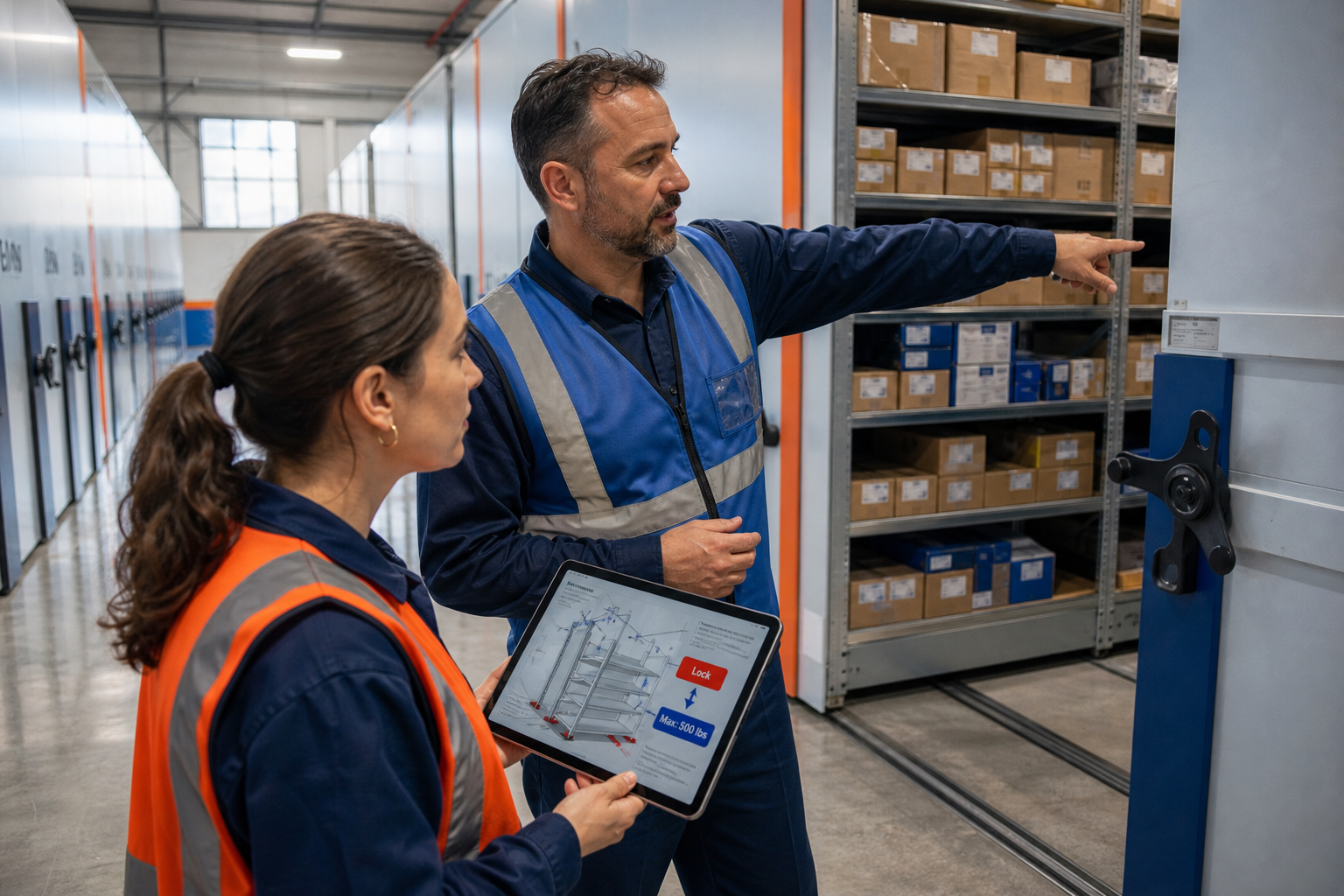
Mobile shelving, also called mobile racking or compact shelving systems, mounts storage bays on motorised or manually driven carriages that travel on rails set into or on top of the floor. Because the carriages slide together, the system needs only one open working aisle instead of a permanent aisle between every row. The same footprint can often hold substantially more storage positions than static shelving. Commonly cited gains run from roughly 50% to 100%, depending on layout, load and building constraints.
There are three main drive types:
- Manual (mechanical-assist): a hand crank or wheel drives the carriage. It suits lighter loads and lower-frequency access.
- Powered (electric): push-button or sensor-controlled movement. Powered mobile shelving operations suit larger systems, heavier loads and higher access rates.
- Pallet-type mobile racking: heavy-duty bases carry pallet racking and are served by forklifts or reach trucks. This is a different operating environment, covered in our guide to heavy-duty mobile shelving for high-density storage.
Mobile shelving fits best where stock count is high, individual SKU velocity is moderate to low, and floor space is expensive. Typical uses are spare parts, archives, cold rooms, e-commerce slow movers, pharmaceutical and MRO stores. It fits poorly where many pickers need simultaneous access to many different SKUs. In that case the single open aisle becomes the bottleneck. Our separate analysis of cost per position against static racking covers the financial side. This article focuses on how the system is actually run.
Daily Inventory Workflow: Step-by-Step Process for Mobile Shelving Systems
Most operational problems come from treating mobile shelving like static shelving with a moving part. The workflow differs because aisle access is sequential: only one operator or team can work a given aisle gap at a time. We use a five-step discipline we call the AISLE protocol to keep put-away, picking and counting both fast and safe.
- Authorise. Only trained, signed-off operators move carriages. Access can be by badge, key or PIN on powered systems, or by site rule on manual ones.
- Inspect. Look into the target aisle and the adjacent carriages. Check for people, loose cartons, trolleys or pallets on the track, and look for damaged items overhanging shelf edges.
- Secure. Open the aisle, then engage the aisle lock, hold-to-run control or safety-stop function so the carriages cannot move while someone is inside.
- Load and work. Perform the put-away, pick or count. Complete the task in that aisle before opening another.
- Exit and reset. Confirm the aisle is empty, remove trolleys and equipment, release the lock and close the system to its default position.
How does the inventory put-away workflow work?
An effective inventory put-away workflow for mobile shelving follows these steps:
- Receive and verify goods against the order and label them with the destination location.
- Group items by destination carriage, not by arrival sequence, so each aisle is opened once.
- Open the aisle, lock it and place goods on the shelf at the assigned position.
- Scan the location label, then the item label, to confirm the move.
- Close the aisle and complete the transaction in the system.
How does picking differ from traditional racking?
With static racking, pickers walk a route through open aisles, and several can work in parallel. With mobile shelving, the aisle itself is a shared resource. The best-performing teams batch picks by carriage, sequence them so aisles are opened as few times as possible, and assign a single picker to a carriage block for a set period. In most operations we see, aisle-opening discipline matters more to throughput than walking distance.
Space Optimization and Aisle Management in Mobile Shelving Setups
Space optimization in a warehouse is not only about packing more shelves into the room. It also means deciding which stock lives where so the single open aisle is rarely a source of delay. Three principles guide this:
- Slot by velocity, not by category. Put the fastest-moving SKUs on carriages nearest the access point or in the most ergonomic shelf zones. Keep slow, bulky or archival stock on remote carriages.
- Use the fixed end bays wisely. Static end units at the ends of a run are always accessible. They are the right home for high-frequency items, consumables and urgent pick stock.
- Size aisles for the task. The working aisle must allow operators, trolleys and ergonomic reach without forcing them to stand on the shelving. Narrow aisles that save a few centimetres can cost minutes per day.
A common mistake is filling every shelf to the maximum, leaving no buffer for put-away of new stock. Plan to keep a share of positions, often around 5% to 10%, free for inbound flexibility and recounts. That figure is a starting point, not a rule. Measure your own put-away delays and adjust.
Safety Protocols and Compliance Requirements for Mobile Shelving Operations
Mobile racking safety protocols centre on one hazard: a carriage moving while someone is in the aisle. The mitigation is layered, combining engineering controls, procedures and training.
Which safety features should a system have?
- Aisle lock or mechanical safety stop that prevents movement when the aisle is open for work
- Sensors (such as photoelectric or floor-level light curtains) on powered systems that detect people or objects in the aisle
- Emergency stop controls at accessible points
- Anti-tip design and rated load limits clearly marked on each carriage
- Clear floor markings and signage that show the safe working aisle
- Guarding of drive components and track clearances to avoid trapping or crushing points
What compliance requirements apply?
Mobile shelving compliance requirements vary by country and by industry. In general, expect a combination of machinery safety rules, workplace safety law, fire and civil defence regulations, and any sector-specific requirements, such as pharmaceutical storage or records retention. Practical steps include:
- Carrying out a documented risk assessment before commissioning, using a recognised method such as ISO 12100 for machinery risk assessment.
- Checking fire detection and sprinkler design with the local authority. Compact storage can change how water or gas suppression reaches stored goods.
- Following the supplier’s rated load and inspection instructions, and inspecting storage equipment on a regular schedule. EN 15635 is a widely used reference for storage equipment use and maintenance.
- Keeping a log of inspections, damage reports and repairs.
Confirm requirements with your local regulator and supplier before relying on any list, including this one. Rules differ between jurisdictions, and a short consultation upfront is cheaper than a retrofit.
Training Your Team: Operator Certification and Best Practices
There is no single universal warehouse operator certification for mobile shelving. Most operators complete supplier-led training on the specific system, followed by a documented site induction. If the installation uses pallet-type bases served by forklifts or reach trucks, operators will also need the relevant powered industrial truck licence or certificate under local rules. Be wary of any claim that a generic course is enough for your installation.
A solid mobile shelving operators training programme covers:
- System basics: carriages, tracks, drive types, controls, and what the safety devices do and do not protect against.
- The working procedure: the AISLE steps above, including how to check the aisle and what to do if someone enters unexpectedly.
- Load rules: rated capacity per shelf and per carriage, correct load distribution, and why overhang is a hazard.
- Fault response: what to do when a carriage stops, an alarm sounds or a sensor trips, and when to escalate rather than attempt a fix.
- Scanning and data discipline: accurate location scanning and transaction confirmation.
Training works best when it is competency-based. Observe each operator performing the full cycle, sign them off in a skills matrix and schedule refreshers, typically annually or after any incident. In our experience, the strongest predictor of safe operation is not the length of the course but whether supervisors enforce the aisle routine on busy days. If you are planning a new installation, our article on installing mobile shelving in Dubai covers timelines, training and first-year maintenance.
Inventory Cycling and Cycle Counting With Mobile Shelving

Warehouse inventory cycle counting means counting a portion of stock on a rolling schedule rather than shutting down for an annual stocktake. Mobile shelving suits this well because compact, clearly addressed locations make targeted counts quick. The constraint is aisle access: a count team occupies the aisle and blocks pickers in it.
How do you run a cycle count in a mobile shelving system?
- Classify stock. Use ABC analysis so high-value or high-velocity items are counted more often than slow movers.
- Schedule by carriage. Group count tasks by aisle so each is opened once, ideally in low-traffic periods.
- Freeze the aisle. Lock it and put a clear “count in progress” notice at the carriage, so no picker tries to use it.
- Count blind where possible. The counter scans the location and enters quantities without seeing the system figure, which reduces confirmation bias.
- Investigate variances at once. Recount, check recent transactions and look for mis-slotted items before adjusting.
- Log root causes. Track whether errors come from put-away, picking, receiving or labelling, and fix the process, not just the count.
Most advice focuses on count frequency. Our view is that location accuracy matters more. A system with clean location labels, one SKU per position where possible and strict scan-to-confirm habits will need far fewer corrections than one that counts often but tolerates loose put-away.
Integrating Mobile Shelving With WMS and Inventory Software
WMS mobile shelving integration usually has two layers: inventory data and equipment control. Most implementations only need the first. The WMS treats each shelf position as a location, with a consistent address that includes the carriage, bay, level and position, for example C12-B03-L2-P4. Handheld scanners or mobile devices confirm moves against those addresses.
Questions to ask before you choose software or a supplier:
- Does the WMS support the location structure you need, including multi-level hierarchies and mixed bin sizes?
- Can it sequence pick tasks by carriage or aisle so aisles are opened as rarely as possible?
- Does it support barcode or RFID scanning at shelf level, and can labels survive the environment?
- Can it record cycle counts by location and flag high-variance positions?
- If you want automated aisle opening, does the powered system’s controller expose interfaces such as vendor APIs or standard industrial signals? Capabilities vary widely, so verify before purchase.
For many sites, the sensible path is a simple, reliable location master with disciplined scanning, adding equipment-level integration only if volumes justify it. Integration that links the WMS to carriage movement can cut aisle waiting time, but it also adds interfaces to maintain, test and secure.
Common Operational Challenges and Troubleshooting
The same mistakes recur across installations. Most are procedural, not mechanical.
| Problem | Typical cause | How to avoid or fix it |
|---|---|---|
| Carriage stops or will not move | Debris on track, tripped sensor, engaged lock or overload | Clear the track, check the aisle, confirm the lock state, and escalate to maintenance if the fault persists |
| Queues at the open aisle | Unbatched picks, too many pickers per block | Batch by carriage, reassign slotting and stagger counting |
| Safety devices bypassed | Pressure to hurry, devices seen as slowing work | Enforce rules, audit use, and report bypassing as a serious incident |
| Overloaded shelves or carriages | Load limits unknown or ignored | Label rated loads, train operators and spot-check weights |
| Inventory errors | Poor labelling, mixed SKUs, skipped scans | Standardise labels, scan to confirm, and track root causes |
| Items falling or jamming | Overhang, unstable stacking, loose goods | Use bins or retainers and keep loads within shelf edges |
Treat any unexplained movement, noise or sensor fault as a stop-and-report event. A short pause costs far less than an injury or a damaged carriage.
Frequently asked questions
How do warehouse teams operate mobile shelving systems day-to-day?
Operators check the aisle, open it, engage the lock, complete put-away, picking or counting, then clear the aisle and release the lock. Tasks are batched by carriage so each aisle opens as rarely as possible.
What safety training do mobile shelving operators need?
Operators need a documented induction before they work in an aisle. It should cover how the aisle controls and safety locks work, how to check an aisle is clear, what to do in a fault or emergency stop, rated load limits, and lockout rules for maintenance. Add refresher sessions and a supervisor sign-off, and follow the manufacturer’s guidance and local regulations.
How often should mobile shelving inventory be counted?
Count by risk, not by calendar alone. Fast-moving, high-value or error-prone locations suit frequent cycle counts, while slow movers can be counted less often. Schedule counts by carriage, and stagger them so they do not block the open aisle during peak picking.
What is the biggest cause of delays in mobile shelving workflows?
Aisle contention is the most common cause. When several people need different aisles at the same time, each one waits for a carriage to move. Batching picks and put-aways by carriage, and slotting fast movers in adjacent aisles, usually removes most of the queuing.
Which items should not be stored on mobile shelving?
Avoid loads that exceed the rated capacity, unstable or overhanging goods, and items that need constant, rapid access. Hazardous materials may also be restricted by local rules or by your insurer. Check the manufacturer’s load ratings and your site’s safety assessment before assigning any item to a carriage.
Where Should You Start With Your Mobile Shelving Workflow?
Most workflow problems on mobile shelving come from the gap between how the system is meant to be used and how people use it under pressure. Start by observing a full shift. Note where operators wait, where aisles open more often than needed, and where scans are skipped. Then fix the largest source of friction first, whether that is slotting, batching, labelling or safety discipline. Small, measured changes hold up better than a full redesign that the floor team never adopts.
Treat safety and accuracy as parts of the same workflow rather than competing priorities. A well-run aisle is one that is cleared, locked, scanned and released in the same order every time.
Download our Mobile Shelving Operations Checklist or contact our warehouse operations team to optimize your inventory workflow. We are happy to talk through your layout, your pick patterns and where a few adjustments could save the most time.
