

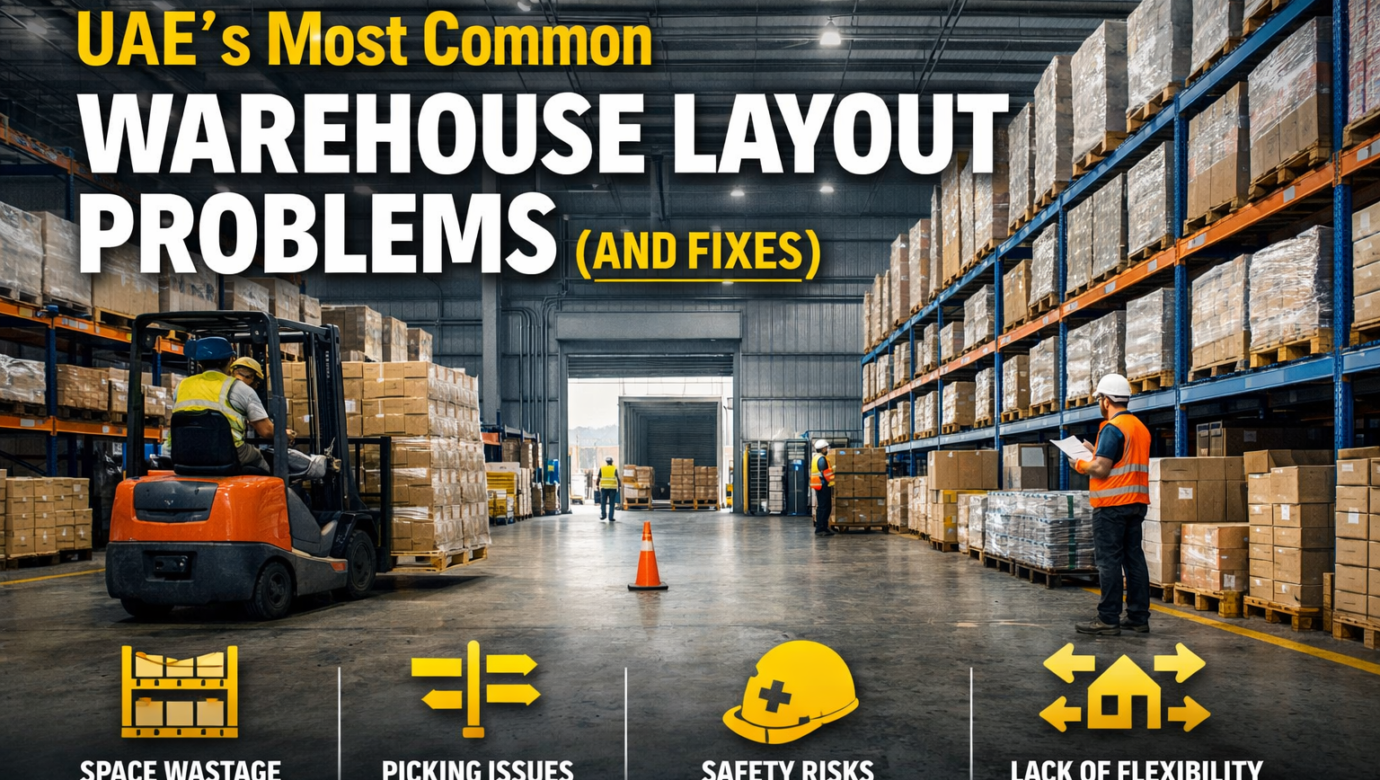
UAE’s Most Common Warehouse Layout Problems (And Fixes)
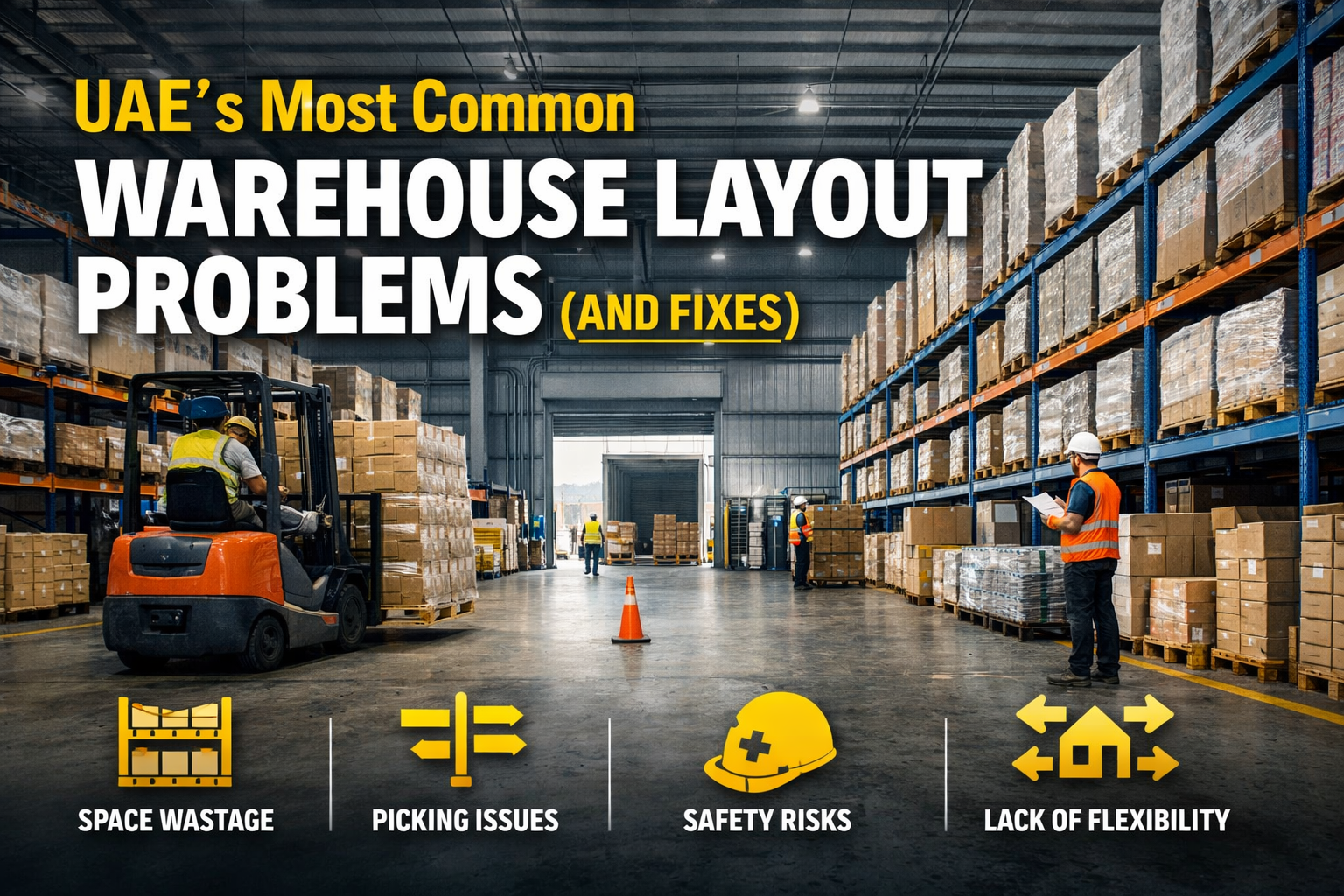
Why Warehouse Layout Matters in the UAE
In the UAE’s fast-moving logistics ecosystem driven by e-commerce, retail distribution, cold storage, and industrial manufacturing, warehouse layout is no longer just an operational detail. It is a strategic advantage.
Yet across Dubai, Abu Dhabi, Sharjah, and emerging industrial zones, many warehouses still suffer from outdated or poorly planned layouts. These inefficiencies lead to congestion, picking delays, safety risks, underutilised space, and rising operational costs.
This article breaks down the most common warehouse layout problems in the UAE and offers practical, proven fixes tailored to regional challenges such as high SKU turnover, vertical space constraints, labour costs, and compliance with UAE safety standards.
1. Poor Space Utilisation in High-Cost Industrial Zones
The Problem
Warehouse real estate in the UAE, especially in Dubai South, JAFZA, and ICAD, is expensive. Yet many facilities use less than 60 percent of available vertical and floor space.
Common issues include:
- Over-reliance on floor stacking
- Low racking heights despite high ceilings
- Excessively wide aisles
- Poor pallet size standardisation
The Fix
Vertical space optimisation is critical in UAE warehouses.
Best practices include:
- Installing selective pallet racking, VNA (Very Narrow Aisle) racking, or double-deep racking
- Increasing beam levels to match ceiling height and fire code regulations
- Redesigning aisle widths based on material handling equipment specifications
- Using mezzanine floors for cartons or light goods
UAE warehouses that optimise vertical space typically increase storage capacity by 30 to 45 percent without expanding floor area.
2. Inefficient Picking Flow and Congested Aisles
The Problem
One of the most common warehouse layout UAE challenges is poor picking flow. Workers often criss-cross the facility, leading to:
- Longer order fulfilment times
- Worker fatigue
- Forklift congestion
- Increased picking errors
This is especially problematic in 3PL, retail, and e-commerce warehouses operating under tight delivery timelines.
The Fix
A flow-based layout design dramatically improves efficiency.
Recommended solutions:
- Separate receiving, storage, picking, packing, and dispatch zones
- Position fast-moving SKUs near dispatch areas
- Implement U-flow or straight-through layouts
- Introduce zone picking for high-volume operations
Optimised picking layouts in UAE warehouses can reduce travel time by up to 35 percent.
3. Layouts That Ignore SKU Velocity
The Problem
Many UAE warehouses store products alphabetically or randomly rather than by demand frequency. This leads to:
- Excessive walking distances
- Bottlenecks during peak seasons such as Ramadan and Dubai Shopping Festival
- Slower outbound operations
The Fix
Use ABC analysis to align layout with SKU velocity.
Smart layout strategy:
- A-items (fast movers): Near dispatch and at ergonomic picking heights
- B-items: Mid-range storage zones
- C-items (slow movers): Higher or deeper storage locations
This approach is especially valuable for FMCG, electronics, and spare parts warehouses in the UAE.
4. Inadequate Safety Planning in Warehouse Layouts
The Problem
Safety is often compromised due to:
- Poorly marked pedestrian walkways
- Shared forklift and pedestrian zones
- Overloaded racks
- Non-compliance with UAE Civil Defence regulations
These issues increase accident risk and can result in fines or shutdowns.
The Fix
A safety-first warehouse layout is both a legal and operational necessity.
Key improvements include:
- Clearly defined pedestrian lanes with barriers
- Adequate turning radii for forklifts
- Rack load signage and impact protection
- Fire exits, sprinkler clearance, and emergency access lanes
Warehouses designed with safety-compliant layouts experience fewer disruptions and stronger regulatory compliance.
5. Lack of Flexibility for Business Growth
The Problem
Many warehouse layouts are designed for current needs only, making expansion costly and disruptive. This is a major issue in the UAE, where businesses scale rapidly.
The Fix
Design for modularity and scalability.
Future-proofing strategies:
- Use adjustable racking systems
- Allow clear expansion zones
- Plan for automation integration such as conveyors, AS/RS, and shuttle systems
- Avoid permanent structural barriers in core storage areas
A flexible layout enables warehouses to adapt to seasonal demand spikes and long-term growth.
6. Poor Dock and Receiving Area Design
The Problem
Congested loading docks cause delays, demurrage charges, and operational chaos, especially in busy logistics hubs.
The Fix
Optimise dock layout by:
- Separating inbound and outbound docks
- Providing adequate staging lanes
- Aligning docks directly with fast-moving storage zones
- Using dock levellers and bumpers for safety and speed
Efficient dock layouts reduce truck turnaround times and improve supply chain reliability.
7. Ignoring Technology and Automation Requirements
The Problem
Traditional layouts often fail to support:
- Warehouse Management Systems
- Barcode or RFID tracking
- Automated storage solutions
This limits efficiency and data visibility.
The Fix
Design layouts that integrate seamlessly with technology:
- Dedicated zones for scanning and labelling
- Consistent rack numbering and aisle mapping
- Space allowances for future automation
- Clear data flow between physical layout and WMS logic
Smart Warehouse Layouts Drive Competitive Advantage in the UAE
In a region where logistics speed, storage density, and safety compliance define success, warehouse layout optimisation is not optional.
By addressing common warehouse layout problems in the UAE, from space wastage and picking inefficiencies to safety risks and lack of scalability, businesses can:
- Reduce operational costs
- Improve order accuracy
- Enhance worker safety
- Maximise return on investment on warehouse space
A professionally designed layout turns a warehouse from a cost centre into a competitive asset.
FAQs
1. What is the most common warehouse layout problem in the UAE?
The most common issue is poor space utilisation, especially failure to use vertical storage effectively in high-ceiling warehouses.
2. How does warehouse layout affect picking efficiency?
A poorly planned layout increases travel time, causes congestion, and leads to picking errors. Optimised layouts improve speed and accuracy significantly.
3. Which racking system is best for UAE warehouses?
This depends on SKU volume and turnover, but selective pallet racking, VNA racking, and double-deep racking are widely used in the UAE.
4. How can I make my warehouse layout safer?
Implement clear pedestrian routes, proper aisle widths, rack protection, load signage, and ensure compliance with UAE Civil Defence standards.
5. When should a warehouse layout be redesigned?
Redesign is recommended when storage capacity is maxed out, order fulfilment slows down, safety incidents increase, or business volume or SKU count changes significantly.
