
Heavy Duty Pallet Racking Dubai UAE
Warehouse operators across the UAE are re-evaluating their storage infrastructure as e-commerce volumes and cold-chain logistics expand. Heavy duty pallet racking in Dubai has become a central part of that conversation, since the system a facility chooses affects everything from floor-space efficiency to worker safety. Unlike light-duty shelving, heavy duty racking is engineered to hold palletized loads that can weigh several hundred kilograms per position. Buyers who understand the differences between racking types, load ratings, and compliance expectations are better positioned to avoid costly redesigns later.
What Heavy Duty Pallet Racking Dubai Buyers Need to Know First
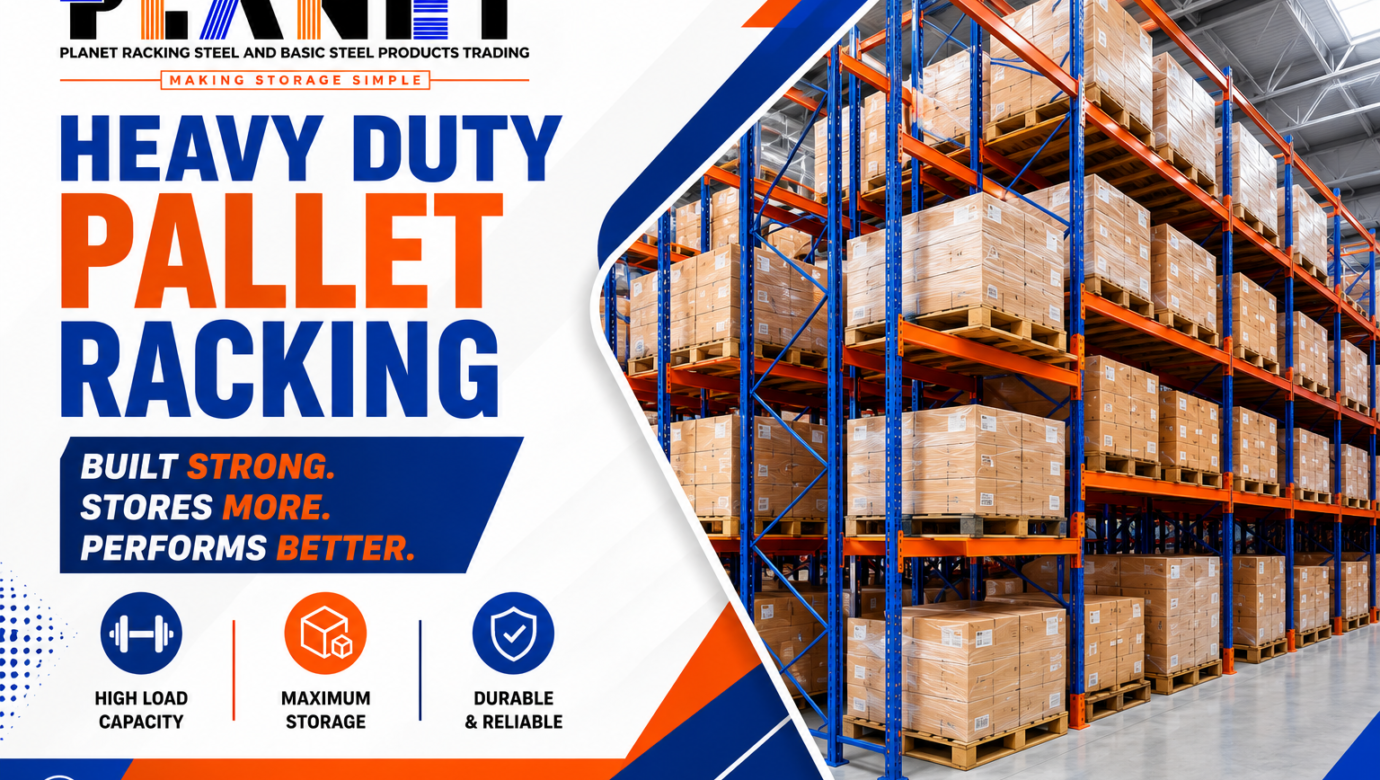
Heavy duty pallet racking refers to structural steel storage systems built from vertical upright frames and horizontal load beams. These systems are designed to carry palletized goods stacked several levels high, often supported by forklifts or reach trucks for loading and retrieval.
The term “heavy duty” distinguishes these systems from light-duty or medium-duty shelving, which typically handles hand-loaded items rather than full pallets. In a warehouse setting, the racking frame itself must be matched to the expected pallet weight, the lifting equipment in use, and the building’s floor and ceiling constraints.
Because Dubai’s logistics sector spans free zones, cold storage hubs, and manufacturing parks, no single racking configuration suits every facility. The right choice depends on inventory turnover, SKU variety, and available floor space.
Types of Heavy Duty Pallet Racking Used in Dubai Warehouses
Several racking formats fall under the heavy duty category, and each serves a different storage pattern.
Selective Pallet Racking
Selective racking is the most common configuration in general warehousing. Every pallet position is directly accessible from the aisle, which makes it well suited to operations with many different SKUs and frequent picking activity. However, this accessibility comes at the cost of storage density, since aisles take up a significant share of floor space.
Drive-In and Drive-Through Racking
Drive-in racking allows a forklift to enter the rack structure itself, storing pallets on rails rather than on individual beams. This design increases storage density considerably, making it popular in cold storage and bulk-goods facilities where inventory is uniform. The trade-off is reduced selectivity, since pallets are typically loaded and unloaded on a last-in, first-out basis.
Push-Back Racking
Push-back systems use nested carts on inclined rails, so each new pallet pushes the previous one further back. This format balances density and selectivity better than drive-in racking, and it works well for operations with a moderate number of SKUs and medium turnover rates.
Cantilever Racking
Cantilever racking removes front columns entirely, relying on arms extending from a single upright line. It is generally used for long or irregularly shaped items such as pipes, timber, or steel bars rather than standard palletized loads, though it is still classed as heavy duty due to the weight it supports.
How Load Capacity Is Determined
Load capacity is one of the most misunderstood aspects of racking specification. A system’s rated capacity depends on several interacting factors rather than a single number.
Beam length and profile affect how much weight a single level can support before deflection becomes a concern. Upright frame design, including the thickness and bracing of the steel columns, determines how the overall structure handles both the weight resting on it and lateral forces from forklift impact or seismic movement.
Typical heavy duty racking installations support anywhere from roughly 1,000 kilograms to more than 3,000 kilograms per beam level, though installations built for bulk industrial goods can exceed that range. Floor conditions also matter, since anchoring performance depends on concrete slab thickness and condition. A racking system rated correctly on paper can still underperform if it sits on an inadequate floor.
Engineers typically calculate capacity using a combination of static load testing and structural analysis based on standards such as ANSI MH16.1, published by the Rack Manufacturers Institute, or equivalent European standards from the Federation Europeenne de la Manutention. Reputable suppliers in the UAE generally design against one of these frameworks, since the country does not maintain a racking-specific national code of its own.
Choosing a Racking Supplier in Dubai
Selecting a supplier involves more than comparing price quotes. A few factors consistently separate reliable installations from problematic ones.
- Engineering documentation: A supplier should provide load capacity certificates and structural drawings for the specific configuration being installed, not generic catalog figures.
- Local manufacturing or stocking capability: Facilities that manufacture or hold stock within the UAE typically offer shorter lead times than those importing every component on demand.
- Installation experience: Racking systems installed incorrectly, particularly regarding anchor bolts and frame alignment, pose safety risks regardless of how well the components themselves are rated.
- After-sales inspection support: Ongoing inspection services help operators catch damage, such as bent uprights or missing safety pins, before it becomes a structural hazard.
Buyers should also confirm that quoted load ratings reflect the actual pallet dimensions and weights used in their operation, since manufacturers’ published capacities are often based on standardized test pallets that may not match real-world loads.
Safety Standards and Compliance Considerations
The UAE does not currently enforce a dedicated national standard exclusively for pallet racking design, so compliance in practice depends on the standard a supplier chooses to follow and the building regulations that apply to the facility itself. Structures that exceed certain heights or carry unusually heavy loads typically require structural sign-off as part of the broader building safety approval process enforced by local municipal authorities.
Operators are generally advised to schedule periodic rack inspections, since damage from forklift collisions is one of the most common causes of structural failure in warehouses. The Storage Equipment Manufacturers Association, a UK-based industry body, recommends formal inspections at set intervals in addition to routine visual checks by warehouse staff, and similar practices are widely adopted by facilities operating in the Gulf region.
Clear load-capacity signage on each rack bay, correctly rated safety pins on beam connectors, and defined aisle widths for the forklifts in use all factor into a facility’s overall safety profile, independent of any single regulatory requirement.
Key Takeaways
- Heavy duty pallet racking covers several distinct formats, including selective, drive-in, push-back, and cantilever systems, each suited to different inventory patterns.
- Load capacity depends on beam profile, upright design, and floor conditions, not a single published figure.
- The UAE lacks a dedicated national racking standard, so most suppliers design against international frameworks such as ANSI MH16.1 or FEM guidelines.
- Supplier selection should prioritize engineering documentation and installation experience over price alone.
- Regular inspection remains one of the most effective ways to prevent structural failure in heavy duty racking systems.
FAQ
What is heavy duty pallet racking?
Heavy duty pallet racking is a structural steel storage system built from upright frames and horizontal beams, designed to hold palletized goods stacked across multiple levels. It differs from light-duty shelving in both the materials used and the weight it can support, making it standard equipment in most warehouse and distribution environments.
How much weight can heavy duty pallet racking hold?
Capacity varies by design, but many heavy duty systems support between roughly 1,000 and 3,000 kilograms per beam level, with some industrial configurations rated higher. The exact figure depends on beam length, upright bracing, and floor conditions, so buyers should request configuration-specific load certificates rather than relying on general catalog numbers.
What is the difference between selective and drive-in racking?
Selective racking gives direct access to every pallet position from the aisle, prioritizing flexibility over density. Drive-in racking allows forklifts to enter the structure itself, storing pallets on rails for higher density but with less selectivity, typically operating on a last-in, first-out retrieval basis suited to uniform inventory.
Does Dubai require certification for warehouse racking installations?
The UAE does not maintain a racking-specific national standard, but structures exceeding certain heights or load thresholds generally require structural approval under local building safety regulations. Most reputable suppliers design against international standards such as ANSI MH16.1 to meet the expectations of building authorities and insurers.
How often should warehouse racking be inspected?
Industry bodies such as the Storage Equipment Manufacturers Association recommend formal inspections at defined intervals, in addition to routine visual checks by warehouse staff. Forklift collisions remain one of the leading causes of structural damage, making regular inspection an important part of maintaining a system’s rated load capacity over time.
