

How Mobile Shelving Systems Work?
Mobile shelving systems are widely used in industries where efficient space utilization is essential. Understanding how mobile shelving systems work provides insight into how businesses can significantly increase storage capacity without expanding their physical footprint.
These systems are designed to reduce unused aisle space by allowing shelving units to move along tracks. Instead of fixed aisles, a single aisle opens only when access is required, improving both storage density and accessibility.
What Are Mobile Shelving Systems?
Mobile shelving systems are storage units mounted on movable bases that slide along floor-mounted tracks. Unlike traditional shelving, which requires multiple fixed aisles, mobile systems compact shelves together when not in use.
They are commonly installed in:
- Warehouses
- Offices
- Libraries
- Healthcare facilities
- Retail storage areas
Their design supports high-density storage while maintaining organized and accessible inventory.
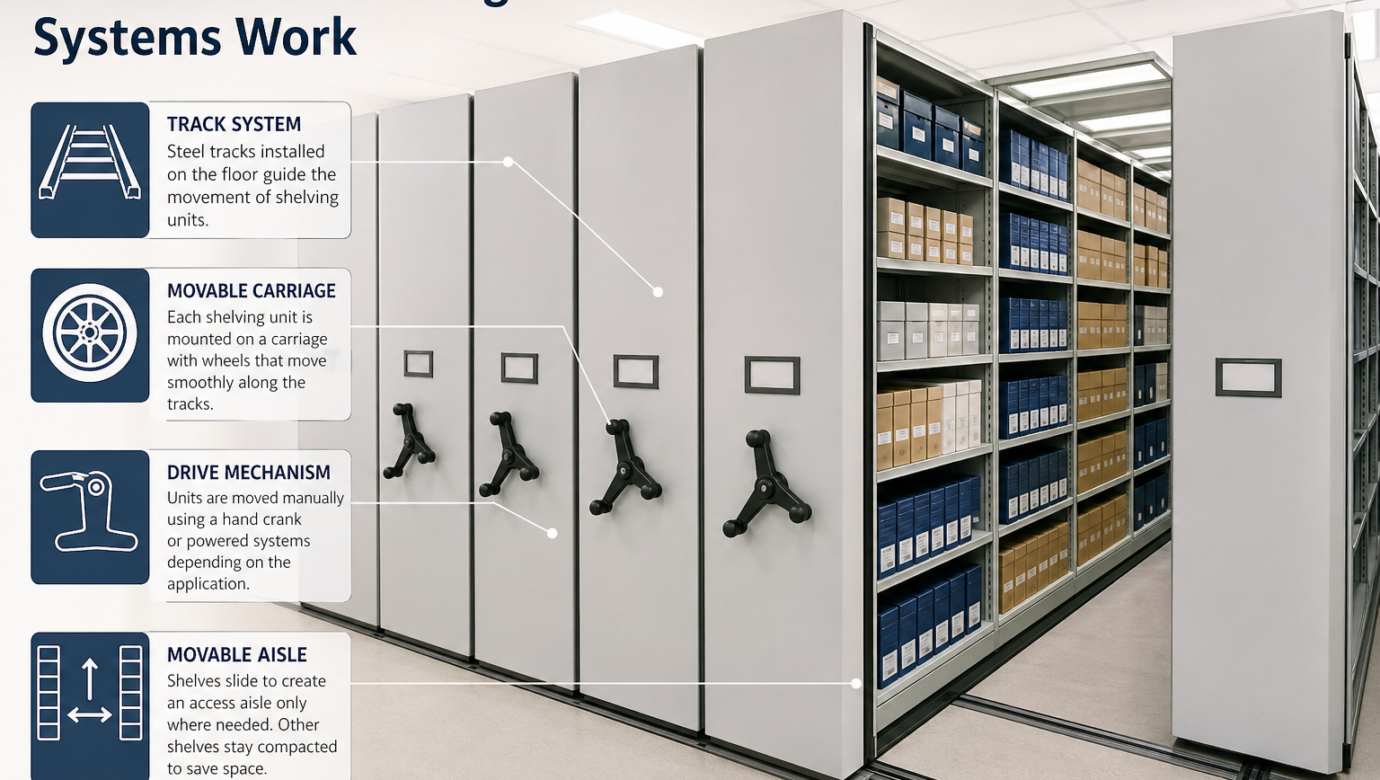
How Mobile Shelving Systems Work
To understand how mobile shelving systems work, it is important to look at the components and the movement mechanism that enables compact storage.
Track and Rail System
Mobile shelving units operate on steel tracks installed on or within the floor.
- Guides the movement of shelving units
- Ensures stability and alignment
- Built to support heavy loads
Movable Carriage Base
Each shelving unit is mounted on a carriage with wheels that move along the tracks.
- Distributes weight evenly
- Allows smooth lateral movement
- Designed for durability in high-load environments
Drive Mechanism
Mobile shelving systems use different drive systems depending on application:
- Manual systems: Operated by pushing or using a hand crank
- Mechanical assist systems: Use gears to reduce effort
- Powered systems: Electrically driven for large-scale or heavy-duty use
Movable Access Aisle
The defining feature of mobile shelving is the movable aisle system.
- Only one aisle is opened at a time
- Shelving units slide to create access
- Remaining units stay compacted
This mechanism maximizes available floor space and reduces wasted areas.
Benefits of Mobile Shelving Systems
Mobile shelving systems offer several practical advantages in storage environments.
Increased Storage Capacity
By removing fixed aisles, storage capacity can increase significantly within the same space.
Better Space Utilization
Facilities can optimize floor space without requiring expansion or relocation.
Improved Organization
Items can be systematically stored and easily retrieved, reducing operational inefficiencies.
Enhanced Security
Some systems include locking features and controlled access, suitable for sensitive storage.
Types of Mobile Shelving Systems
Different types of mobile shelving systems are designed for specific needs.
Manual Mobile Shelving
- Operated by hand
- Suitable for light to medium storage
- Common in offices and archives
Mechanical Assist Shelving
- Gear-assisted movement
- Reduces physical effort
- Ideal for moderate loads
Powered Mobile Shelving
- Motorized operation
- Used in warehouses and industrial environments
- Often includes safety sensors
Safety Features in Mobile Shelving Systems
Safety is a critical aspect of mobile shelving design. Modern systems include:
- Anti-tip mechanisms
- Locking systems
- Obstruction detection sensors
- Emergency stop controls (in powered systems)
Regular maintenance ensures long-term safe operation.
Applications Across Industries
Mobile shelving systems are used across various sectors due to their efficiency and flexibility.
- Warehouses: Maximize pallet and inventory storage
- Healthcare: Store medical records and supplies
- Offices: Organize files and documents
- Libraries: Manage large volumes of books
Their adaptability makes them suitable for both small and large-scale storage environments.
What This Means
Understanding how mobile shelving systems work highlights their importance in modern storage strategies. These systems help organizations improve storage capacity, maintain organization, and use space more effectively.
Key takeaways include:
- Mobile shelving reduces unused aisle space
- It allows higher storage density
- Systems can be manual, mechanical, or powered
- Applicable across multiple industries
8. FAQs Section
1. How do mobile shelving systems operate?
Mobile shelving systems operate by moving storage units along floor-mounted tracks. Users open an aisle where access is needed while keeping other shelves compacted. This design reduces wasted space and improves storage efficiency in various environments.
2. What makes mobile shelving different from static shelving?
Unlike static shelving, mobile shelving eliminates fixed aisles. Shelves can move to create access only when required, allowing more storage units to fit within the same area. This results in higher storage density and better space utilization.
3. Are mobile shelving systems suitable for heavy storage?
Yes, many mobile shelving systems are designed to handle heavy loads. Industrial-grade systems use strong steel structures and durable track systems, making them suitable for warehouses and other high-capacity storage environments.
4. Do mobile shelving systems require maintenance?
Mobile shelving systems require periodic maintenance to ensure smooth operation. This includes checking tracks, wheels, and drive mechanisms. Proper upkeep helps prevent operational issues and extends the system’s lifespan.
5. Where are mobile shelving systems commonly used?
Mobile shelving systems are commonly used in warehouses, offices, libraries, healthcare facilities, and retail storage areas. They are ideal for environments where space optimization and organized storage are essential.
