
Mobile Shelving System Cost per Pallet Position vs. Static Racking in Dubai
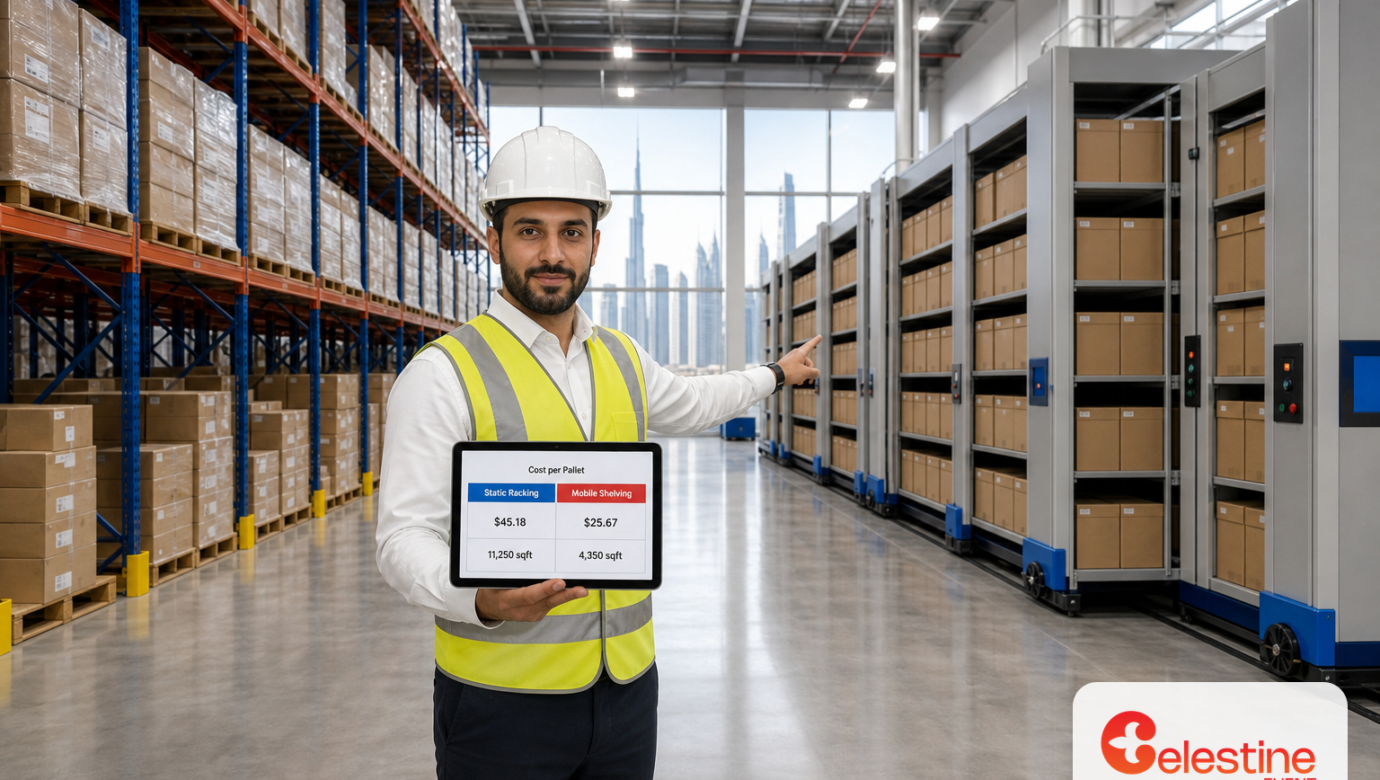
Mobile shelving usually costs more per pallet position to install than static racking, often two to three times more. Once you count the floor area, cooling and rent each position consumes, the picture can reverse. In our worked example below, mobile racking is about 12% lower in ten-year cost per position in ambient storage and about 32% lower in chilled storage. The gap depends on your lease rate, your throughput and your climate control load.
We manage exhibition booths, stage sets, branded installations and event assets across Dubai, so we think about storage density as an operational discipline. The framework below is built to be copied into a spreadsheet.
What Is Cost Per Pallet Position and Why It Matters

Cost per pallet position is the total cost of providing one usable, accessible storage slot over a defined period. A quoted price per position covers only the steel. Decision-grade figures cover everything the slot needs to exist and operate.
We use a simple model we call Cost per Accessible Position (CPAP):
- CPAP = (Capex + Space cost + Operating cost + Maintenance) ÷ Accessible positions
- Capex: racking or mobile bases, rails, floor preparation, safety systems, installation.
- Space cost: floor area occupied × annual rate (rent plus cooling and utilities) × years of analysis.
- Operating cost: additional handling time, power for drives, and any retrieval delays.
- Maintenance: rail inspection, drive servicing, safety sensor checks and floor tolerance monitoring.
- Accessible positions: positions you can reach without moving other pallets. This matters most for mobile systems.
Most comparisons stop at the first line and compare installed price per position. That is the common mistake, because it ignores the cost of the floor underneath.
Mobile Shelving vs. Static Racking: Capex Breakdown
Static selective racking needs an aisle for every one or two rows. Mobile racking mounts rows on motorised bases running on rails, so aisles open only where you need them. That removes most of the fixed aisle space but adds components.
Capex differences to model:
- Structure: mobile bases must carry the full pallet load plus the frame, so steel and engineering content is higher.
- Rails and floor work: rails need a level, load-rated slab. Floor surveys and grinding add cost, especially in older units.
- Drives and controls: motors, controllers, and safety scanners or light curtains.
- Installation: mobile systems take longer to commission and test.
For the worked example below we assume illustrative installed costs of AED 300 per position for static racking and AED 800 per position for mobile. These are planning assumptions, not quotations. Replace them with supplier figures for your site.
Operating Costs: Labor, Maintenance, and Energy Efficiency
Capex versus opex analysis is where hidden costs appear. Are there operating costs specific to mobile shelving? Yes, and they are manageable if you plan for them.
- Retrieval delay: operators wait for an aisle to open, typically 15 to 40 seconds. In low-frequency picking this is negligible. In continuous full-pallet flow it adds up.
- Maintenance: rails, drive wheels, and safety sensors need scheduled inspection. We model 2 to 3% of capex per year for mobile versus around 1% for static.
- Power: drive motors use modest electricity. In chilled rooms, the greater saving is that a smaller room needs less cooling.
- Training and discipline: operators must follow aisle-opening and lockout procedures. We would not skip this step, as any system with moving loads demands it.
- Downtime risk: a stuck block can block access to a whole group of positions, so spares and service response times matter.
Space Utilization and Hidden ROI Gains
How much space efficiency gain justifies the investment? There is no universal threshold, but a useful rule: if mobile racking recovers at least 40% more positions in the same footprint and your annual cost per square metre is high, the case usually holds. Below that gain, or in cheap, expandable space, static racking often wins.
Typical warehouse space density metrics: static selective layouts use roughly 35 to 50% of floor area for storage, while mobile layouts can reach 70 to 80%. That commonly translates to 60 to 100% more positions per square metre.
Gains that rarely appear in a first pass:
- Avoiding or delaying a lease expansion or relocation.
- Fewer square metres to light, secure, sprinkler and clean.
- Shorter travel inside a compact block for some workflows.
- Better access control, since aisles can be locked closed.
Worked example: 1,750 positions, ten-year view
Assumptions (illustrative): static layout uses 0.6 m² per position (1,050 m² total); mobile uses about 0.34 m² per position (600 m²). Ambient space cost AED 400/m²/year; chilled space cost AED 1,200/m²/year including cooling. Maintenance as above.
| Ten-year cost per position (AED) | Static racking | Mobile racking |
|---|---|---|
| Capex | 300 | 800 |
| Space, ambient | 2,400 | 1,371 |
| Maintenance | 30 | 240 |
| Total, ambient | 2,730 | 2,411 |
| Space, chilled | 7,200 | 4,114 |
| Total, chilled | 7,530 | 5,154 |
Payback on the extra capex (AED 875,000) is roughly 4.9 years from ambient space savings alone (450 m² × AED 400 = AED 180,000 a year) and about 1.6 years in chilled space (450 m² × AED 1,200 = AED 540,000 a year). That is how to estimate a mobile racking payback period for your own site: divide the capex difference by annual space and energy savings.
Mobile Shelving for Temperature-Sensitive Storage in Dubai
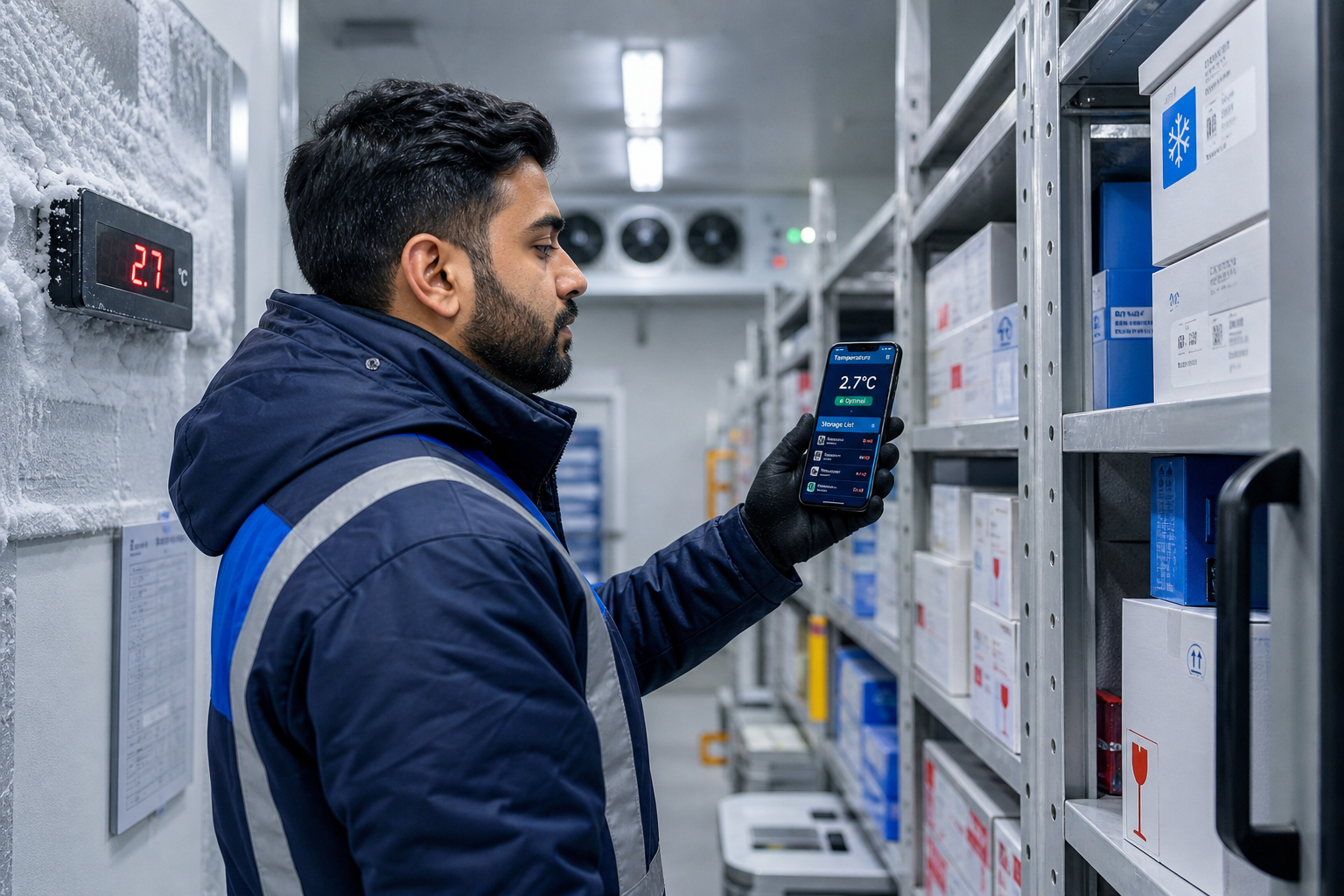
Cold storage shelving systems and temperature-controlled storage solutions are where density pays most in Dubai. Cooling load scales with room volume and with envelope exposure, and external temperatures above 40°C for much of summer make every cubic metre expensive to hold at setpoint.
Points to check:
- Rail and floor design: cold rooms need rails and floor treatment suited to condensation and low temperatures. Confirm drive components are rated for your setpoint.
- Door cycles: a smaller room means shorter air-travel distances and less infiltration per access.
- Airflow: tightly packed rows can restrict circulation. Design air paths and verify temperature mapping after installation.
- Product suitability: for event use, this applies to fabrics, adhesives, electronics, LED panels and finished décor that can degrade in heat and humidity.
High-Turnover Applications: Where Mobile Shelving Delivers Maximum Value
Which applications see the fastest ROI? Mobile shelving does best where inventory is dense but access is bursty rather than constant.
- Cold and chilled storage: highest space cost per square metre, fastest payback.
- Archive, spares and slow-to-medium movers: many SKUs, few picks per SKU.
- Seasonal or project-based inventory: event assets, exhibition components and campaign materials are stored in bulk and drawn down around a show.
- Space-constrained urban or free-zone units: where expansion is not possible.
For genuinely high-turnover inventory, where every pallet moves several times daily, mobile systems create queueing at the aisle. Consider a hybrid: static racking or flow lanes for fast movers, mobile blocks behind them for reserve stock. This improves inventory turnover efficiency without forcing one design everywhere. For very heavy loads, our related guide on heavy-duty mobile shelving for high-density storage covers when and how to use it.
Real-World Comparison: When to Choose Mobile Over Fixed
We use a short decision test before recommending any storage design:
- Is space expensive or capped? If yes, mobile gains weight.
- Is the room climate-controlled? If yes, mobile usually wins.
- Do you need 100% selectivity at all times? If yes, static or a hybrid is safer.
- Is the floor suitable? A poor slab can erase the savings through rework.
- Is peak pick frequency low enough? Calculate aisle-wait time against picks per hour.
- Can you train and enforce procedures? Safety and workflow discipline are non-negotiable. Our companion pieces on inventory workflow, setup and operator training, and on installation timelines and first-year maintenance in Dubai, go into the detail.
Choose static racking when space is cheap, turnover is continuous, loads are uneven, or the budget horizon is short. Choose mobile when density, climate control and long-term occupancy line up. Automated storage systems cost more again, and they are best compared only after you have established your CPAP baseline.
Frequently asked questions
How do you calculate cost per pallet position for mobile vs. static racking?
Add capex, space cost over the analysis period, operating cost and maintenance, then divide by accessible positions. Compare both systems on the same inventory volume, not the same floor area.
What is the typical payback period for mobile shelving in high-density warehouses?
It varies with space cost. In our illustrative model it is about five years in ambient space and under two years in chilled space. Your actual figure depends on lease rate, cooling load and supplier pricing.
How much space efficiency gain justifies the mobile shelving investment?
As a working rule, a gain of 40% or more in positions per square metre, combined with a high annual cost per square metre, usually supports the investment. Lower gains rarely justify the extra capex unless expansion is impossible.
Are there hidden operating costs specific to mobile shelving systems?
Yes: rail and drive maintenance, safety sensor checks, operator training, floor tolerance monitoring and aisle-wait time. Include them in your model rather than discovering them after installation.
Which warehouse applications see the fastest ROI with mobile shelving?
Cold and chilled storage, archives, spares, and seasonal or project-based inventory. Continuous full-pallet flow sees the slowest return.
Next Step: Plan Storage with the Same Precision as the Event
At Celestine Event, we treat logistics, asset storage and execution as one connected discipline, from concept to execution. If you are weighing mobile against static racking for event assets, exhibition inventory or temperature-sensitive materials in Dubai, talk to our team and we will help you structure the comparison around your own numbers. To go further, explore our complete mobile shelving and inventory management cluster to transform your warehouse operations and maximize storage efficiency.
