Warehouse Racking System Comparison Guide: Drive-In vs Cantilever vs Double-Deep for Dubai
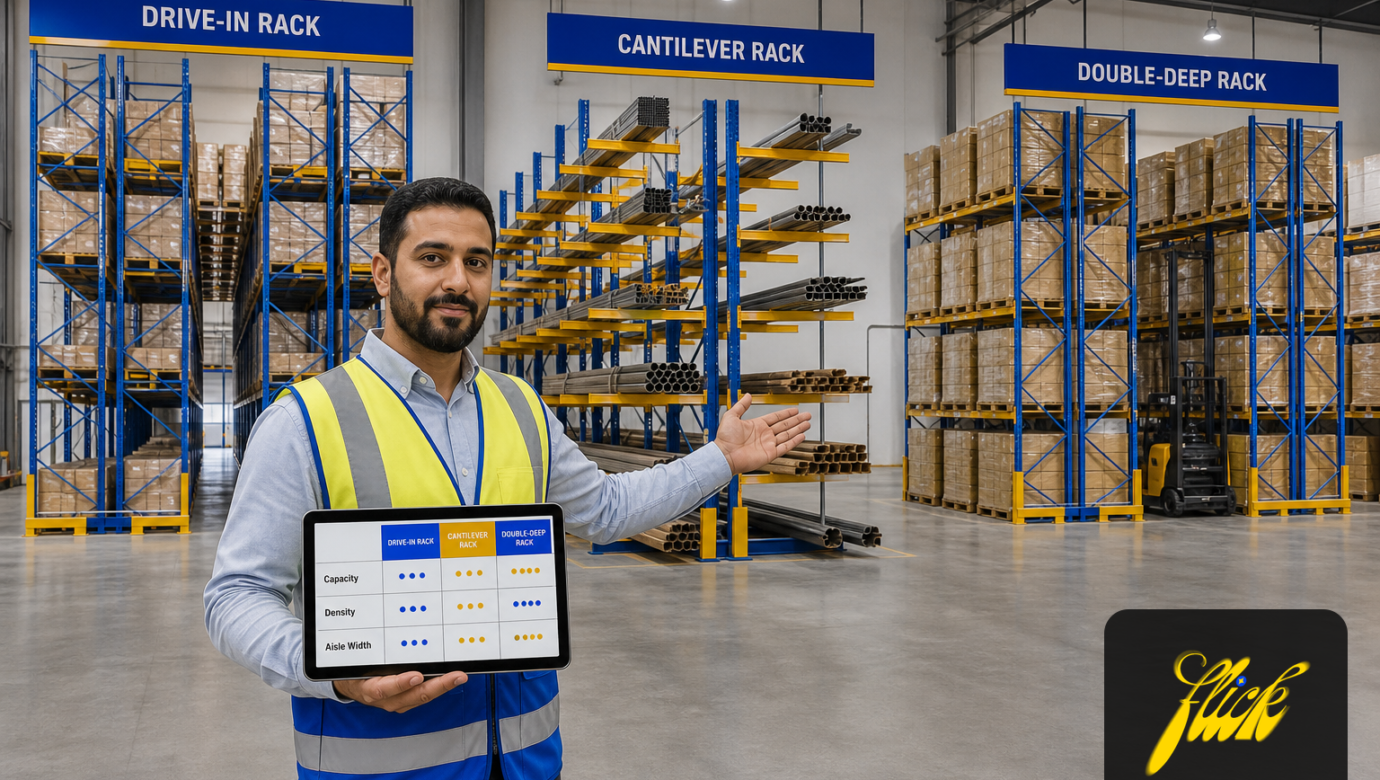
The right racking system depends on your inventory, not on the rack. Drive-in racking gives the highest density for large volumes of identical pallets. Double-deep racking adds roughly 30-40% more pallet positions than selective racking, with a modest loss of access. Cantilever racking is the only one of the three built for pipes, lumber, profiles and other long loads. This guide compares them on cost, density, speed, climate resilience, compliance and reconfiguration, using Dubai logistics scenarios rather than generic feature lists.
Drive-In vs. Cantilever vs. Double-Deep Racking: The Core Differences
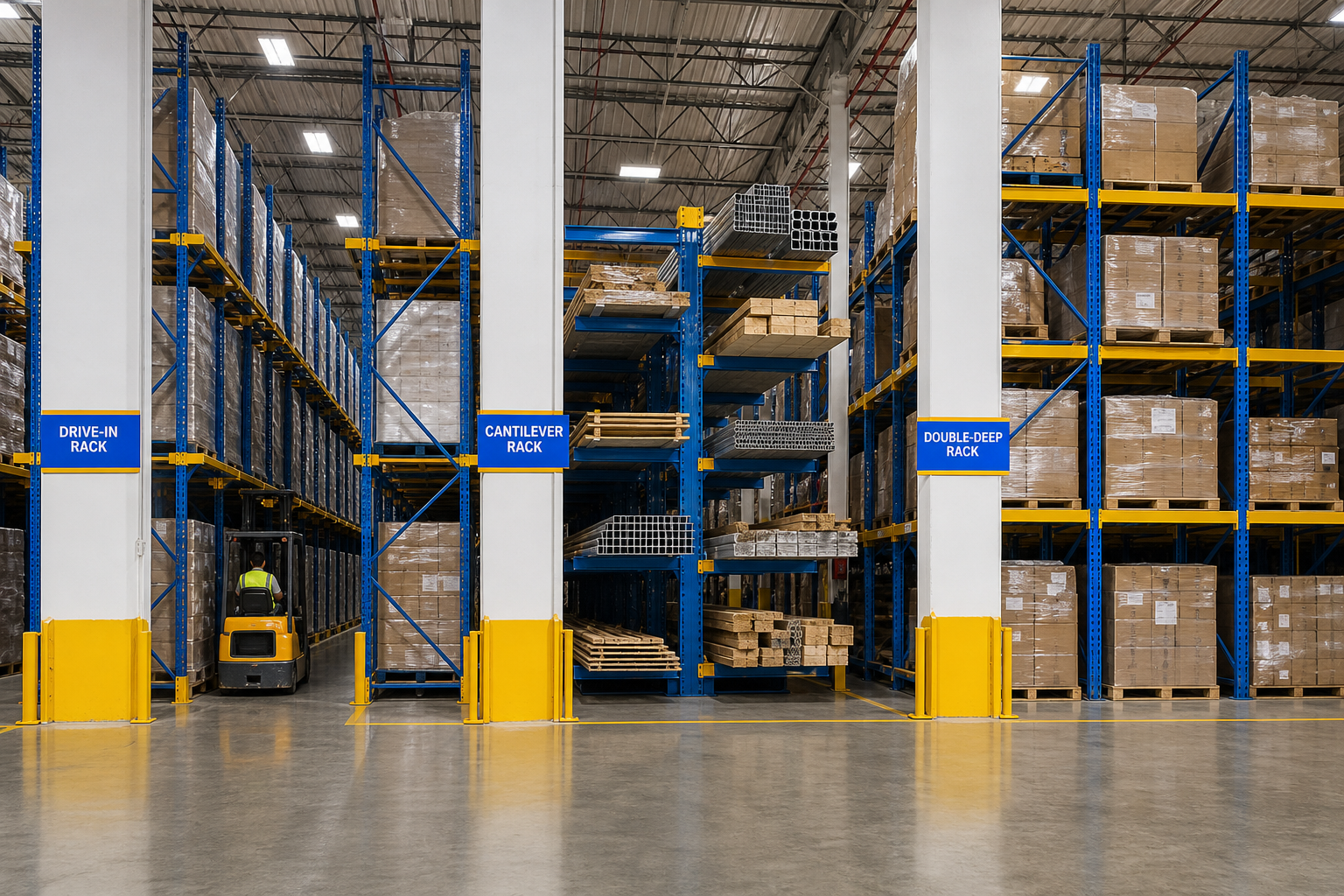
These three systems solve different problems, so comparing them like-for-like can mislead you. Two of them (drive-in and double-deep) are pallet racking systems that trade access for density. The third, cantilever, exists because some loads don’t fit on pallets at all. For a wider overview of every category, see our guide to the core types of racking systems for modern warehouses, or start with the basics in what warehouse racking is, with its types, uses and safety.
- Drive-in racking: forklifts drive into the rack structure and place pallets on continuous rails. Storage is typically last-in, first-out (LIFO), with one SKU per lane.
- Double-deep racking: pallets are stored two deep on each side of an aisle. It is selective racking with a second pallet position behind the first, and it needs reach trucks with extending forks.
- Cantilever racking: vertical columns carry horizontal arms, with no front uprights. Long, bulky or irregular items rest on the arms and load from the side or end.
Side-by-side summary
| Factor | Drive-In | Double-Deep | Cantilever |
|---|---|---|---|
| Typical load | Uniform pallets, high volume per SKU | Palletised goods, moderate SKU variety | Pipes, timber, steel bar, panels, profiles |
| Density | Highest | High | Depends on load geometry |
| Access | Lane-level only (LIFO) | 50% direct, 50% via the front pallet | 100% direct, per arm level |
| Handling equipment | Counterbalance or reach trucks, narrow tolerances | Deep-reach trucks | Side-loaders, forklifts, overhead cranes |
| Reconfigurability | Low | Medium to high | High (adjustable arms) |
| Best for | Bulk, seasonal, cold storage | Medium-volume, repeat SKUs | Long and awkward materials |
The Profile–Flow–Climate test
Most warehouse storage solutions in the UAE get specified from a floor plan and a price. We use a three-question test instead, and most bad purchases fail it at the first question.
- Profile: How many SKUs do you hold, how many pallets per SKU, and what is the load shape and weight?
- Flow: Do you need first-in-first-out (FIFO), random access, or bulk in-and-out campaigns? How often is a specific pallet requested?
- Climate: Is the building air-conditioned, ventilated or open-sided, and how close is it to the coast?
If the answer to Profile is “long materials”, the decision is made and the other two questions only refine it. If it’s pallets, the Flow answer separates drive-in from double-deep.
Cost Breakdown: Capital Investment & Long-Term Economics
What is the real cost difference between drive-in, cantilever and double-deep racking in Dubai? Quotes depend on steel prices, load ratings, finish and project size, so treat any published figure with caution. The useful comparison is cost per usable pallet position, or per tonne of arm capacity for cantilever, over the system’s life.
Where the money goes
- Drive-in: the lowest steel cost per pallet position, because frames and rails are shared across deep lanes. Heavier-gauge columns and guide rails add cost, and you should budget for rail guards and ongoing repair.
- Double-deep: rack cost per position is close to selective racking. The larger expense is equipment. Deep-reach trucks cost more than standard reach trucks and need operator training.
- Cantilever: priced by column height, arm length and rated capacity. It is often more expensive per kilogram of steel than pallet racking, but no pallet system can replace it for long loads.
Long-term economics
A racking system cost analysis should include five lines beyond purchase price:
- Handling equipment (purchase or lease, batteries, operator training).
- Product damage, which is usually higher in drive-in lanes where trucks work inside the structure.
- Labour time per movement.
- Lease cost avoided by fitting more stock in the same footprint.
- Reconfiguration cost when your product mix changes.
In our experience, the commonly missed item is lease cost avoided. In Dubai’s logistics parks and free zones, rent per square metre is a major running cost. A system that frees 25% of floor area can justify a higher capital outlay within a few years, particularly where expansion means a new lease. The opposite error is buying density you can’t use. A drive-in system holding 40 SKUs with six pallets each wastes most of its theoretical capacity.
Storage Density & Space Efficiency in Dubai Warehouses
How much floor space does each system need, and what is the cubic efficiency gain? Benchmarks vary with aisle width, truck type and building height, but these are widely used industry ranges for pallet storage:
- Conventional selective racking: about 30-40% of the floor area used for pallet storage (the baseline).
- Double-deep: about 45-55%, around 30-40% more positions than selective in the same footprint, because one aisle serves twice the depth.
- Drive-in: about 60-75%, since aisles between rows nearly disappear.
- Cantilever: not measured in pallet positions. Efficiency depends on how well arm spacing matches your material, and on whether you need a wide side aisle for long loads.
Floor utilisation is only half the story, because cubic efficiency matters too. Many Dubai warehouses have clear heights of 10-12 metres or more, and floor-based density gains multiply when racks go tall. Drive-in structures are limited by stability and the reach of the truck, often to a modest number of pallet levels, so a tall building can favour a double-deep layout at greater height. Always check the sprinkler layout, since in-rack sprinklers or clearance beneath the sprinkler heads may limit usable height.
Warehouse density optimisation also means looking at the alternatives. Push-back racking gives lane-depth density with FIFO-friendly behaviour on inclined carts, and suits moderate SKU counts. Selective racking remains the answer when access matters more than density. Automated storage and retrieval systems (ASRS) reach the highest density and speed but carry a much higher capital cost, and they make sense for stable, high-throughput operations.
Retrieval Speed & Workflow Impact: Which System Moves Fastest?
Which system delivers the fastest retrieval for time-sensitive import/export work? Of the three, double-deep is generally faster than drive-in for mixed picking, and cantilever is the fastest for long materials because every item is individually accessible. Selective racking, which we use as the baseline, remains faster than any of them for random pallet access.
- Drive-in: quick for bulk moves of a single SKU, such as loading a full container. The truck is working inside the structure, so travel is slower and operators must be skilled. LIFO makes retrieving a specific pallet slow, because the pallets in front have to be moved first.
- Double-deep: pallets in the front position are immediately accessible. Back-position pallets need the front one moved. It works best when each SKU occupies full double-pallet runs, so the front and back share the same product and date.
- Cantilever: each arm level is directly accessible. Speed is often governed by the handling equipment (side-loaders or cranes) and by how safely long loads can be moved.
Customs holds and inspections
This is where generic comparisons fall short. In an import/export setting, a customs inspection, a documentation hold or a quarantine release can require a specific consignment on short notice. Drive-in’s LIFO structure is a poor fit here. If a batch must be pulled from the back of a lane, you may have to unload most of it. For consolidated or bonded cargo with frequent selective release, selective or double-deep layouts give you the access you need. Drive-in suits goods that are received, held and shipped in full-lane lots, such as beverages, packaged foods or seasonal consumer goods.
Climate & Import/Export Considerations for UAE Operations
How does Dubai’s heat and humidity affect racking durability and maintenance costs? Heat itself is rarely the problem for steel. Corrosion, coatings and handling conditions are.
Corrosion and finish
- Coastal and humid zones (near Jebel Ali or the creek) carry more salt and moisture. Powder-coated rack suits dry, air-conditioned interiors. For open-sided buildings, outdoor yards or coastal sites, specify hot-dip galvanised steel or a higher-grade protective finish.
- Cantilever racking is the system most often used outdoors or under open canopies for pipes and lumber. Galvanising is the practical default there, because UV and moisture degrade standard paint quickly.
- Drive-in rails take repeated contact from pallets and forklifts. Chipped coating exposes bare steel, so inspection and touch-up cost more in humid sites.
Temperature effects on operations
Non-air-conditioned warehouses can reach very high internal temperatures in summer. Steel expansion is within design tolerances, but heat affects forklift batteries, operator fatigue and the accuracy of tight-tolerance work. Drive-in lanes require careful truck positioning, and fatigue in hot conditions is a safety factor, not just a productivity one. Pallet quality matters too. Warped or damaged pallets cause more problems in deep-lane systems.
Cold chain and condensation
Drive-in racking is common in cold and frozen storage precisely because density cuts the volume you must refrigerate. Condensation at dock transitions between ambient heat and chilled space can accelerate corrosion, so protective finishes and drainage deserve attention at design stage.
Import/export flow
Dubai’s logistics infrastructure runs on fast container turnover through Jebel Ali, free zones and air cargo hubs. Operations that receive full containers of one SKU and ship in similar volume favour drive-in or double-deep. Operations that break bulk, consolidate, or serve many consignees favour selective-style access. Re-export and transit cargo often has unpredictable dwell times, which weakens any system that depends on predictable rotation.
Best Use Cases: Matching Racking Type to Your Inventory Profile
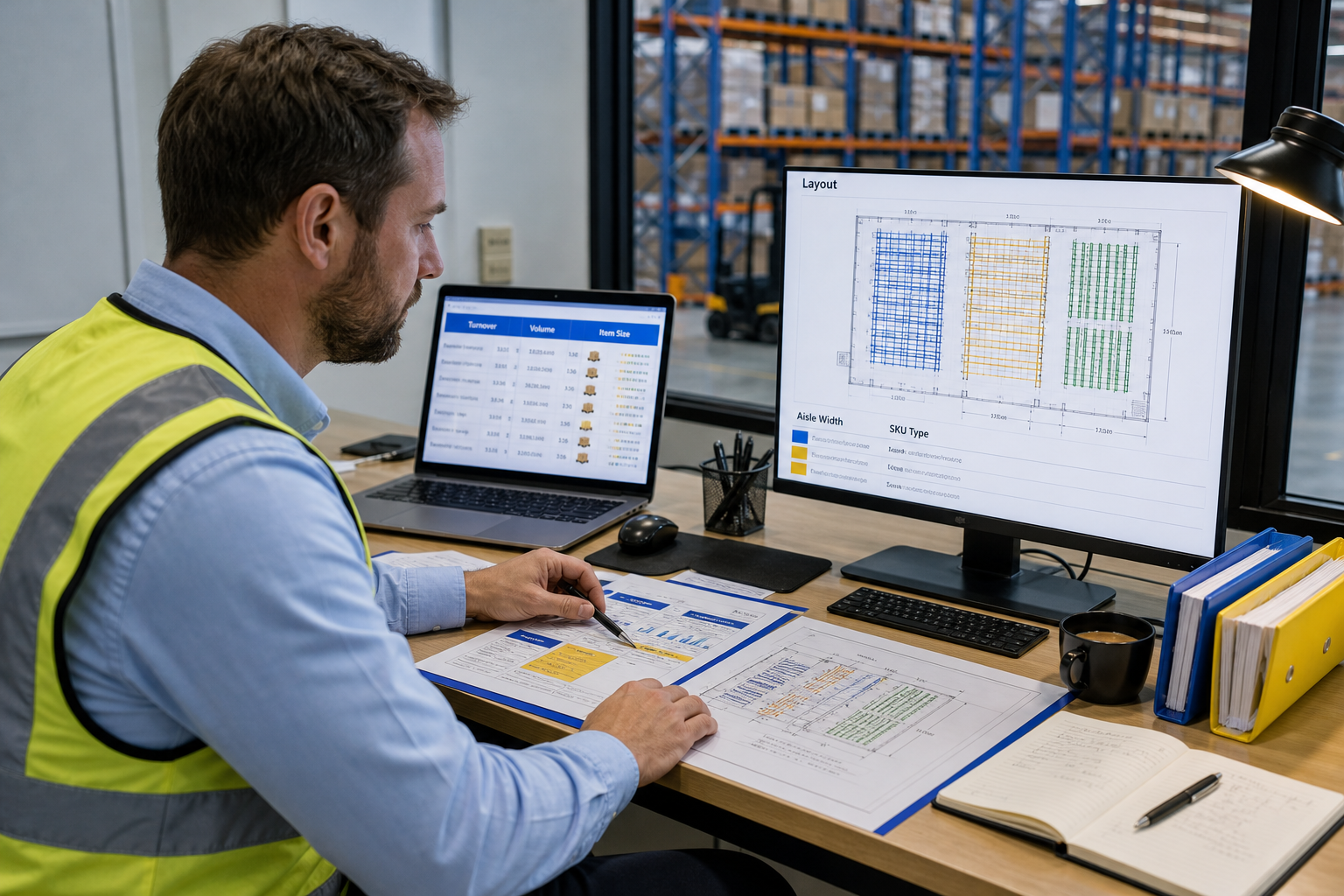
When drive-in racking fits
- High pallet counts per SKU (typically many pallets per lane) and few SKUs.
- Seasonal or campaign stock, such as Ramadan or promotional goods.
- Cold and frozen storage where space is costly to cool.
- Products where LIFO rotation is acceptable (non-perishable or non-expiring goods).
When double-deep racking fits
- Medium-to-high SKU counts with at least two pallets per SKU or batch.
- Operations that need more density but cannot accept full LIFO behaviour.
- Warehouses willing to invest in deep-reach trucks and operator training.
When cantilever racking fits
- Pipes, conduits, steel sections, rebar, timber and board, common in Dubai’s construction supply chain.
- Rolled goods, furniture components and irregular-length items.
- Mixed indoor and outdoor storage where load length varies.
When none of the three is right
If you need strict FIFO, choose pallet flow or push-back racking. If you need maximum access for hundreds of SKUs, selective racking is the answer. If you run high-throughput, stable operations with strong labour or space pressure, assess ASRS. A mixed warehouse often uses two systems: cantilever for long materials, and a pallet system for the rest.
Can I upgrade or reconfigure later?
Yes, but flexibility differs sharply:
- Cantilever: highly adjustable. Arms can be repositioned, and bays added if the column base allows.
- Double-deep: beam levels are adjustable, and a double-deep bay can often be converted to selective, though aisle widths and truck type will need reviewing.
- Drive-in: the least flexible. Lane depth, rail height and truck clearances are set at design, and changing them usually means structural modification.
Plan for growth at the start. Ask whether the rack can be extended, whether the manufacturer will still supply compatible components in five years, and whether the floor slab can carry added loads.
Cost Breakdown: Capital Investment & Long-Term Economics
Most racking comparisons rank systems by price per pallet position at purchase. That figure is useful, but it hides most of what you will actually spend. We use a simple lens, Total Cost per Pallet Position (TCPP), which adds five components over a 10-year horizon:
- Capital cost: steel, installation, safety accessories, and any floor works.
- Space cost: the rent or build cost of the floor area the system occupies.
- Handling cost: labour hours and equipment (reach trucks, VNA trucks, shuttles) needed to move each pallet.
- Damage and maintenance cost: repairs, replaced beams and uprights, inspections, product loss.
- Change cost: the price of reconfiguring when your product mix shifts.
How do the systems compare on cost?
As a general pattern, not a quotation:
- Selective racking: lowest capital cost and the most widely available components. It uses the most floor space per pallet, so its cost rises quickly where rent is high.
- Double-deep racking: slightly higher capital cost because it needs specialist reach trucks, but a lower space cost per pallet.
- Drive-in racking: low steel cost per pallet position and the lowest space cost per pallet. It carries a higher damage risk because forklifts enter the rack structure.
- Cantilever racking: priced per linear metre of load. It is the right-priced option for long loads and a poor one for pallets.
- ASRS: by far the highest capital outlay, including software, controls and integration. The return comes from labour savings, density and accuracy.
What most buyers get wrong about cost
The common mistake is to compare steel prices and stop. In our experience, handling and space costs usually exceed the cost of the racking itself within a few years. A cheaper rack that forces slower picking or requires more floor area is rarely the cheaper system. The other common error is ignoring damage. Impact damage to uprights is the single most frequent racking failure in operating warehouses, and drive-in systems are the most exposed. Budget for column guards, end-of-aisle protectors, and trained operators from day one.
Storage Density & Space Efficiency in Dubai Warehouses
How much more can each system store?
Density is the main reason to move away from selective racking. Typical floor utilisation for pallet storage looks like this:
- Selective: roughly 30 to 40 percent of floor area used for storage, with the rest taken by aisles.
- Double-deep: roughly 50 to 60 percent, because it removes about half the aisles.
- Drive-in: often 70 percent or more, because aisles are almost eliminated.
- ASRS: highest in effect, because very narrow aisles and greater heights are practical.
These are planning ranges. Actual results depend on building geometry, column spacing, truck type and pallet size.
Why does height matter as much as footprint?
Dubai land and leasing costs, especially in prime logistics zones, make cubic space more valuable than floor area. Clear height is the variable that many tenants underuse. Before choosing a system, confirm the clear height under roof trusses, lights and sprinkler lines, because the usable storage height is often several metres lower than the building’s stated eave height. Then check the floor slab. Taller racking concentrates loads on the slab through each baseplate, and slab flatness becomes critical for narrow-aisle and automated operations.
Density versus selectivity
Density and access pull in opposite directions. A drive-in system stores the most pallets per square metre but gives access to only the pallets at the front of each lane. If you hold hundreds of SKUs with a few pallets each, high density becomes false efficiency: you gain positions you cannot use. A useful rule is to match density to pallets per SKU. Fewer than about 10 pallets per SKU points toward selective. Large single-SKU lots point toward drive-in or double-deep.
Retrieval Speed & Workflow Impact: Which System Moves Fastest?
No system is fastest in every workflow. Speed depends on whether you need access to any pallet, any time, or throughput on a limited range of products.
- Selective racking: 100 percent direct access to every pallet. It is the benchmark for flexibility and works with standard counterbalance or reach trucks.
- Double-deep racking: about 50 percent selectivity. The rear pallet is reachable only after the front one moves, which adds handling when stock rotates unevenly.
- Drive-in racking: last-in, first-out (LIFO) flow, with the slowest access per pallet. It performs well for bulk, uniform, time-insensitive stock.
- Cantilever racking: direct access along the face, but loading and unloading use side-loaders or overhead cranes rather than standard pallet trucks.
- ASRS: the highest consistent throughput, with predictable cycle times and almost no picking errors, provided the product profile is stable.
How should you test retrieval speed before you buy?
Do not rely on brochure cycle times. Take 30 days of order data and model three numbers: peak-hour pallet movements, the proportion of orders needing the oldest stock, and the average number of pallets per SKU. If peak movements are low and SKU count is high, selective will outperform denser systems. If peak movements are high and product is uniform, a denser or automated system pays back faster. Specialists should be able to run this analysis with you before quoting.
The FIFO and expiry question
For food, pharmaceuticals, chemicals, and anything with a shelf life, first-in, first-out matters. Drive-in racking works against this. Selective, pallet flow and ASRS support it. If you re-export or hold goods under bonded conditions, stock traceability also matters, and your warehouse management system needs to match the rack logic.
Climate & Import/Export Considerations for UAE Operations
How does Dubai’s climate affect racking choice?
Heat, humidity and salt air are practical engineering inputs, not footnotes. Warehouses close to the coast or in Jebel Ali-area zones face higher corrosion risk than inland sites. Consider:
- Finish: powder-coated steel is adequate for most dry, air-conditioned interiors. Hot-dip galvanised steel is the safer choice for outdoor racking, open-sided sheds, cold-chain thresholds and coastal sites.
- Thermal movement: in uninsulated buildings, large temperature swings between day and night cause expansion that can affect long beam runs and automated rail alignment.
- Cold storage: low-temperature rooms need steel grades and anchoring rated for those conditions. Drive-in is common in cold rooms because it maximises density in costly refrigerated volume, but impact risk should be managed carefully.
- Dust: sand and fine dust affect automated equipment, sensors and shuttle rails, so ASRS requires a maintenance plan and enclosure design to match.
What import and export factors shape the layout?
Dubai’s role as a re-export hub means inbound and outbound profiles often differ sharply, and your racking should reflect that:
Related reading: Pallet Geometry and Rack Fit Explained
Frequently asked questions
What is the real cost difference between drive-in, cantilever, and double-deep racking systems in Dubai?
Cost per pallet position varies by system. Drive-in has the lowest steel cost per position due to shared frames and rails, but requires heavier-gauge columns. Double-deep costs similar per position to selective racking but demands more expensive deep-reach trucks and training. Cantilever costs more per kilogram of steel than pallet systems. Long-term analysis must include equipment, labour, product damage, and avoided lease costs from improved space efficiency.
Which racking system is fastest for time-sensitive import/export operations?
Double-deep is generally faster than drive-in for mixed picking scenarios. Cantilever is fastest for long materials because every item is individually accessible per arm level. Selective racking remains faster than all three for pure access speed, but sacrifices density. Choice depends on your specific retrieval patterns and SKU mix rather than a single system.
How does Dubai’s climate affect racking durability and maintenance costs?
Dubai’s heat and coastal humidity impact steel corrosion and maintenance. Buildings that are air-conditioned, ventilated, or open-sided face different exposure levels. Proximity to the coast increases corrosion risk. Drive-in systems require ongoing repair of rails and guides, adding to maintenance budgets. Material selection and protective finishes should be specified based on your building’s climate conditions to minimize long-term maintenance costs.
Can I upgrade or reconfigure my racking system if inventory needs change?
Reconfigurability varies by system. Cantilever racking offers high reconfigurability with adjustable arms. Double-deep has medium to high flexibility for layout adjustments. Drive-in racking has low reconfigurability once installed. Reconfiguration costs should be included in long-term cost analysis. Choose a system that matches your expected product mix stability, or budget for future changes if your SKU profile is likely to evolve.
What compliance certifications and safety inspections are required for racking in the UAE?
The article does not provide specific UAE compliance certification details or inspection requirements. However, safety and compliance are critical considerations for warehouse racking systems. You should consult with local UAE authorities, your racking supplier, and safety engineers to determine which certifications, load ratings, and inspections are mandatory for your jurisdiction and facility type.
How much floor space does each system require, and what cubic efficiency gains are possible?
Conventional selective racking uses 30-40% of floor area. Double-deep uses 45-55%, delivering 30-40% more pallet positions in the same footprint. Drive-in uses 60-75%, nearly eliminating inter-row aisles. Cantilever efficiency depends on load geometry and side aisle width. Cubic efficiency multiplies gains when warehouses have 10-12+ metre clear heights. Drive-in is limited to modest pallet levels, so tall buildings may favour double-deep at greater height.
