

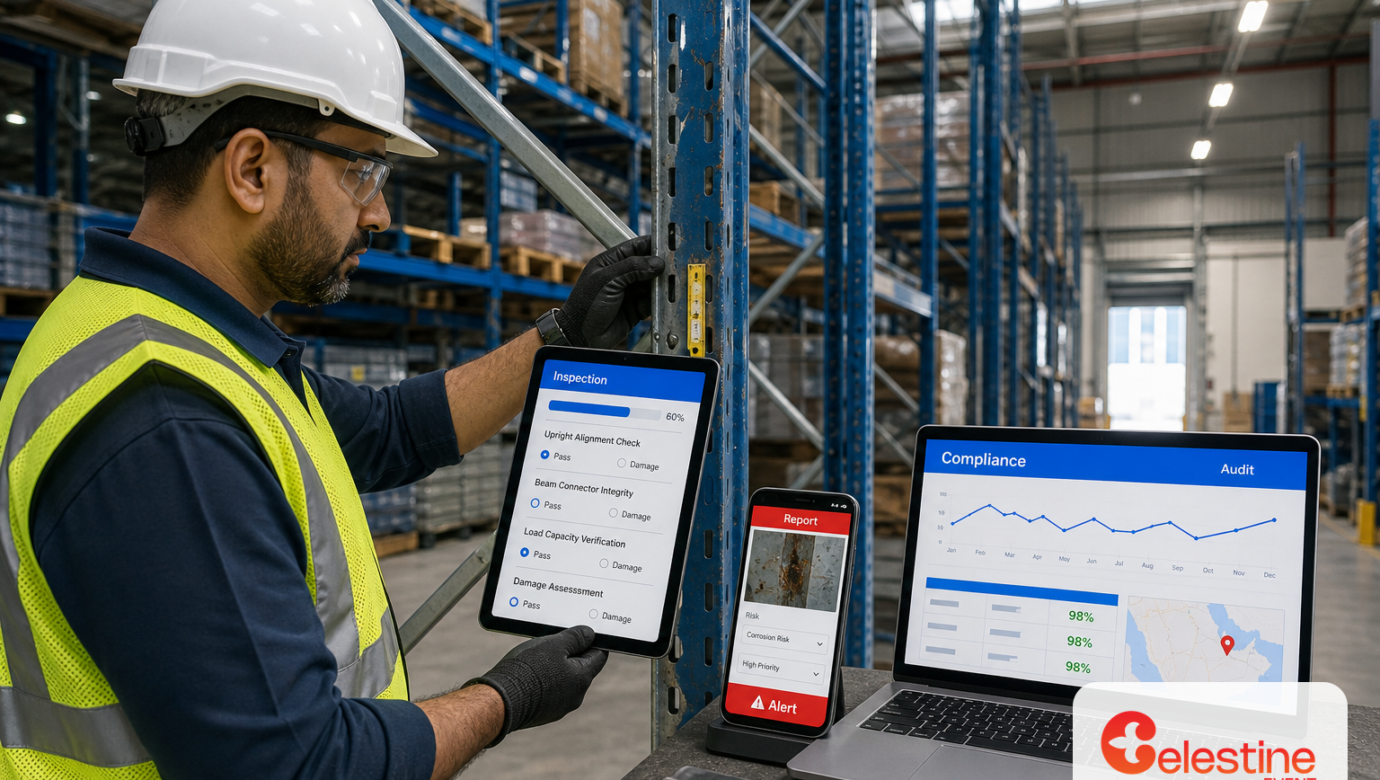
Warehouse Racking Safety Inspection & Compliance in the UAE: Checklists, Standards and Audits
Warehouse racking safety inspection compliance in the UAE rests on three things: a documented inspection routine, adherence to recognised design and maintenance standards (chiefly EN 15512 and EN 15635), and evidence that every installation was verified against its approved design. The UAE has no single law dedicated to pallet racking. Compliance is built from civil defence requirements, municipal and emirate-level occupational safety rules, insurer expectations and your general duty of care. This guide sets out what that means in practice, from climate-driven failure modes to auditing a system someone else installed.
We are an events and exhibition company in Dubai, and we store large volumes of booth structures, staging and lighting equipment between projects. Storage discipline is part of how we deliver From Concept to Execution with precision, and the lessons below come from that perspective.
Why Warehouse Racking Safety Matters in UAE Operations

A loaded pallet rack bay can hold several tonnes at height. When one upright is struck by a forklift and nobody reports it, the bay’s capacity falls, sometimes drastically, while it still looks serviceable. The risks are personnel injury, stock loss, fire-protection interference (collapsed racking can block sprinklers and egress) and insurance disputes after an incident.
UAE conditions add pressure. Operations run long shifts, often with high pallet turnover, mixed workforces and fast-changing stock profiles. Racking is frequently reconfigured as tenants change or product lines shift, and each reconfiguration is a chance for load plans and the installed hardware to drift apart.
Most advice treats racking safety as an annual inspection event. In our experience it is a continuous control, and the annual expert report is only one layer of it. We return to this in the framework below.
UAE Compliance Standards for Racking Systems: Regulatory Framework
What are the specific UAE regulatory requirements for warehouse racking inspections?
There is no federal statute that prescribes a racking inspection interval by name. Instead, obligations arrive from several layers, and you should confirm the current position with your authority and insurer, since requirements vary by emirate and free zone.
- Federal labour and safety obligations: UAE labour law requires employers to provide a safe workplace and protect workers from occupational hazards. A collapsed rack that was visibly damaged and not acted upon is difficult to defend under this duty.
- Civil defence and fire code: The UAE Fire and Life Safety Code of Practice governs storage height, aisle widths, sprinkler clearance and egress. Racking layouts must respect these, and alterations can trigger re-approval.
- Emirate-level frameworks: Dubai Municipality requirements apply in Dubai, while Abu Dhabi operators work within the OSHAD system. Free zones such as JAFZA and KIZAD add their own authority conditions in leases and operating permits.
- Building and seismic codes: Racking sits on slabs designed under local building codes, and seismic provisions affect anchoring and bracing design.
- Insurer and client requirements: Property insurers and third-party logistics clients increasingly ask for inspection records and engineer sign-off as a condition of cover or contract.
Which technical standards do UAE operators actually follow?
In practice, pallet racking compliance in the UAE relies on internationally recognised standards:
- EN 15512: design of adjustable pallet racking.
- EN 15620: installation tolerances, such as verticality and beam level.
- EN 15635: application and maintenance, including inspection regimes and damage assessment.
- EN 16681: seismic design of storage systems.
- RMI/ANSI MH16.1: commonly used where systems are of North American origin.
- SEMA guidance: widely used for the green, amber and red damage classification.
The rule we apply is simple: whichever standard the system was designed to is the standard it should be inspected and maintained to. Mixing frameworks without an engineer’s rationale invites disputes.
Environmental Risk Factors Specific to UAE Warehouses: Dust, Humidity & Seismic Considerations
How do UAE environmental conditions affect racking structural integrity?
Racking is robust, but the regional climate acts on it slowly and unevenly. The main factors are:
- Dust and sand: Fine particulate settles on beam connectors, safety locks and floor plates. It hides early damage during visual checks, works into moving parts and holds moisture against steel. This is the core of warehouse dust environmental damage: the dust itself is rarely structural, but it masks and accelerates other problems.
- Humidity and condensation: Coastal sites in Dubai, Sharjah and Abu Dhabi see very high humidity, and air-conditioned or chilled zones create condensation cycles. Combined with airborne chlorides near the coast, this accelerates corrosion at cut edges, welds, base plates and damaged coatings.
- Temperature extremes: Un-air-conditioned warehouses can far exceed 45°C inside during summer. Steel expansion across that range is small, but heat affects floor slabs, adhesives, plastic components such as row spacers and guards, and stored goods that change weight or shape.
- Floor condition: Slab cracking, settlement and dusty or contaminated surfaces affect base plate seating and anchor performance.
For beam performance under these conditions, see our related guide on calculating racking beam load capacity with UAE climate and dust in mind.
How significant is seismic risk?
The UAE is generally low to moderate in seismic hazard, with higher zoning in the northern emirates closer to the Zagros and Makran influences. That does not make a warehouse seismic risk assessment optional. Heavily loaded, tall racking can be sensitive to even modest ground motion, particularly with poorly anchored frames, missing down-aisle bracing or unstable pallets. A sound assessment checks that the installed design reflects the local seismic zone, that anchoring matches the specification, and that nothing has been reconfigured away from the design assumptions. Our companion article on seismic safety in UAE racking covers compliance, bracing and risk mitigation in depth.
Inspection Frequency Requirements: How Often Should Racking Be Assessed?
How frequently should racking be inspected, and does it vary?
Following EN 15635 and common practice, we structure inspection into what we call the Four-Tier Racking Assurance Model. It is a framework, not a regulation, but it maps cleanly to the standards and to what auditors and insurers expect.
- Tier 1, Continuous operator observation: Every forklift driver and picker reports impacts and visible damage immediately, with no penalty for honest reports. Anything affecting an upright is reported the same shift.
- Tier 2, Routine trained-person inspection: A designated, trained person walks the aisles on a set cycle, typically weekly in busy operations and at least monthly in low-activity ones. This is the visual warehouse racking inspection checklist described below.
- Tier 3, Expert inspection: A competent engineer or specialist inspects the entire system at intervals not exceeding twelve months, producing a written report with damage classification and actions.
- Tier 4, Event-triggered inspection: Any impact, overload, reconfiguration, relocation, flooding, fire, or seismic event triggers inspection regardless of the calendar.
Frequency should rise with risk. We would tighten the routine cycle for:
- High-throughput distribution with narrow aisles and heavy forklift traffic.
- Coastal or high-humidity sites where corrosion progresses faster.
- Very tall systems or those holding heavy, concentrated loads.
- Operations with frequent reconfiguration, such as multi-tenant or project-based storage.
- Dusty environments where early damage is hard to see without cleaning first.
Low-activity cold or ambient storage with stable stock can sit at the lower end, though the annual expert inspection remains the floor. For how to plan these intervals against cost over a year, see our guide to budgeting racking maintenance, inspection schedules and prevention.
Comprehensive Racking Inspection Checklist: What to Examine at Each Level
This warehouse racking inspection checklist works as a Tier 2 walk-through. Clean visible dust from connectors and base areas first, so you inspect steel rather than debris.
Floor and base level
- Base plates seated flat, with no gaps, lifting or slab cracking beneath.
- Anchor bolts present, tight and not corroded or sheared. Perform racking bolt and weld inspection on base plate welds as well as fasteners.
- Column guards and end-of-aisle protectors intact and not displaced.
- Evidence of water pooling or standing moisture.
Uprights and frames
- Dents, kinks, twists and bowing, especially in the lowest 400 mm where impacts concentrate.
- Out-of-plumb frames: check against tolerances in the installation standard.
- Bracing members straight, secured and undamaged.
- Corrosion at perforations, cut edges and weld zones.
Beams and connectors
- Beam deflection: sagging beyond the limit in the design documents (commonly span divided by 200 under full load) needs engineer review.
- Safety locking pins or clips present at every beam end.
- Connector hooks fully engaged, with no distortion or cracked welds.
- Beam end plates free of deformation.
Load and signage
- Load capacity plates fitted, legible and matching the actual configuration.
- Pallets within rated weight per beam level and bay, correctly positioned, and in sound condition.
- Row spacers, decking and pallet supports in place.
- Stored goods not protruding into aisles or against sprinkler heads.
Top level and environment
- Clearance to sprinklers, lighting and building structure as required by the fire code.
- Roof leaks, condensation drips or air-conditioning discharge hitting steel.
- Heavy dust build-up on top beams that could conceal damage.
How should findings be classified?
Use the traffic-light approach: green for acceptable, amber for damage that needs monitoring and repair within a defined period, and red for damage requiring immediate unloading and isolation of the bay until an engineer clears it. Define these thresholds in writing, with example photographs, so classification is consistent between inspectors.
Common Racking Failure Modes and What Causes Them
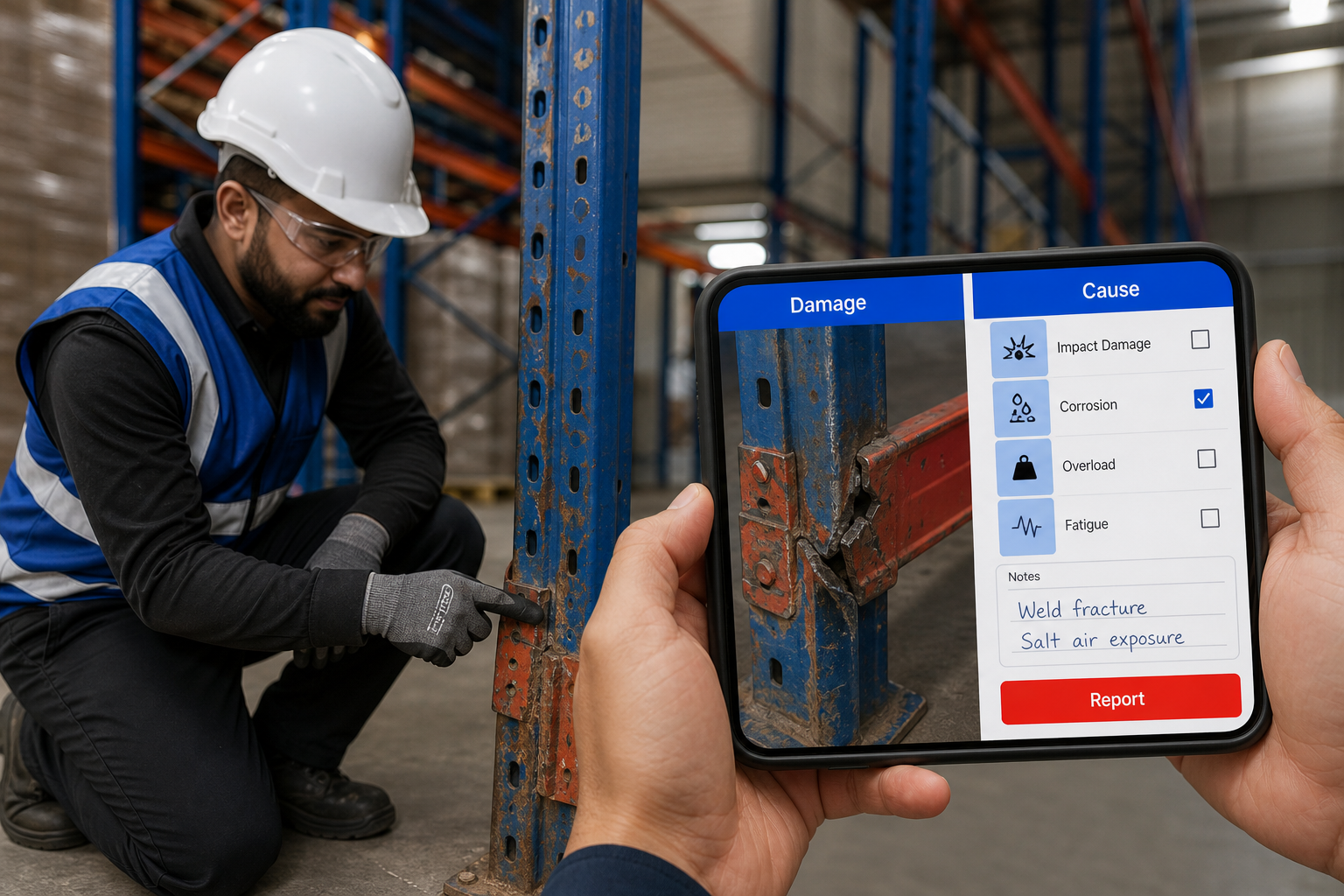
What are the most common failure points, and how can inspectors catch them early?
- Impact damage to uprights: The most frequent cause of reduced capacity. Early signs include scuffed paint, small dents or slightly bowed sections at forklift height. Fix: guards, driver training and a no-blame reporting culture.
- Overloading: Beams that sag permanently or connectors that deform. Early signs: visible deflection, loose locks. Fix: load plates and pallet weight control at inbound.
- Missing or dislodged safety locks: Beams can lift out when struck by a pallet. Fix: include locks in every Tier 2 check.
- Corrosion: Section loss at base plates, weld toes and damaged galvanising, accelerated by humidity and chlorides. Early signs: rust staining, flaking coating, pitting under dust deposits.
- Anchor and floor problems: Loosened or missing anchors, slab cracking, uneven floors. Fix: torque checks and floor surveys, particularly after relocations.
- Unauthorised modifications: Moved beams, drilled holes, welded repairs or mixed components from different manufacturers. Fix: change control requiring engineer approval.
- Progressive buckling and frame instability: Often the end result of the above. Early signs: out-of-plumb frames and racking that visibly leans down-aisle.
One point we stress, and which general advice often misses: failures usually chain. A small impact bends an upright, an unreported bend lowers capacity, humidity corrodes the compromised area, and a routine overload finishes the job. Inspection finds value in catching the first link.
Auditing Third-Party Installation: Verification and Documentation Standards
How should organisations audit racking installed by third-party vendors?
A third-party racking installation audit should confirm that what was designed, what was supplied and what was installed are the same thing. We recommend a structured check in four stages:
- Document review: Obtain the design calculations, load capacity charts, manufacturer drawings, material certificates and the engineer’s approval. Confirm the design reflects the actual floor slab, seismic and wind assumptions, and storage method. Check which standards were used, such as EN 15512 for design, and which local authority or free zone requirements apply to the site.
- Component verification: Compare what is installed against the drawings. Check upright and beam sections, connector types, safety locks, base plates, bracing and anchor specifications. Mixed components from different manufacturers are a common finding and should be treated as a non-conformance until an engineer approves them.
- Geometric and installation checks: Measure plumb, beam levelness, aisle widths and anchor embedment against the tolerances in the design basis (EN 15620 is the usual reference). Spot-check anchor torque and confirm the floor is flat enough for the rack design.
- Handover and records: Confirm load notices are fixed at every bay, as-built drawings are issued, punch-list items are closed with evidence, and a named person accepts responsibility for the system.
In our experience, most gaps in third-party installations sit in stage one. Teams inspect the steel but never check whether the paperwork describes the rack that was actually built. An audit that cannot trace a component back to a drawing and a certificate is incomplete.
Creating a Maintenance Schedule and Documentation System
What should a racking inspection and maintenance schedule include?
A racking maintenance schedule should combine inspections at several frequencies with a documented route from finding to repair. Each inspection layer has its own owner, method and record. The common structure is:
- Daily or per-shift operator checks: Forklift drivers and supervisors look for fresh impact damage, displaced beams, missing locks and unusual leaning, and report immediately.
- Weekly or monthly walk-through inspections: A trained warehouse inspector checks every aisle for uprights, beams, locks, base plates, signage and pallet condition.
- Annual expert inspection: A technically competent person, ideally with structural or racking-specific qualifications, inspects the whole installation, measures deformation and writes a formal report. Guidance such as EN 15635 and the SEMA code of practice supports this approach.
- Event-driven inspections: A recheck after any significant impact, reconfiguration, relocation, change in load profile, or extreme weather or flooding.
Frequency should follow risk, not habit. A high-throughput facility with narrow aisles and reach trucks will need tighter intervals than a low-activity store. Operators in humid or coastal sites should also bring base plate and galvanising checks forward in the cycle.
What records should a UAE warehouse keep for racking compliance?
Inspection is only as defensible as its records. If an authority, insurer or auditor asks how you managed the risk, a complete file answers the question faster than any explanation. We recommend a documentation system that holds:
- A rack register: A unique reference for every bay, with location, manufacturer, configuration, rated capacity and installation date.
- Design and installation file: Calculations, drawings, certificates, load notices and the installation audit results.
- Inspection logs: Date, inspector, area covered, findings and photographs, stored against bay references.
- Damage classification records: A consistent rating, such as the green, amber and red approach in FEM 10.2.03, with a clear rule that red-rated bays are unloaded and isolated immediately.
- Repair and change control records: Who approved the repair, which parts were used, who carried out the work, and a post-repair verification.
- Training records: Evidence that operators and inspectors are trained for their responsibilities, with refresher dates.
How do you keep racking inspection records from becoming paperwork?
Many warehouses have thick binders and little control. We approach records as a loop we call Record, Rank, Resolve. Record each finding at the bay reference with a photograph. Rank it by severity and set a response time. Resolve it, then verify and close the entry with evidence. An open amber item that is never reviewed is a liability, because it shows the risk was known.
Three measures show whether the system works:
- Average time from reported damage to closed repair.
- Percentage of bays inspected on schedule.
- Number of repeat damage locations, which points to layout or traffic problems instead of operator error.
Digital inspection tools can help, especially for multi-site operators who need consistent data, but a disciplined spreadsheet with photographs and clear ownership beats an unused software platform. What matters is that someone is accountable for reviewing the register every month.
Frequently asked questions
How often should warehouse racking be inspected in the UAE?
Use layered inspections: daily operator checks, regular walk-through inspections by a trained person, and at least one full expert inspection each year. Add extra inspections after impacts, reconfiguration or changes in load. High-activity and humid sites may need shorter intervals.
Is a racking safety inspection mandatory in the UAE?
Requirements vary by emirate, free zone and the authorities or insurers involved, but employers carry a general duty to maintain safe workplaces and equipment. We advise confirming the specific requirements for your site and adopting recognised standards such as EN 15635 as your baseline.
Who is qualified to carry out a racking inspection?
Daily checks can be done by trained operators and supervisors. Annual inspections should be performed by a technically competent person with demonstrable racking or structural knowledge, ideally independent of the installer.
What damage requires racking to be unloaded immediately?
Under the commonly used green, amber and red system, red-rated damage requires immediate unloading and isolation. Typical examples include severely bent or twisted uprights, torn or cracked sections, and beams that have lost their connection or safety lock.
What documents should I keep for racking compliance?
Keep the design calculations, drawings, load notices, installation audit results, inspection logs, damage ratings, repair approvals and training records. Link every record to a bay reference in a rack register.
Next Steps for Your Racking System
Racking safety depends on three things working together: a sound installation, disciplined inspection and a record that proves both. Where one of these is weak, risk accumulates quietly until a failure exposes it. If you would like a second opinion on where your system stands, we are glad to talk it through with you.
Read our cluster guides on Technical Specifications and Racking Performance in UAE Warehouses, or contact our expertise team to audit your current system.
