

Installing Mobile Shelving in Dubai: Timeline, Training & First-Year Maintenance
A typical mobile shelving installation in Dubai takes 10 to 20 weeks from site survey to handover. That covers design approval, manufacture and shipping, floor preparation, installation, commissioning and operator training. The physical installation is often only one to three weeks of that. This guide sets out the sequence, the climate factors, the local labor logistics and the first-year service cycles, so you can plan with realistic dates.
Understanding Mobile Shelving System Installation in Dubai
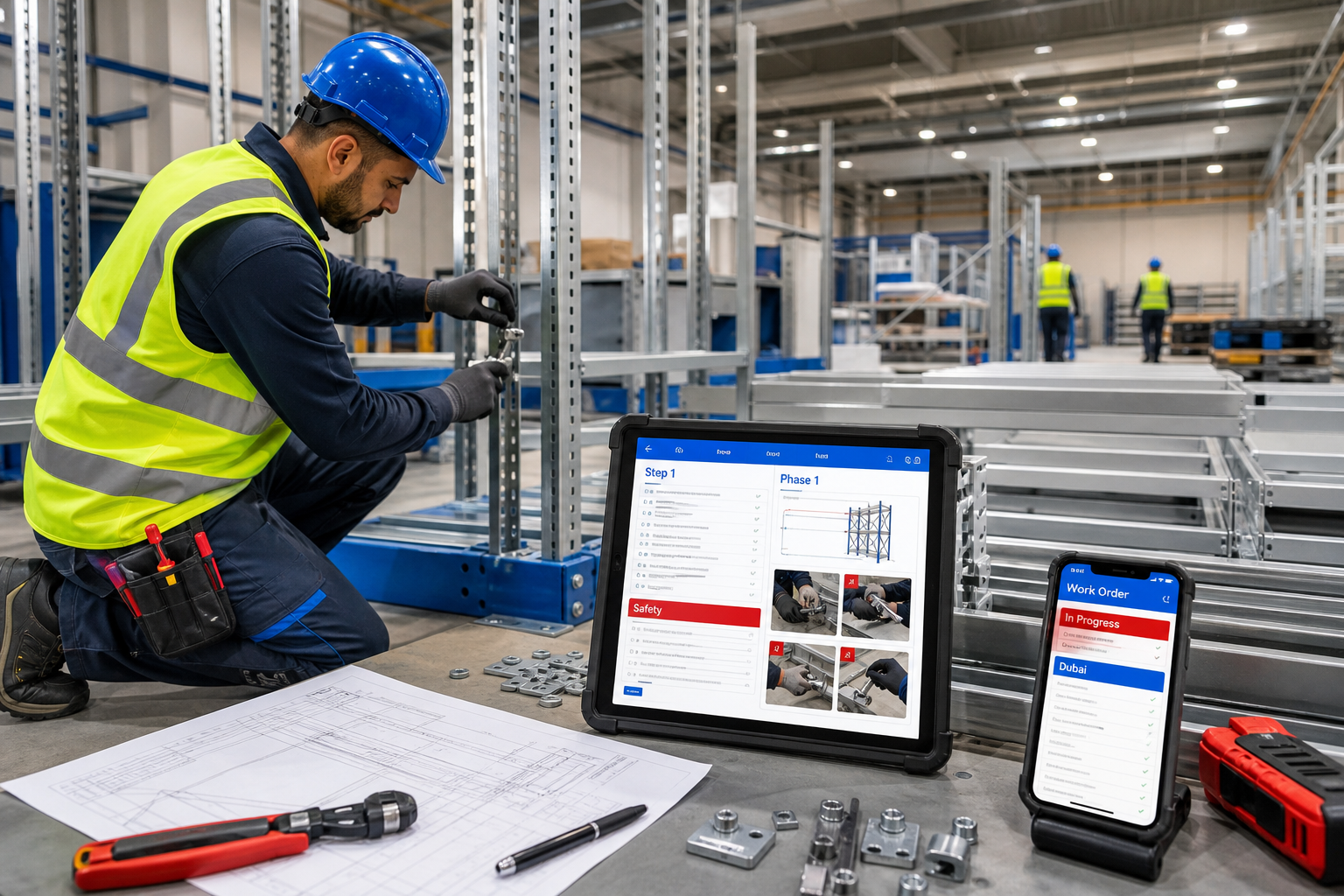
A mobile shelving system (also called a mobile racking system) mounts storage bays on motorized or manual carriages that run along floor rails. Closing the unused aisles gives you high-density storage in a smaller footprint. Because the system is a machine rather than static furniture, its installation is closer to equipment commissioning than to assembling racks.
Most planning advice treats installation as the finish line. We think that is the main thing it gets wrong. In our work managing exhibition and event logistics, where large inventories of staging, booth components and branded materials must be stored and retrieved to a schedule, the projects that run smoothly treat handover as the midpoint. We use a simple model called the Four Gates Framework:
- Site Gate: the building and floor are verified as ready.
- Install Gate: rails, carriages and safety systems are fitted and tested.
- Operator Gate: people are trained and signed off before live stock goes in.
- Service Gate: a documented first-year maintenance cycle is in place.
No gate opens until the one before it is closed. That discipline prevents most of the delays we see.
How Long Does Mobile Shelving Installation Take, and What Site Preparation Is Required?
The ranges below are planning figures for a mid-sized warehouse project. Confirm exact durations with your supplier, because system size, import origin and floor condition all move them.
- Site survey and design sign-off: 1 to 3 weeks
- Manufacture and sea or air freight, including customs clearance: 6 to 12 weeks
- Floor preparation and rail bed works: 1 to 3 weeks, often in parallel with manufacture
- Installation: 1 to 3 weeks depending on number of carriages
- Commissioning and safety testing: 2 to 4 days
- Operator training: 1 to 2 days, plus a supervised first week
What site preparation comes before installation?
Before any carriage arrives, the Site Gate should confirm the following:
- Floor flatness and load capacity. Mobile systems concentrate heavy loads on narrow rails. A floor survey should check levelness against the manufacturer’s tolerance, which is typically only a few millimetres across the rail run. Slab thickness and reinforcement must suit the loaded weight.
- Clear working area. Remove existing racking and stock, and confirm access doors and ramps accommodate delivery vehicles and lifting equipment.
- Power supply. Motorized systems need a dedicated, correctly rated supply and a defined control panel location.
- Fire protection. Sprinkler heads, flue spaces and detection must be reviewed against the new, denser layout. Check current requirements with Dubai Civil Defence and your free zone or landlord before finalizing the design.
- Stock plan. Decide how inventory will be decanted and held elsewhere during the works.
The most underestimated item is the floor. Correcting an uneven slab after delivery can add weeks, and no amount of site effort can recover that time.
Installation Process: What to Expect During Setup
Installation follows a predictable order:
- Layout marking: rail lines and bay positions are set out from the approved drawings.
- Rail fitting and leveling: rails are shimmed, anchored and checked along their full length.
- Carriage placement: chassis are positioned and aligned on the rails.
- Shelving assembly: uprights, beams and shelves are fitted to each carriage.
- Drive and control wiring: motors, controls and aisle-entry safety sensors are connected.
- Commissioning: travel, braking, sensors, emergency stops and locking are tested under load.
Commissioning is where shelving system durability testing happens in practice. Insist on a loaded travel test and a written record of results. A system that moves smoothly empty can behave differently with full bays.
What Operator Training and Certification Is Needed in the UAE?
Operators should be trained and signed off before live inventory goes in. We are not aware of a single national certificate specific to mobile shelving, so warehouse operator training certification usually comes from the supplier and your own safety system. Verify any regulatory expectations with your free zone authority or insurer. A sound program covers:
- How the carriages move, and how to open and secure aisles
- Safety sensors, emergency stops and lockout procedures
- Load limits and correct weight distribution across bays
- Pre-shift visual checks and fault reporting
- Integration with your inventory management system in Dubai, including location coding for each bay and aisle
Keep a signed training register, and repeat the session for new starters. Bilingual or multilingual materials matter here, since UAE warehouse teams are often drawn from many language backgrounds. Pictorial aisle-safety signage helps everyone.
How Does Dubai’s Climate Affect Mobile Shelving?
Climate is the factor that most generic guides ignore. Four conditions matter:
- Heat. Summer temperatures in unconditioned warehouses can be very high. Heat thins lubricants, stresses motors and electronics, and causes rails to expand. Allow for expansion in the design, and use lubricants rated for the site’s temperature range.
- Humidity and salt air. Coastal and port-adjacent sites such as those near Jebel Ali face corrosion risk. Specify appropriate coatings or galvanized components.
- Dust and sand. Fine particles collect in rails and drive mechanisms. Rail cleaning is a routine task here, not an occasional one.
- Condensation. Moving stock between climate-controlled storage facilities and outdoor loading areas can create moisture on shelves and packaging.
For these reasons, the same system will wear differently in a conditioned unit than in a ventilated shed. Plan maintenance intervals around the real environment, not the brochure.
What Is the First-Year Maintenance Schedule for Mobile Shelving?
This is the Service Gate. A practical first-year cycle for mobile racking system maintenance in the UAE looks like this:
- Week 1 to 2: a post-handover check of rail fixings, carriage alignment and safety sensors after initial live loading.
- Month 1: re-check leveling and drive tension once the structure has settled under full load.
- Quarterly: clean rails, inspect wheels and bearings, lubricate to specification, and test emergency stops and aisle sensors.
- Before peak summer (around May): inspect electronics and ventilation, and review lubricant suitability.
- Month 12: a full inspection, load-path review and written condition report, with any worn parts planned for replacement.
Add a short daily operator check on top of this. Most faults are noticed first by the people using the system, so give them a simple way to report problems.
How Do Local Labor Logistics Affect the Timeline?
Supply chain logistics in the UAE are efficient, but the calendar has features that matter to a schedule:
- Customs and freight. Imported components add transit and clearance time. Confirm documentation early.
- Access permits. Free zones and industrial areas often require gate passes and approved contractor lists for installation crews. Apply well before mobilization.
- Midday work restrictions. The UAE’s summer midday break rules for outdoor work apply to loading yards and external works, which can shift delivery windows.
- Ramadan and public holidays. Reduced working hours during Ramadan and Eid closures can add days. Schedule around them, not through them.
- Trade coordination. Electricians, civil contractors and installers must sequence tightly. One missed handoff stalls the others.
Appoint a single project coordinator who owns the gate sign-offs. In our experience across complex event builds, a clear owner and a written sequence prevent more delays than extra labor does.
Related reading: How Climate Affects Racking Durability in UAE Warehouses · UAE Fire Safety Standards for Pallet Racking Explained
Frequently asked questions
How long does mobile shelving installation take in Dubai?
Expect 10 to 20 weeks overall, of which the on-site installation is typically one to three weeks. Manufacture, shipping and floor preparation make up most of the rest.
What must be done to the site before installation?
Survey the floor for flatness and load capacity, clear the area, confirm power supply, review fire protection, and arrange temporary storage for existing stock.
What training do operators need?
Operators need training in carriage movement, safety sensors, emergency stops, load limits and daily checks, with a signed register. Supplier-led training is the usual route.
How does Dubai’s climate affect lifespan?
Heat, humidity, salt air and dust accelerate wear on lubricants, rails, motors and finishes. Suitable coatings and more frequent cleaning protect the system.
What is the recommended first-year maintenance?
Check after weeks 1 to 2 and month 1, service quarterly, inspect before summer, and complete a full inspection at month 12.
Do local labor logistics change the schedule?
Yes. Access permits, customs, Ramadan hours, public holidays and trade sequencing can each add days, so build them into the plan from the start.
Plan Your Installation With Confidence
A mobile shelving project succeeds when each gate is closed properly, from site preparation through to the first-year service cycle. Ready to plan your mobile shelving installation? Contact our warehouse solutions team to discuss your project timeline and requirements. We will help you turn the plan into a precise, well-sequenced reality.
