

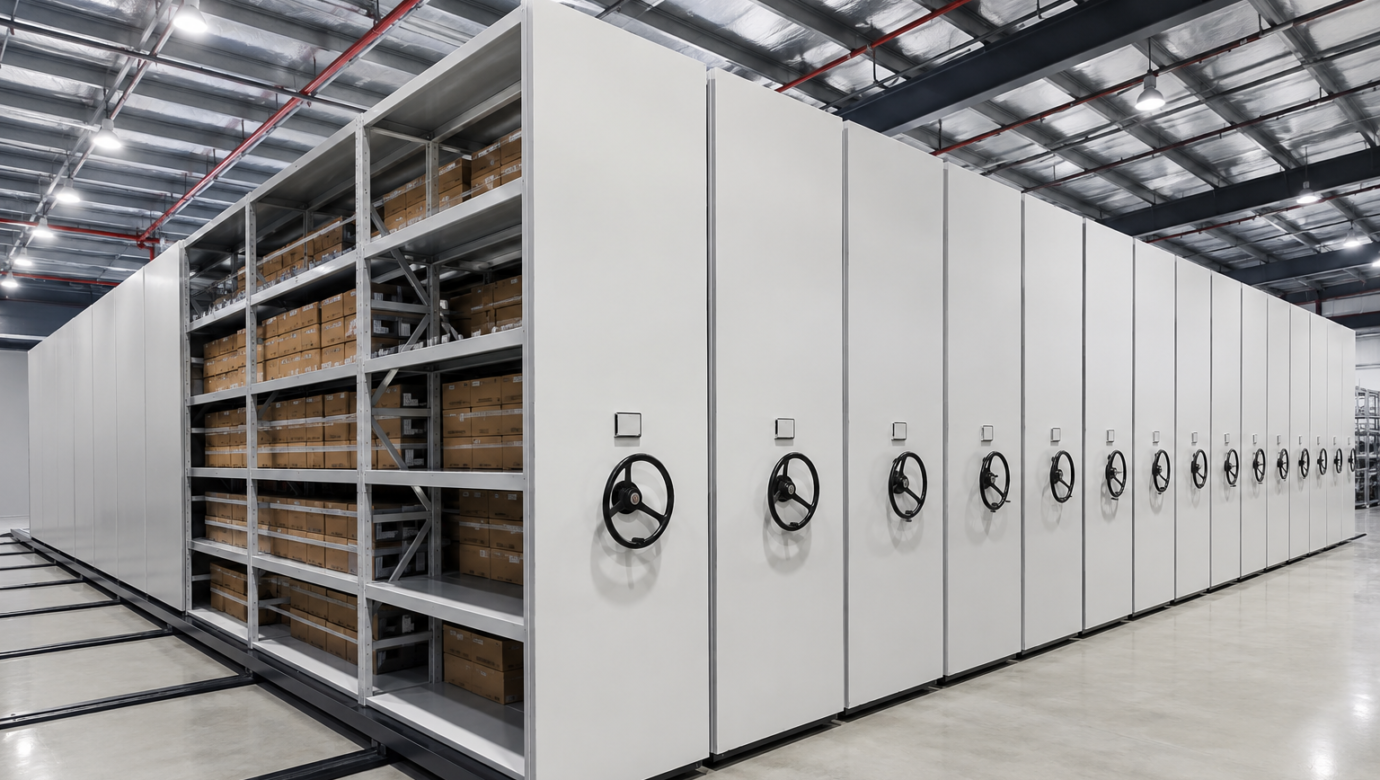
Mobile Shelving System for Warehouse Storage
As warehouse operators face increasing pressure to store more inventory within existing facilities, the Mobile Shelving System for Warehouse Storage has become a practical solution for improving space utilization without expanding building footprints. By eliminating unnecessary fixed aisles, mobile shelving systems allow businesses to increase storage capacity while maintaining organized and secure access to inventory.
Across logistics, manufacturing, healthcare, retail, and archival storage facilities, mobile shelving systems are helping organizations optimize warehouse layouts, improve inventory management, and support safer working environments.
What Is a Mobile Shelving System for Warehouse Storage?
A Mobile Shelving System for Warehouse Storage consists of shelving units mounted on mobile carriages that travel along floor-mounted rails or rail-free guided systems. Instead of maintaining multiple permanent aisles, operators open only the aisle needed to access stored items.
This design significantly increases storage density while keeping inventory easily accessible.
Typical components include:
- Heavy-duty steel shelving
- Mobile carriage bases
- Precision rail systems
- Electric or manual drive mechanisms
- Safety locking devices
- Control panels and sensors (for powered systems)
How Mobile Shelving Systems Work
Unlike traditional static shelving, mobile shelving units move sideways to create an access aisle only where required.
The operating process is straightforward:
- Select the shelving unit to access.
- Move adjacent units using manual or powered controls.
- Open a working aisle.
- Retrieve or store inventory.
- Close the aisle after use.
Modern powered systems often include automatic controls, safety sensors, emergency stop functions, and access permissions for improved operational safety.
Benefits of Mobile Shelving System for Warehouse Storage
Maximizes Storage Capacity
One of the biggest advantages is increased storage density. Since fixed aisles are minimized, warehouses can often achieve 40% to 80% more storage capacity within the same floor area, depending on the layout.
Improves Warehouse Organization
Mobile shelving keeps inventory systematically arranged, making it easier for staff to locate products and maintain accurate stock records.
Reduces Facility Expansion Costs
Instead of leasing additional warehouse space or constructing new facilities, businesses can often optimize existing storage by installing mobile shelving.
Enhances Inventory Protection
Shelving systems help protect inventory from damage by reducing unnecessary handling and maintaining organized storage locations.
Supports Better Security
Because only one aisle is open at a time, access to stored inventory can be better controlled, making mobile shelving suitable for high-value goods and confidential records.
Industries That Use Mobile Shelving Systems
Mobile shelving systems serve a wide range of industries, including:
Logistics and Distribution
Warehouses use mobile shelving for spare parts, cartons, tools, and fast-moving inventory.
Manufacturing
Manufacturers store components, maintenance equipment, and production materials efficiently.
Healthcare
Hospitals and laboratories use mobile shelving for medical supplies, pharmaceuticals, and records.
Government and Archives
Government agencies and archives use high-density shelving for secure document storage.
Retail Warehouses
Retail distribution centers organize seasonal inventory and back-stock products using compact shelving systems.
Types of Mobile Shelving Systems
Manual Mobile Shelving
Operated using a handwheel or mechanical drive, manual systems are cost-effective and suitable for lighter storage applications.
Mechanical-Assisted Shelving
These systems reduce the effort needed to move heavier shelving units through geared mechanisms.
Powered Mobile Shelving
Electric motors move shelving automatically using push-button controls or touchscreen interfaces, making them ideal for larger facilities and heavy-duty storage.
Key Features to Consider
When selecting a mobile shelving solution, businesses should evaluate:
- Load capacity
- Shelving dimensions
- Manual or powered operation
- Safety mechanisms
- Floor loading requirements
- Expansion capability
- Corrosion-resistant finishes
- Integration with warehouse management systems
Professional site assessments help determine the most suitable configuration based on inventory size, operational workflow, and available floor space.
Safety Considerations
Modern mobile shelving systems include several safety features designed to protect workers and inventory.
Common safety features include:
- Emergency stop buttons
- Motion sensors
- Anti-tip mechanisms
- Audible warning alarms
- Locking systems
- Overload protection
Routine inspections and scheduled maintenance help ensure long-term reliability and safe operation.
Maintenance Best Practices
Proper maintenance extends the service life of mobile shelving systems.
Recommended practices include:
- Inspect rails for debris and wear.
- Lubricate moving components as recommended.
- Check safety sensors and emergency stops.
- Verify carriage alignment.
- Inspect fasteners and structural connections.
- Perform annual professional inspections.
Mobile Shelving vs. Traditional Static Shelving
| Feature | Mobile Shelving | Static Shelving |
|---|---|---|
| Storage Density | High | Moderate |
| Floor Space Utilization | Excellent | Lower |
| Fixed Aisles | Minimal | Multiple |
| Inventory Access | Controlled | Open |
| Security | Higher | Standard |
| Expansion Efficiency | Excellent | Limited |
How Planet Racking Supports Mobile Shelving Projects
Planet Racking supplies and installs mobile shelving systems for warehouse storage across Dubai and the UAE. The company provides customized storage solutions designed to maximize available warehouse space while supporting operational efficiency and workplace safety.
Its services include warehouse assessments, layout planning, system design, professional installation, and after-sales support for businesses in logistics, manufacturing, retail, healthcare, and commercial sectors.
Future Trends in Mobile Warehouse Storage
The growing adoption of warehouse automation is influencing mobile shelving technology.
Emerging developments include:
- IoT-enabled monitoring
- Smart access control
- RFID inventory integration
- Automated inventory tracking
- Energy-efficient drive systems
- AI-assisted warehouse optimization
These innovations are expected to further improve warehouse productivity while supporting more efficient inventory management.
Key Takeaways
- Mobile shelving systems maximize warehouse storage capacity by reducing fixed aisles.
- They improve inventory organization and operational efficiency.
- Manual, mechanical-assisted, and powered systems suit different business needs.
- Modern systems include advanced safety features for reliable operation.
- Planet Racking provides customized mobile shelving solutions, installation, and support across Dubai and the UAE.
FAQs
What is a mobile shelving system for warehouse storage?
A mobile shelving system for warehouse storage uses shelving units mounted on movable bases that slide along rails. Instead of permanent aisles, only the required aisle is opened, allowing businesses to maximize storage capacity while maintaining easy access to inventory.
How much space can a mobile shelving system save?
Depending on the warehouse layout and shelving configuration, mobile shelving systems can increase storage capacity by approximately 40% to 80% compared with conventional static shelving by reducing the number of permanent access aisles.
Which industries benefit most from mobile shelving systems?
Industries including logistics, manufacturing, healthcare, retail, government archives, education, and commercial offices benefit from mobile shelving because these systems improve organization, maximize storage density, and support secure inventory management.
Are mobile shelving systems safe for warehouse operations?
Modern mobile shelving systems include safety features such as emergency stop buttons, motion sensors, anti-tip devices, locking mechanisms, and overload protection. Regular inspections and proper operator training further support safe warehouse operations.
How do I choose the right mobile shelving system?
Selecting the right system depends on available floor space, load requirements, inventory type, operational workflow, expansion plans, and budget. A professional warehouse assessment helps identify the most suitable shelving configuration for long-term storage efficiency.
