

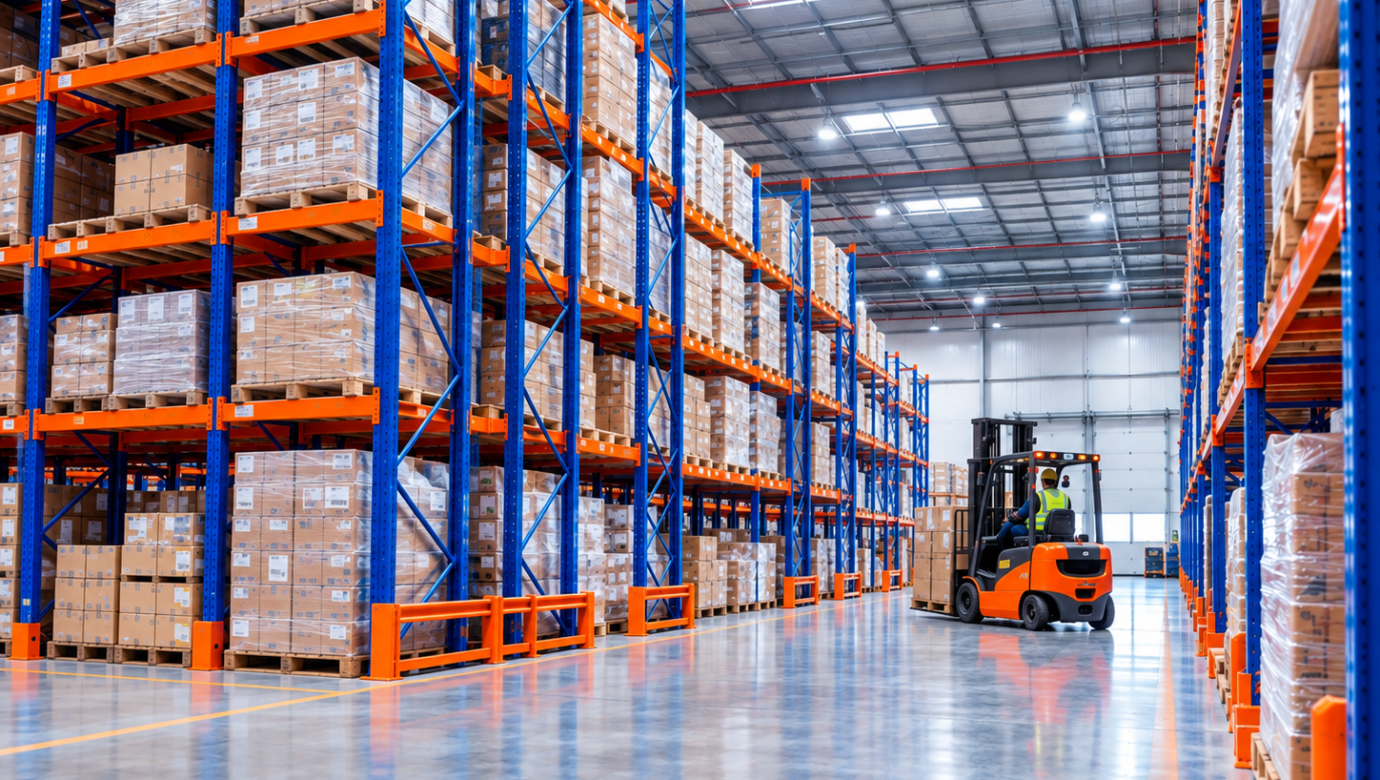
Warehouse Storage Racking Solutions Dubai UAE
Warehouse Storage Racking Solutions Dubai UAE are used across logistics, manufacturing, distribution, retail and other industrial facilities to organize inventory and make better use of available warehouse space. The appropriate system depends on factors such as load requirements, product dimensions, storage volume, access frequency, available floor area and material-handling equipment.
A well-planned warehouse storage system can separate inventory clearly, improve accessibility and support safer movement through storage aisles. However, selecting a racking system requires more than simply choosing the tallest or highest-capacity structure. Warehouse operators need to consider how goods enter, move through and leave the facility.
What Are Warehouse Storage Racking Solutions?
Warehouse storage racking solutions are engineered systems designed to store goods in an organized vertical or horizontal arrangement. They can range from simple shelving to high-capacity pallet racking structures.
Common applications include:
- Palletized goods
- Cartons and packaged products
- Small parts and components
- Bulk inventory
- Long or irregular items
- High-density storage
- Temperature-controlled warehouse operations
The objective is generally to use warehouse space efficiently while maintaining suitable access to stored products.
Warehouse Storage Racking Solutions Dubai UAE: Common Systems
Different warehouse operations require different storage configurations. Several systems are widely used in industrial facilities.
Heavy-Duty Pallet Racking
Pallet racking is designed to store palletized products on horizontal beams supported by upright frames. Forklifts or other handling equipment can access individual storage locations.
Selective pallet racking is commonly considered when warehouses need direct access to many different stock-keeping units. Other configurations can provide greater storage density where product variety and access requirements allow it.
Drive-In Racking
Drive-in racking allows material-handling equipment to enter storage lanes. Pallets are stored on rails within the structure.
This configuration can increase storage density because it reduces the number of aisles required. It is generally more appropriate for operations handling larger quantities of fewer product types.
Mobile Shelving Systems
Mobile shelving places storage units on movable bases. The units can be moved to create an access aisle when required.
This approach can be useful where floor space is limited and the operation requires organized access to stored items. Mobile shelving is particularly relevant for archive, document, parts and smaller-item storage applications.
Slotted Angle Shelving
Slotted angle shelving uses perforated metal angles and horizontal shelves to create adjustable storage levels.
It can be suitable for lighter loads, cartons, tools, components and manually handled inventory. Because the system can be configured with different shelf heights, it can accommodate products of varying dimensions.
Mezzanine Floor Systems
A mezzanine creates an additional usable level above part of the warehouse floor.
Depending on the design and application, the additional level can support storage, work areas or other operational functions. Structural design, loading requirements, access arrangements and applicable building and safety requirements must be assessed before installation.
Custom Racking Solutions
Some warehouses have unusual dimensions, product characteristics or workflow requirements. In such cases, a storage system may combine multiple racking or shelving configurations.
Custom planning can consider:
- Building dimensions
- Column positions
- Ceiling height
- Loading requirements
- Product dimensions
- Forklift characteristics
- Aisle requirements
- Stock rotation
- Future capacity needs
How to Choose a Warehouse Racking System
Choosing a storage system should begin with the warehouse’s operational requirements rather than the equipment itself.
1. Assess the Products
Determine the dimensions, weight and packaging of the products being stored. Palletized goods may require a different configuration from cartons, components or long materials.
2. Review Available Space
Measure the warehouse carefully. Floor area is important, but vertical clearance can also influence the storage configuration.
Existing columns, doors, fire protection equipment, lighting and other building features should be considered during planning.
3. Consider Access Requirements
Inventory that is accessed frequently may require direct access. Products with lower access frequency may be suitable for higher-density arrangements.
Stock rotation requirements also influence the choice of storage system.
4. Match the System to Handling Equipment
Forklifts and other material-handling equipment require suitable aisle widths, turning areas and operating clearances.
The racking layout should therefore be developed alongside the warehouse’s handling equipment and operating procedures.
5. Account for Load Capacity
Every racking configuration should be designed for its intended loads. Pallet weight, load distribution, beam capacity and frame capacity are important considerations.
Operators should follow the manufacturer’s specified load limits and applicable safety requirements.
Warehouse Racking Safety Considerations
Storage capacity should not be considered separately from safety.
Warehouse operators should establish procedures for inspecting storage systems and identifying visible damage. Impact from forklifts, overloaded components and improper loading can affect a racking structure.
Important considerations include:
- Clearly defined load limits
- Suitable aisle clearances
- Proper pallet placement
- Protection against vehicle impact where required
- Regular inspection procedures
- Appropriate operator training
- Maintaining clear emergency access
- Following applicable local and international safety requirements
The specific requirements depend on the facility, equipment, building design and jurisdiction.
How Racking Can Affect Warehouse Operations
The layout of storage equipment can influence how workers and material-handling equipment move through a facility.
A suitable layout can help organize:
- Receiving areas
- Put-away operations
- Storage locations
- Picking zones
- Packing areas
- Dispatch operations
For example, frequently picked products may be positioned closer to picking or dispatch areas, while slower-moving inventory can be placed in less accessible locations where operationally appropriate.
This type of planning can reduce unnecessary movement and make inventory locations easier to manage.
Racking for Different UAE Warehouse Applications
Dubai and other UAE logistics hubs accommodate warehouses serving several industries. Storage requirements can therefore vary significantly.
Logistics and Distribution
Distribution warehouses often need accessible pallet positions and layouts that support frequent receiving and dispatch activity.
Manufacturing
Manufacturers may require storage for raw materials, components, work-in-progress goods and finished products. Racking can be integrated with production and material-flow requirements.
Retail Distribution
Retail supply chains often handle large product ranges. Storage layouts may therefore need to balance product variety with accessibility.
E-Commerce
E-commerce warehouses can require efficient picking arrangements because individual orders may contain multiple products stored across different locations.
Cold Storage
Temperature-controlled facilities have additional environmental and operational requirements. Storage systems must be compatible with the facility’s operating conditions and handling equipment.
Planning for Future Warehouse Capacity
Warehouse requirements can change as inventory volumes, product ranges and operational processes evolve.
A storage plan should therefore consider potential future requirements where practical. Leaving suitable expansion possibilities can be useful when designing a new warehouse or reorganizing an existing facility.
However, increasing storage height or density should never be done without checking structural capacity, fire protection, handling equipment, access and applicable requirements.
Key Takeaways
Warehouse storage racking solutions in Dubai, UAE can include pallet racking, drive-in systems, mobile shelving, slotted angle shelving and mezzanine structures.
The right system depends on:
- Product type and dimensions
- Load requirements
- Available warehouse space
- Required storage density
- Product accessibility
- Material-handling equipment
- Inventory movement
- Safety and building requirements
- Future operational needs
A storage system should be treated as part of the overall warehouse layout rather than as an isolated piece of equipment. Proper planning can help create an organized storage environment that supports day-to-day warehouse operations.
FAQs
1. What are warehouse storage racking solutions in Dubai UAE?
Warehouse storage racking solutions in Dubai UAE are systems used to organize and store inventory within warehouses and industrial facilities. Common examples include pallet racking, drive-in racking, mobile shelving, slotted angle shelving and mezzanine systems. Selection depends on product characteristics, load requirements, available space, accessibility and material-handling operations.
2. Which warehouse racking system is suitable for pallet storage?
Pallet racking is commonly used for palletized inventory because it provides defined storage positions and can be configured for different loads and warehouse layouts. Selective pallet racking provides direct access to individual pallet locations, while higher-density systems may be considered when product variety and access requirements permit less direct access.
3. How do I choose warehouse storage racking solutions in Dubai UAE?
Choosing warehouse storage racking solutions in Dubai UAE starts with assessing the products, pallet dimensions, load weights, warehouse height, floor area and access requirements. The operation should also consider forklift specifications, aisle requirements, stock rotation and future capacity. A detailed site assessment can help determine an appropriate storage configuration.
4. Are warehouse racking systems suitable for different industries?
Yes. Warehouse racking systems can be configured for logistics, manufacturing, retail distribution, e-commerce, cold storage and other industrial applications. However, requirements differ between facilities. Product dimensions, storage temperatures, load characteristics, handling equipment, inventory turnover and available space should be evaluated before selecting a particular racking or shelving arrangement.
5. What safety factors should warehouses consider when installing racking?
Warehouses should consider rated load capacities, suitable aisle clearances, correct pallet placement, forklift interaction, structural condition and inspection procedures. Racking should be used according to manufacturer specifications and applicable safety requirements. Any visible damage, particularly from vehicle impact, should be assessed by an appropriately qualified person before the affected area is returned to normal use.
