
What Is Warehouse Racking? Types, Uses and Safety
Warehouse racking is a structured storage system designed to organize goods, pallets and materials inside warehouses and distribution facilities.
Instead of storing inventory only at floor level, warehouse racking allows businesses to use vertical space while maintaining organized access to stored products. Different systems are available depending on pallet size, inventory movement, load weight, building height and the material-handling equipment used inside the facility.
Racking is commonly found in logistics centres, manufacturing plants, retail distribution hubs, cold stores and industrial warehouses.
However, selecting a suitable system involves more than simply adding shelves. Capacity, accessibility, aisle dimensions, load requirements and safety all influence how a warehouse should be designed.
What Is Warehouse Racking and How Does It Work?
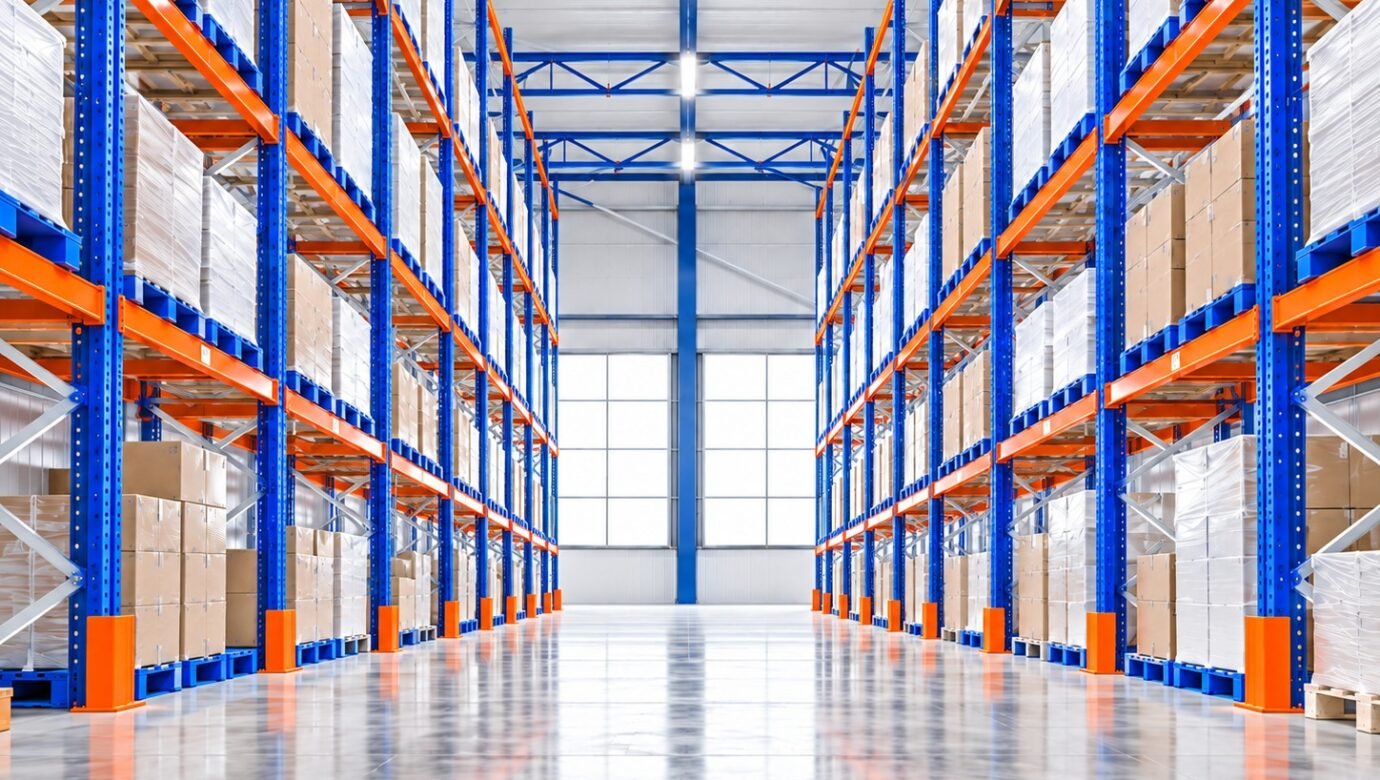
Warehouse racking consists of structural frames, beams and other components arranged to create storage levels above the warehouse floor.
In a typical pallet-racking installation, pallets rest on horizontal beams connected to vertical upright frames. Forklifts or other material-handling equipment place and retrieve pallets from the designated locations.
The basic objective is simple: store more inventory in an organized way while keeping goods accessible.
However, the exact configuration can vary significantly from one operation to another.
For example, a warehouse handling thousands of different products may require direct access to almost every pallet. Another facility storing large quantities of the same product may prioritize storage density instead.
Main Components of a Warehouse Racking System
Although designs differ, pallet-racking installations commonly include:
- Upright frames: Vertical structural sections that support the rack.
- Horizontal beams: Components that connect the frames and support pallet loads.
- Base plates and anchors: Components that help secure upright frames to the warehouse floor.
- Bracing: Structural elements positioned within frames to provide stability.
- Safety locks or beam connectors: Components designed to help keep beams correctly positioned.
- Rack protection: Guards or barriers installed in vulnerable areas to reduce damage from vehicle contact.
- Load signage: Information showing permitted loading conditions and capacities.
The specification of these components should match the intended loads and operating environment.
Why Do Warehouses Use Racking Systems?
One of the main reasons businesses install racking is to make better use of available cubic space.
Warehouses often have considerably more vertical space than usable floor area. A correctly planned storage system can use this height while creating defined locations for inventory.
Racking can also support more systematic inventory management.
Products can be assigned to specific bays, levels and locations, making it easier for warehouse teams and warehouse management systems to identify where stock is stored.
Other potential benefits include:
- Improved use of vertical warehouse space
- More organized inventory locations
- Easier pallet identification
- Support for different stock-rotation methods
- Better integration with forklifts and handling equipment
- Greater flexibility for different product categories
- More structured picking and replenishment processes
The actual benefit depends on selecting a layout that matches the warehouse operation.
What Are the Main Types of Warehouse Racking?
There is no single racking system that suits every warehouse. Different systems provide different balances between accessibility, storage density and operational speed.
Selective Pallet Racking
Selective pallet racking is one of the most widely recognized configurations.
Each pallet position can generally be accessed directly from an aisle. This makes the system suitable for warehouses carrying many different stock keeping units, or SKUs.
Its main advantage is accessibility.
However, because aisles are required between rack rows, selective racking may provide lower storage density than some high-density systems.
Drive-In Racking
Drive-in racking allows a forklift to travel inside designated rack lanes to place or retrieve pallets.
It can reduce the number of aisles required and increase storage density.
This configuration is often considered where significant quantities of similar products are stored. Inventory rotation and forklift movements need careful consideration because pallet accessibility differs from selective racking.
Double-Deep Pallet Racking
Double-deep racking stores pallets two positions deep rather than one.
The configuration can increase storage density by reducing the number of aisles needed. However, rear pallets are not directly accessible when another pallet occupies the front position.
Specialized handling equipment may also be required.
Very Narrow Aisle Racking
Very narrow aisle, or VNA, systems reduce aisle width to increase the amount of warehouse floor area available for storage.
They may be used in high-density and high-bay applications.
Because the operating clearances are smaller, VNA facilities generally require equipment designed specifically for narrow-aisle operation and carefully planned traffic movements.
Pallet Flow Racking
Pallet flow systems use inclined tracks or rollers that allow pallets to move from the loading side toward the picking side.
They are commonly associated with first-in, first-out inventory movement.
Such systems may be useful for products where stock rotation is particularly important.
Push-Back Racking
Push-back systems allow several pallets to be stored within the depth of a rack lane.
When a new pallet is placed into the system, previously loaded pallets move farther into the lane. As the front pallet is removed, those behind it move toward the picking position.
The system can provide higher density while maintaining aisle-side loading and retrieval.
How Is the Right Warehouse Racking System Selected?
Choosing warehouse racking should begin with operational requirements rather than with the rack itself.
Important factors include the physical characteristics of the inventory, pallet dimensions, stock movement and available building space.
Product and Pallet Characteristics
Warehouse planners should understand:
- Pallet dimensions
- Maximum pallet weight
- Product dimensions
- Number of SKUs
- Pallets held per SKU
- Product turnover
- Storage duration
- Any special handling requirements
These factors influence rack dimensions, beam levels and loading requirements.
Warehouse Height and Floor Area
The dimensions of the building determine how much storage capacity can potentially be created.
Available clear height, columns, doors, fire-protection infrastructure, lighting and other building services can influence the final design.
Floor conditions and structural limitations may also require technical assessment.
Forklift and Aisle Requirements
A warehouse layout cannot be planned independently of the equipment operating within it.
Forklifts need adequate space to travel, turn and place loads safely.
The US Occupational Safety and Health Administration states that where mechanical handling equipment is used, safe clearances should be provided in aisles, loading docks, doorways and areas where vehicles turn or pass.
Therefore, reducing aisle width solely to gain additional pallet positions may create operational problems if the handling equipment cannot work effectively within that space.
Warehouse Racking Safety Considerations
Warehouse racking carries substantial loads, so inspection and proper use are important parts of warehouse management.
OSHA advises warehouses to inspect and maintain shelving and racking, avoid exceeding rack load capacities and isolate areas where damage creates a safety concern.
Avoid Overloading
Every storage system should operate within its engineered capacity.
Increasing pallet weight or changing storage configurations without checking the rack specification can alter the forces acting on the structure.
Clear load information can help operators understand the permitted conditions for each installation.
Watch for Forklift Damage
Forklift impact is a common risk around warehouse racks.
Uprights positioned close to busy aisles or turning areas can be vulnerable to accidental contact.
Where damage is found, affected areas should be assessed rather than assuming that a bent or damaged component remains safe.
Keep Loads Stable
Stored products must remain stable and secure.
OSHA requirements state that storage of materials should not create a hazard and that stored items should be arranged to remain secure against sliding or collapse.
Load placement, pallet condition and weight distribution can therefore be just as important as the rack structure itself.
Inspect Racking Regularly
Warehouse conditions change over time.
Forklift impacts, altered pallet loads, damaged components or changes to the original configuration can affect a storage system.
Regular visual inspections can help identify issues such as:
- Bent uprights
- Damaged beams
- Missing safety locks
- Loose or damaged components
- Rack movement
- Damaged pallet supports
- Impact damage around aisle-facing uprights
Significant structural concerns should be assessed by appropriately qualified professionals.
Warehouse Racking vs Shelving: What Is the Difference?
Warehouse racking and warehouse shelving are related storage solutions, but they are generally designed for different types of loads.
Pallet racking is primarily intended for palletized goods that are placed and retrieved with forklifts or similar equipment.
Shelving is more commonly associated with smaller products that workers can access manually.
A distribution centre may use both systems.
For example, reserve stock may remain on pallet racks while individual products are picked from shelving or dedicated order-picking areas.
How Warehouse Racking Affects Warehouse Efficiency
Racking layout can influence almost every stage of warehouse movement.
A poorly arranged storage system may create unnecessary forklift travel, congestion or difficult picking routes.
By contrast, a layout based on inventory movement can position frequently handled products closer to relevant receiving, picking or dispatch areas.
Warehouse planning therefore involves more than calculating the maximum number of pallet positions.
Businesses must consider the relationship between:
- Storage capacity
- Product accessibility
- Travel distance
- Picking frequency
- Replenishment
- Forklift movement
- Loading and dispatch
- Future inventory requirements
The most space-efficient design on paper may not always be the most operationally efficient design.
Can Warehouse Racking Be Reconfigured?
Many industrial racking systems are modular, meaning beam levels and certain components can be adjusted as storage requirements change.
However, modifications should not be treated as simple cosmetic changes.
Moving beam levels, changing pallet weights or altering a rack configuration can affect structural loading.
Any significant modification should therefore be reviewed against the system manufacturer’s requirements and applicable engineering or safety standards.
Key Takeaways
Warehouse racking provides a structured method for storing pallets and goods while making better use of warehouse height and floor space.
Several systems are available, including selective, drive-in, double-deep, very narrow aisle, pallet flow and push-back racking.
The appropriate system depends on inventory characteristics, pallet weights, stock rotation, forklift requirements, building dimensions and operational priorities.
Most importantly, warehouse capacity should not be considered separately from safety and movement.
Effective warehouse planning balances storage density with accessibility, material flow and safe operating conditions.
FAQs
What is warehouse racking?
Warehouse racking is a structural storage system used to organize pallets, goods and materials inside warehouses. It typically uses vertical frames and horizontal beams to create multiple storage levels. This allows businesses to use vertical space while providing organized locations from which forklifts or other equipment can store and retrieve inventory.
What are the most common types of warehouse racking?
Common warehouse racking systems include selective pallet racking, drive-in racking, double-deep racking, very narrow aisle racking, pallet flow and push-back systems. Each provides a different balance between storage density and pallet accessibility, so the appropriate choice depends on inventory volumes, stock rotation and warehouse operating requirements.
How much weight can warehouse racking hold?
Warehouse racking capacity varies according to the rack design, beam length, upright specification, configuration and load distribution. There is no universal weight capacity for all racks. Businesses should follow the load limits specified for the particular system and should not increase pallet weights without checking whether the existing installation can accommodate them safely.
What is the difference between pallet racking and shelving?
Pallet racking is generally designed for palletized loads that are moved using forklifts or other mechanical handling equipment. Shelving usually holds smaller products that workers can access manually. Many warehouses use both, with pallet racks supporting bulk or reserve inventory and shelving supporting smaller-item picking and order fulfilment operations.
How do you choose the right warehouse racking system?
Choosing warehouse racking requires an assessment of pallet dimensions, load weights, SKU quantities, stock turnover, warehouse height, available floor space and forklift requirements. Businesses should also consider future inventory growth, picking patterns and safety requirements. The goal is to balance storage capacity with practical access and efficient material movement.
