
What Is the Meaning of Racking?
The meaning of racking refers to the use of structured storage frameworks designed to hold, organize, and manage goods, materials, or products efficiently. In industrial and commercial settings, racking systems are an essential part of warehouse operations, helping businesses maximize available space while improving inventory accessibility.
The term “racking” can also describe the process of placing goods onto these storage structures. Across logistics, manufacturing, retail, and distribution industries, racking has become a fundamental component of modern supply chain management.
Understanding the Meaning of Racking
Racking is a storage method that uses engineered frames, beams, and shelves to create vertical storage capacity. Rather than storing products directly on the floor, businesses use racking systems to stack inventory safely and systematically.
The concept supports several operational goals:
- Better use of warehouse height
- Faster inventory retrieval
- Improved workplace safety
- More efficient stock management
- Reduced floor congestion
According to supply chain management practices widely adopted across the logistics sector, effective warehouse layout planning often begins with selecting the right racking solution.
Why the Term “Racking” Is Important
In warehouse management, the word “racking” refers not only to the physical equipment but also to the overall storage strategy. A well-designed racking system helps businesses maintain order while supporting inventory tracking technologies such as barcode scanning and warehouse management systems (WMS).
As global e-commerce and distribution networks continue to expand, the demand for organized storage infrastructure has increased across industries.
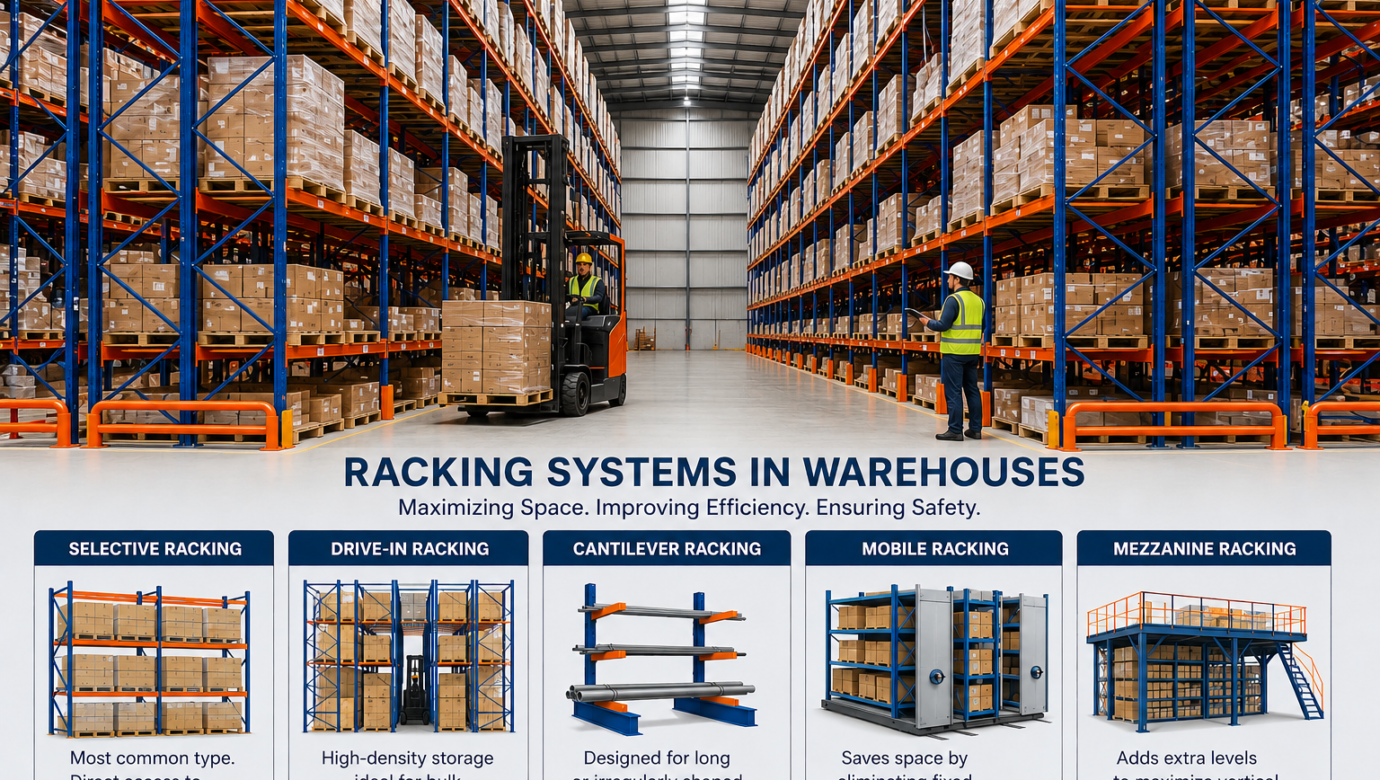
Types of Racking Systems
Selective Pallet Racking
Selective pallet racking is one of the most common warehouse storage systems. It provides direct access to every pallet, making it suitable for operations with diverse inventory.
Key characteristics:
- Easy pallet access
- Compatible with standard forklifts
- Flexible storage arrangement
- Common in retail and logistics warehouses
Drive-In Racking
Drive-in racking allows forklifts to enter the storage lanes, enabling high-density storage.
It is commonly used for:
- Bulk inventory
- Cold storage facilities
- Products with lower stock rotation
Cantilever Racking
Cantilever systems are designed for long or irregularly shaped products.
Typical applications include:
- Steel pipes
- Timber
- Furniture components
- Construction materials
Mobile Racking
Mobile racking systems operate on guided tracks, allowing aisles to open only when needed. This design significantly increases storage capacity within limited warehouse space.
Mezzanine Racking
A mezzanine storage solution adds an additional floor level inside a warehouse, creating more usable storage without expanding the building footprint.
How Racking Improves Warehouse Efficiency
Better Space Utilization
One of the primary advantages of racking is vertical storage. Warehouses can use building height rather than expanding horizontally, reducing the amount of unused space.
Faster Inventory Management
Clearly organized storage locations help employees locate products quickly. This reduces picking times and improves order fulfillment speed.
Enhanced Workplace Safety
Modern racking systems are designed to support heavy loads while maintaining structural stability. Regular inspections and compliance with safety standards help reduce workplace accidents.
Support for Automated Warehousing
Many modern warehouses integrate racking systems with automated storage and retrieval systems (AS/RS), robotics, and digital inventory management software.
Industries That Commonly Use Racking
The meaning of racking extends beyond traditional warehouses. Many industries rely on specialized storage systems.
Logistics and Distribution
Distribution centers use pallet racking to handle large volumes of incoming and outgoing goods efficiently.
Retail
Retail stockrooms and fulfillment centers organize products using shelving and racking structures to simplify replenishment.
Manufacturing
Factories use industrial racking to store raw materials, components, and finished products.
Cold Storage
Temperature-controlled facilities often use drive-in or mobile racking systems to maximize available refrigerated space.
Automotive
Automotive businesses store spare parts, tires, and heavy components using specialized racking solutions.
Materials Used in Racking Systems
Most industrial racking systems are manufactured from high-strength steel due to its durability and load-bearing capabilities.
Common components include:
- Upright frames
- Horizontal beams
- Decking panels
- Bracing systems
- Safety locks and protectors
Some light-duty storage applications may also use aluminum or reinforced shelving materials.
Factors to Consider When Choosing a Racking System
Selecting the appropriate storage solution depends on several operational requirements.
Inventory Type
The size, weight, and dimensions of products influence the choice of racking design.
Warehouse Layout
Ceiling height, aisle width, and forklift access determine how effectively a racking system can be installed.
Stock Rotation Method
Businesses often choose between:
- FIFO (First In, First Out)
- LIFO (Last In, First Out)
Different racking systems support different inventory management methods.
Future Scalability
Warehouses experiencing business growth often prioritize modular racking systems that can be expanded over time.
Safety Standards and Maintenance
Warehouse safety authorities and industry organizations recommend regular inspection and maintenance of racking installations.
Best practices include:
- Checking for damaged beams or frames
- Avoiding overloading
- Installing rack protectors
- Training forklift operators
- Performing scheduled safety audits
Routine maintenance helps preserve structural integrity and operational reliability.
Meaning of Racking in Modern Supply Chains
As supply chains become increasingly data-driven, racking systems play a larger role in inventory visibility and operational efficiency. They provide the physical framework that supports advanced warehouse technologies, including automation and real-time stock tracking.
Businesses across logistics, manufacturing, healthcare, and retail sectors continue to invest in optimized storage solutions to improve productivity and accommodate growing inventory demands.
Key Takeaways
- The meaning of racking refers to structured storage systems used to organize goods efficiently.
- Racking helps maximize warehouse space through vertical storage.
- Several types exist, including selective, drive-in, cantilever, mobile, and mezzanine racking.
- Proper racking improves inventory management, workplace safety, and operational efficiency.
- Modern supply chains increasingly rely on well-designed racking systems to support automation and logistics operations.
FAQs
What is the basic meaning of racking?
Racking refers to a storage system made of frames, beams, and shelves used to organize products or materials. It is commonly used in warehouses and industrial facilities to maximize space and improve inventory management through structured storage.
What are racking systems used for?
Racking systems are used to store goods safely while making them easily accessible for handling and distribution. They help businesses improve warehouse organization, optimize floor space, and support efficient stock movement.
What is the difference between racking and shelving?
Racking is generally designed for heavier loads and palletized goods, often requiring forklifts for access. Shelving systems are typically intended for lighter items that can be manually picked by workers.
Why is racking important in warehouses?
Racking allows warehouses to use vertical storage space effectively, reducing clutter and improving operational efficiency. Organized storage also helps speed up inventory retrieval and supports safer working environments.
What are the main types of warehouse racking?
The most common warehouse racking types include selective pallet racking, drive-in racking, cantilever racking, mobile racking, and mezzanine systems. Each type is designed to meet different storage requirements based on inventory characteristics and warehouse layouts.
