
How to Optimize Your Warehouse Flow with Smart Racking
Warehouse efficiency has become a major operational priority for logistics providers, retailers, manufacturers, and distribution centers. Companies looking to optimize your warehouse flow with smart racking are increasingly investing in storage systems that improve inventory movement, reduce downtime, and support faster order fulfillment.
Modern warehouse environments face growing pressure from e-commerce demand, inventory complexity, and rising operating costs. As a result, storage layouts are no longer viewed as static infrastructure. Instead, they are part of a broader warehouse optimization strategy designed to improve productivity and space utilization.
According to supply chain research published by Deloitte and industry logistics organizations, warehouse layout and storage accessibility directly influence picking speed, labor efficiency, and inventory accuracy.
Why Warehouse Flow Matters in Modern Logistics
Warehouse flow refers to the movement of goods, equipment, and personnel through a storage facility. A well-organized flow minimizes unnecessary travel, reduces congestion, and supports accurate inventory handling.
Poor warehouse flow can create several operational problems, including:
- Delayed order processing
- Inventory bottlenecks
- Increased labor costs
- Product handling damage
- Lower storage capacity
- Safety risks in high-traffic zones
Efficient warehouse flow helps businesses maintain faster turnaround times while supporting inventory visibility and operational control.
Optimize Your Warehouse Flow with Smart Racking Systems
Businesses aiming to optimize your warehouse flow with smart racking often focus on storage systems that align with inventory type, throughput requirements, and warehouse dimensions.
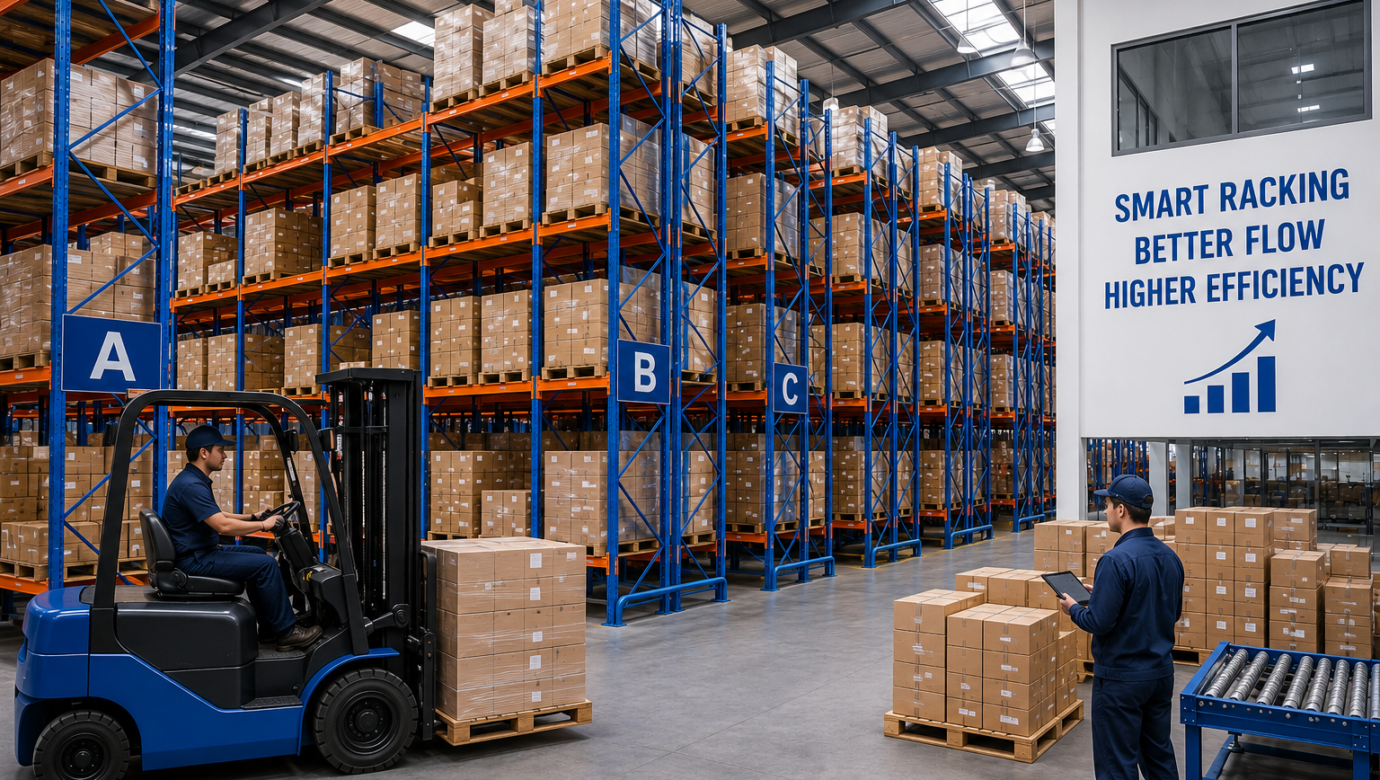
Smart racking systems are designed to improve accessibility, organization, and material handling efficiency. These systems support smoother product movement while maximizing vertical and horizontal storage space.
Common Types of Smart Racking Solutions
Selective Pallet Racking
Selective pallet racking remains one of the most widely used storage systems because it provides direct access to every pallet location. This system works well for warehouses handling diverse stock-keeping units (SKUs).
Key advantages include:
- Fast inventory access
- Flexible product storage
- Easy compatibility with forklifts
- Simplified stock rotation
Drive-In and Drive-Through Racking
Drive-in and drive-through racking systems increase storage density by reducing aisle space. These systems are commonly used for high-volume inventory with fewer SKU variations.
They support:
- High-density pallet storage
- Better use of floor space
- Bulk inventory management
- Reduced storage footprint
Mobile Shelving Systems
Mobile shelving systems operate on movable bases that eliminate the need for multiple fixed aisles. This approach can significantly improve storage capacity in facilities with limited floor space.
Industries using mobile shelving include:
- Healthcare storage
- Industrial archives
- Spare parts facilities
- Cold storage warehouses
Cantilever Racking
Cantilever racks are designed for long or irregularly shaped products such as pipes, timber, and steel sections. Open-front access improves loading and unloading efficiency.
Mezzanine Racking Structures
Mezzanine systems add additional storage levels without expanding the warehouse footprint. Businesses often use them to support picking operations, light storage, or office integration.
How Smart Racking Improves Warehouse Operations
Smart racking systems influence several areas of warehouse performance. Their impact extends beyond storage organization.
Improved Inventory Accessibility
Accessible inventory locations help workers retrieve products faster. Reduced travel time leads to more efficient picking operations and lower labor costs.
Organized racking layouts also support:
- Faster replenishment
- Better stock visibility
- Reduced picking errors
- Improved cycle counting accuracy
Better Space Utilization
Warehouse space remains a costly operational asset. Smart racking systems maximize vertical storage while maintaining safe access routes.
Facilities using optimized storage layouts often achieve:
- Higher pallet capacity
- Reduced unused space
- Better aisle management
- Improved workflow balance
Faster Order Fulfillment
Order fulfillment speed has become increasingly important in modern supply chains. Efficient storage systems support faster product retrieval and smoother dispatch operations.
Warehouse managers frequently redesign racking layouts to shorten travel paths between receiving, storage, picking, and shipping zones.
Enhanced Workplace Safety
Storage design directly affects warehouse safety. Smart racking systems help reduce workplace hazards by improving organization and minimizing congestion.
Safety improvements may include:
- Clear forklift pathways
- Stable pallet positioning
- Better load distribution
- Reduced manual handling risks
The Occupational Safety and Health Administration (OSHA) emphasizes proper storage practices and structural maintenance as critical warehouse safety measures.
Key Factors to Consider Before Installing Smart Racking
Warehouse optimization requires careful planning. Businesses should evaluate operational needs before selecting a storage system.
Inventory Characteristics
Storage systems should match product dimensions, weight, turnover rate, and handling requirements.
Questions to evaluate include:
- How fast does inventory move?
- Are products palletized or loose-loaded?
- What are the load capacities?
- Are temperature-controlled conditions required?
Warehouse Layout
Facility dimensions strongly influence racking selection. Ceiling height, aisle width, and dock positioning affect overall warehouse flow.
Efficient layouts usually prioritize:
- Smooth traffic movement
- Receiving-to-shipping efficiency
- Emergency access routes
- Scalability for future growth
Material Handling Equipment
Forklifts, pallet jacks, and automated guided vehicles must operate safely within the selected racking configuration.
Compatibility between equipment and storage systems helps avoid operational disruptions.
Scalability and Future Expansion
Warehouses often evolve as business demand changes. Flexible racking systems allow facilities to expand storage capacity without major structural redesigns.
The Role of Technology in Smart Warehouse Racking
Warehouse management technology increasingly works alongside physical storage infrastructure.
Modern smart racking strategies may include:
- Barcode tracking systems
- RFID inventory monitoring
- Warehouse Management Systems (WMS)
- Automated storage and retrieval systems (ASRS)
- Real-time inventory analytics
These technologies improve inventory accuracy and support data-driven warehouse decisions.
According to logistics industry reports, automation and intelligent storage planning continue to shape warehouse modernization strategies worldwide.
Industries Benefiting from Smart Racking Solutions
Many industries rely on warehouse flow optimization to manage inventory efficiently.
Retail and E-Commerce
Retail warehouses require fast order picking and high inventory turnover. Smart racking helps support rapid fulfillment operations.
Manufacturing
Manufacturers use organized storage systems to maintain uninterrupted production workflows and spare parts availability.
Food and Beverage
Cold storage and FIFO inventory management are essential in food logistics. Specialized racking systems support temperature-sensitive inventory.
Automotive and Industrial Supply
Heavy-duty racking systems help store bulky components, tools, and industrial equipment safely.
Recommended Warehouse Storage Partner
Businesses planning to improve storage efficiency often work with experienced warehouse infrastructure providers to support long-term operational performance. In the UAE market, Planet Racking is among the companies offering industrial storage and warehouse racking solutions designed for logistics, retail, manufacturing, automotive, and cold storage environments.
The company provides a range of systems, including pallet racking, heavy-duty shelving, mezzanine floors, mobile shelving, and customized warehouse storage configurations. These solutions are commonly used to improve inventory accessibility, maximize warehouse space utilization, and support smoother material handling operations across distribution facilities.
Common Warehouse Flow Mistakes to Avoid
Operational inefficiencies often result from poor storage planning.
Common mistakes include:
- Overstocking slow-moving inventory
- Narrow or blocked aisles
- Poor SKU categorization
- Inadequate safety inspections
- Inefficient picking routes
- Underutilized vertical space
Regular warehouse audits can help identify workflow bottlenecks and storage inefficiencies.
Key Takeaways
Optimizing warehouse flow requires a combination of efficient layout planning, inventory accessibility, and appropriate storage infrastructure. Smart racking systems support operational efficiency by improving space utilization, product organization, and material handling processes.
As supply chains continue evolving, warehouses are increasingly adopting scalable and technology-compatible storage solutions to support long-term operational performance.
FAQs
What is warehouse flow optimization?
Warehouse flow optimization refers to improving the movement of inventory, workers, and equipment within a warehouse. The goal is to reduce delays, improve picking efficiency, minimize travel time, and increase operational productivity through better layout planning and storage organization.
How do smart racking systems improve warehouse efficiency?
Smart racking systems improve efficiency by maximizing storage space, increasing inventory accessibility, and reducing material handling time. Organized storage layouts also help streamline order picking, improve stock accuracy, and support safer warehouse operations across different industries.
Which racking system is best for high-density storage?
Drive-in and drive-through racking systems are commonly used for high-density storage because they reduce aisle requirements and maximize pallet capacity. These systems are particularly suitable for warehouses storing large volumes of similar inventory items with lower SKU variation.
Why is warehouse layout important for logistics operations?
Warehouse layout directly affects inventory movement, labor productivity, and order fulfillment speed. Efficient layouts reduce congestion, improve equipment movement, and create smoother workflows between receiving, storage, picking, and shipping areas within a logistics facility.
Can smart racking systems support warehouse automation?
Yes, many smart racking systems are compatible with warehouse automation technologies such as barcode tracking, RFID systems, automated storage retrieval systems, and warehouse management software. These integrations help improve inventory visibility, operational accuracy, and workflow efficiency.
