
Slotted Angle Shelving vs Steel Shelving: Key Differences
Choosing the right storage system can affect how efficiently a warehouse, workshop, office, or stockroom uses its available space. Slotted angle shelving vs steel shelving is a common comparison because both systems provide organised storage while offering different approaches to construction, adjustment, load handling, and installation.
Although both shelving types use steel components, their designs and typical applications can differ. Understanding these differences helps businesses select a shelving solution based on the type of items stored, available space, expected loads, and future storage requirements.
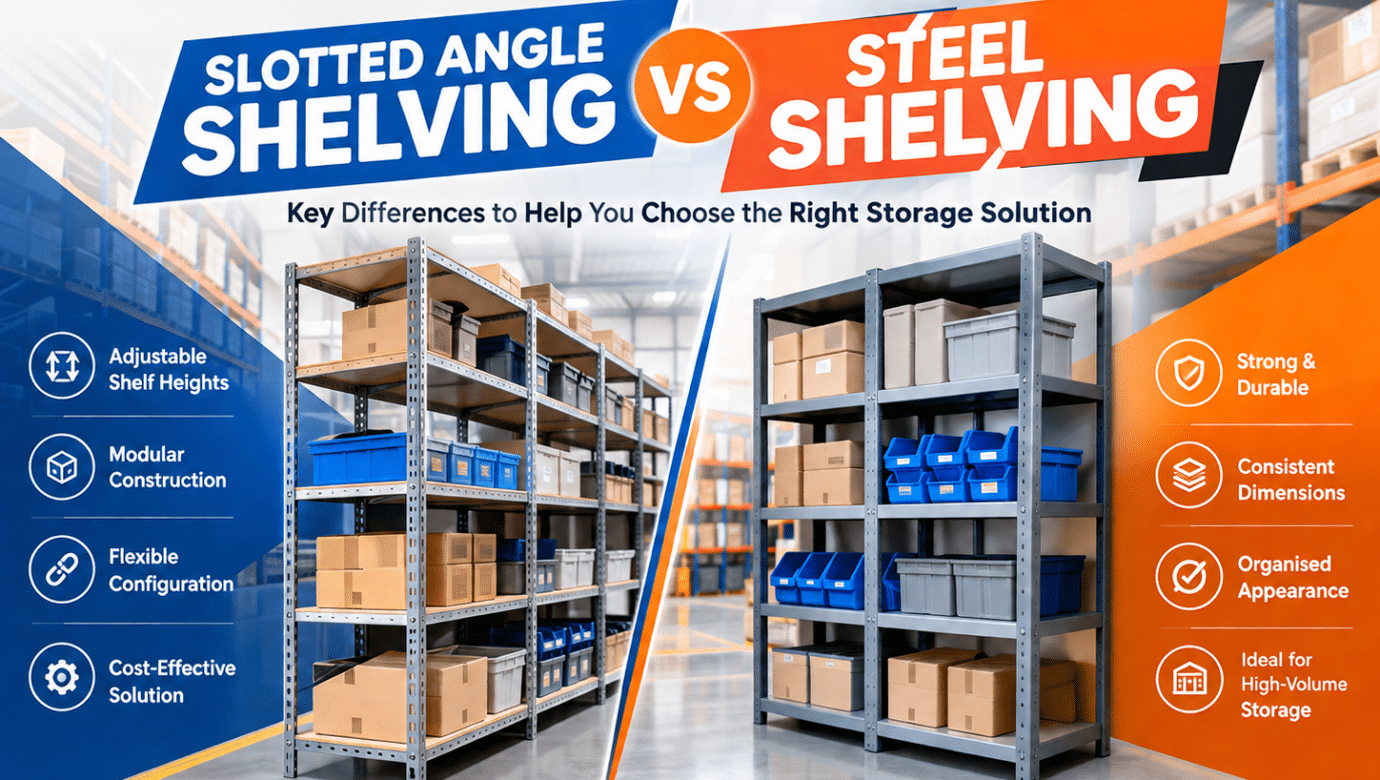
Slotted Angle Shelving vs Steel Shelving: What Is the Difference?
The main difference between slotted angle shelving and steel shelving is their construction and configuration.
Slotted angle shelving is built using perforated or slotted angle sections connected with shelves and fasteners. The pre-punched holes allow components to be adjusted and assembled into different configurations.
Steel shelving, meanwhile, generally uses formed steel panels, uprights, brackets, shelves, and other structural components designed as a complete shelving system. It can provide a more rigid and finished storage arrangement.
Both systems can be used for storing boxes, documents, spare parts, tools, components, and other products. However, their suitability depends on the specific storage environment.
How Slotted Angle Shelving Works
Slotted angle shelving uses vertical angle posts with regularly spaced slots or holes. Horizontal members and shelves are connected to these posts to create individual storage levels.
One of its main characteristics is adjustability. Shelf levels can often be changed according to the dimensions of the stored items.
Common characteristics
- Adjustable shelf heights
- Modular construction
- Relatively straightforward assembly
- Flexible configurations
- Suitable for light- and medium-duty storage applications
- Useful for workshops, stockrooms, archives, and general storage areas
The modular design can also make it easier to modify a shelving layout when storage requirements change.
How Steel Shelving Works
Steel shelving uses manufactured steel components designed to create a stable shelving structure. Depending on the system, shelves may be adjustable and can be configured at different heights.
Steel shelving is commonly selected where businesses require an organised and durable storage system with a more finished appearance.
Typical characteristics
- Steel construction
- Adjustable storage levels in many systems
- Consistent shelf dimensions
- Structured installation
- Suitable for organised stockrooms and storage areas
- Available in different sizes and load capacities
The exact capacity and configuration depend on the design, dimensions, materials, and manufacturer specifications.
Key Differences Between the Two Systems
The following factors are useful when comparing the two shelving options.
1. Construction
Slotted angle shelving uses slotted angle sections as its primary structural framework. This makes the system modular and adaptable.
Steel shelving generally uses formed or engineered steel components that create a more integrated shelving structure.
2. Flexibility
Slotted angle shelving is known for its flexible construction. Components can be assembled into different dimensions and configurations.
Steel shelving can also offer adjustable shelf levels, but the degree of modification depends on the particular system.
3. Load Requirements
Load capacity is an important consideration for any storage system.
Neither shelving type has one universal load rating. Capacity depends on factors such as shelf dimensions, steel thickness, support configuration, span, and installation.
For heavier products, the specified safe working load should always be checked before selecting a system.
4. Installation
Slotted angle shelving can be assembled from individual components using suitable fasteners. Its modular construction can be useful where storage layouts need to be adapted.
Steel shelving may use specific connection mechanisms or components depending on the design. Installation requirements should therefore be assessed before purchase.
5. Appearance
Slotted angle shelving has a functional, industrial appearance because its angle sections remain visible within the framework.
Steel shelving can provide a more uniform and finished appearance, particularly in organised stockrooms, offices, archives, and commercial environments.
6. Storage Applications
Slotted angle shelving is often considered for:
- Workshops
- Small warehouses
- Stockrooms
- Garages
- Archives
- Spare-parts storage
- Maintenance areas
Steel shelving can be suitable for:
- Warehouses
- Retail backrooms
- Offices
- Archives
- Parts storage
- Industrial stockrooms
- General-purpose storage areas
Which Shelving System Is More Suitable?
There is no single answer for every application. The right choice depends on the storage requirements.
Slotted angle shelving may be suitable when:
- The layout needs flexibility.
- Shelf heights may change frequently.
- The storage area requires modular construction.
- Items are relatively light or medium in weight.
- A practical industrial storage solution is preferred.
Steel shelving may be suitable when:
- A structured shelving system is required.
- Consistent shelf dimensions are important.
- The storage area needs a more finished appearance.
- The application requires specific shelf capacities.
- Organised stockroom or warehouse storage is the priority.
The actual load rating, dimensions, and configuration should always be verified against the manufacturer’s specifications.
Factors to Consider Before Choosing
Businesses comparing shelving systems should look beyond the initial purchase price.
Storage Load
Determine the weight of the products that each shelf must support. The expected load should be compared with the system’s rated capacity.
Product Dimensions
Measure the height, width, depth, and weight of the products. Adjustable shelving can be particularly useful when product dimensions vary.
Available Floor Space
Consider the available floor area and ceiling height. A properly planned shelving layout can improve the use of vertical space without obstructing access routes.
Accessibility
Think about how frequently items need to be retrieved. Shelving should allow workers to access products safely and efficiently.
Future Requirements
Storage needs can change as inventory increases or product ranges expand. A modular system may provide additional flexibility where future changes are expected.
Key Takeaways
Slotted angle shelving and steel shelving can both provide practical storage for warehouses, workshops, stockrooms, and other facilities. However, they differ in construction, flexibility, appearance, installation, and potential applications.
Slotted angle shelving can be advantageous where modularity and adjustability are important. Steel shelving can be appropriate where businesses need a structured, durable shelving arrangement with defined specifications.
The most suitable system should be selected based on load capacity, product dimensions, available space, accessibility, and future storage requirements rather than appearance or price alone.
FAQs
What is slotted angle shelving used for?
Slotted angle shelving is commonly used for organised storage in workshops, stockrooms, archives, garages, and general warehouse areas. Its modular construction allows shelf levels and configurations to be adjusted according to storage requirements. It can be useful for applications involving light- to medium-duty items, subject to the system’s specified load capacity.
Is steel shelving stronger than slotted angle shelving?
Strength depends on the specific design, steel thickness, dimensions, support arrangement, and rated capacity. Neither term represents one standard load rating. When comparing systems, businesses should review the manufacturer’s stated safe working load and select shelving that is appropriate for the weight and dimensions of the stored products.
Can slotted angle shelving be adjusted?
Yes. Slotted angle shelving is designed around slotted vertical angle sections, allowing shelves and structural components to be positioned at different levels. This makes the system adaptable to products with different heights. The exact adjustment method depends on the design and components used in the shelving system.
Which shelving is better for a warehouse?
The better option depends on the warehouse’s storage requirements. Slotted angle shelving can work well for flexible light- or medium-duty storage, while steel shelving may be preferred for structured stockrooms and applications with defined capacity requirements. Product weight, dimensions, access requirements, and available space should guide the selection.
What should be considered when choosing warehouse shelving?
Important considerations include the weight and dimensions of stored products, shelf capacity, available floor and vertical space, accessibility, aisle requirements, installation conditions, and future storage needs. Businesses should also check the manufacturer’s specifications to ensure that the selected shelving system is suitable for the intended application.
