
Drive-In Racking in Dubai: Cost, Density & When It’s Worth It
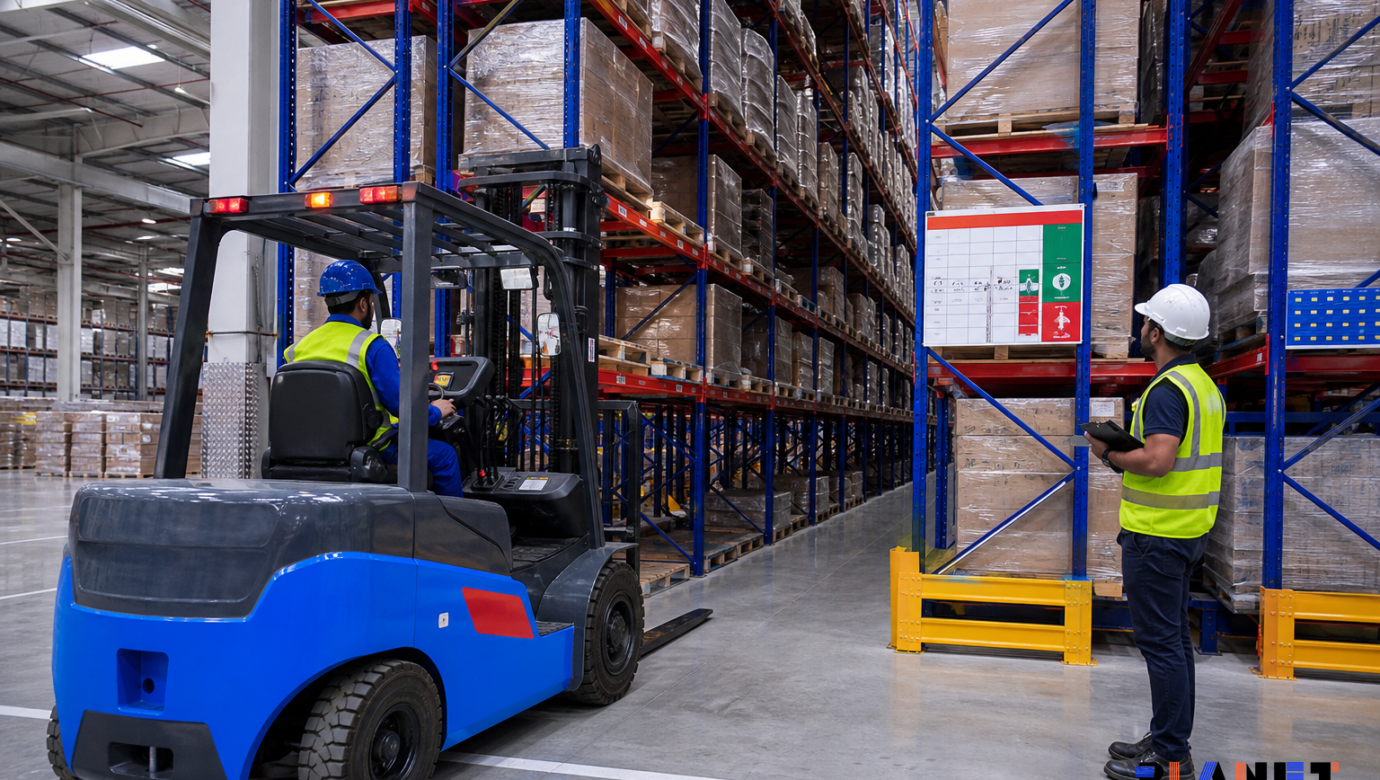
Drive-in racking systems in Dubai deliver high-density storage by eliminating aisle space, allowing forklifts to drive directly into the racking lanes to deposit and retrieve pallets on continuous rails. Designed for Last-In, First-Out (LIFO) inventory management, drive-in racking increases storage density by 60% to 80% compared to standard selective pallet racking. For UAE importers, FMCG distributors, and cold storage operators facing high industrial real estate costs in areas like JAFZA and Dubai South, drive-in racking lowers the long-term cost per pallet position by maximizing vertical and floor space usage.
What Is Drive-In Racking and How Does It Work?
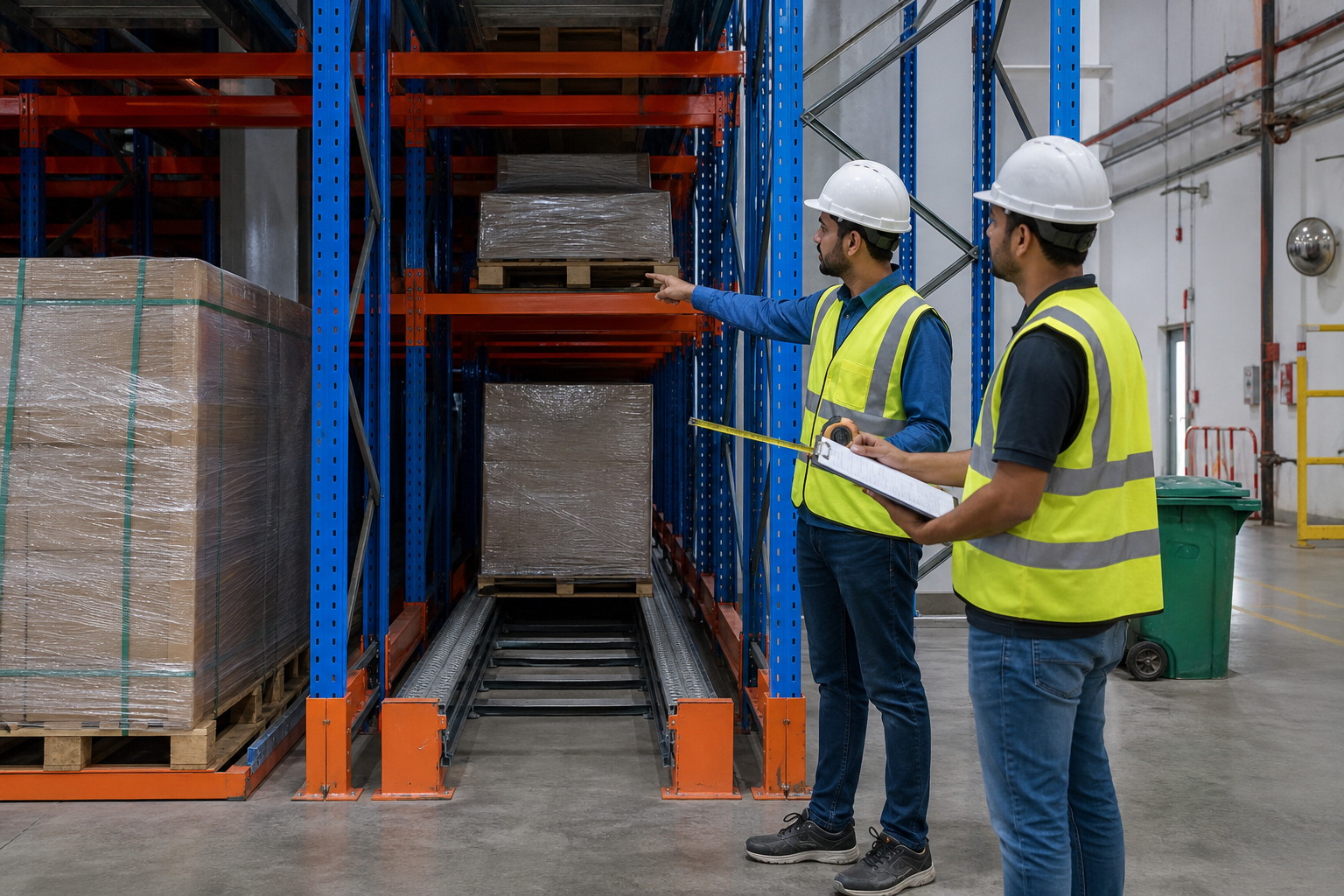
Drive-in racking is a continuous block storage configuration that eliminates access aisles between individual rows of racking. Forklifts enter the structure itself from one side to stack or retrieve pallets placed on heavy-duty cantilevered rails. Because access is from a single side, the system operates on a Last-In, First-Out (LIFO) inventory control principle.
Unlike standard selective pallet racking, where every pallet position is instantly accessible from an adjacent aisle, drive-in pallet racking sacrifices individual selectivity to achieve maximum volumetric efficiency. For warehouses dealing with high volumes of uniform SKUs, this high-density storage structure transforms underutilized overhead volume into revenue-generating storage space. Understanding the structural differences among core types of racking systems for modern warehouses helps operations managers determine if single-entry drive-in or dual-entry drive-through configurations fit their material handling equipment.
Drive-In Racking Systems Dubai Cost Efficiency: The Real Cost Drivers
Assessing the cost efficiency of drive-in racking in Dubai requires looking beyond the initial capital expenditure for steel components. While heavy duty racking components for drive-in systems carry a higher upfront hardware cost per square meter than selective racking due to specialized top-bracing and robust uprights, the overall operational economics favor drive-in systems in high-cost logistics zones.
The primary cost drivers for drive-in racking in the UAE market include:
- Initial Material and Engineering Costs: Drive-in structures require thicker steel gauges, custom anchor designs, and specialized guide rails to handle dynamic forklift forces within the lanes.
- Real Estate Savings: Dubai prime warehouse space commands high annual rental rates per square foot. Drive-in systems shrink the footprint needed for a given pallet volume, yielding immediate reduction in lease expenditures.
- Cooling Energy Costs: For chilled and frozen goods distributors, energy used to cool empty aisle space is pure operational loss. Drive-in racking concentrates inventory, lowering the cubic meter volume requiring active refrigeration.
How Much Storage Density Can You Gain vs. Standard Pallet Racking?
Transitioning from standard selective pallet racking to a drive-in system typically yields a 60% to 80% increase in overall storage density. Selective racking systems allocate up to 60% of total warehouse floor area to forklift aisles. Drive-in systems collapse those aisles into a single access corridor.
To quantify the density gain in a standard 2,000-square-meter Dubai facility:
- Selective Pallet Racking: Accommodates roughly 2,200 to 2,500 pallet positions with standard 3.5-meter counterbalanced forklift aisles. Floor space utilization averages 35% to 40%.
- Drive-In Pallet Racking: Accommodates 3,800 to 4,400 pallet positions within the exact same footprint by consolidating storage into deep lanes (typically 6 to 10 pallets deep and 4 to 6 levels high). Floor space utilization rises to 75% to 80%.
Most basic warehouse optimization advice suggests simply buying taller racks. In reality, vertical expansion without aisle consolidation yields diminishing returns. Drive-in racking solves both vertical and horizontal space inefficiency simultaneously.
When Drive-In Racking Is Worth It for UAE Importers and FMCG Distributors
Drive-in racking is not a universal solution; it excels under specific operational profiles common to the UAE supply chain landscape. It delivers maximum return on investment under the following operational conditions:
- Low SKU Diversity, High Pallet Volume: Importers holding 500 pallets of a single fast-moving beverage, bulk food ingredient, or uniform packaged item.
- Seasonal Goods Storage: Operations that aggregate large batches of inventory prior to peak retail periods and ship out whole lots.
- Cold Storage and Frozen Logistics: Facilities operating at sub-zero temperatures where square footage and electrical power carry premium costs.
Conversely, operations with high SKU variation, fast-rotating FIFO requirements, or partial pallet picking will experience severe “honeycombing”—where deep lanes remain under-utilized because older stock cannot be mixed with new arrivals. For such facilities, evaluating alternative configurations like double-deep racking or cantilever systems for long materials is necessary to avoid operational bottlenecks.
Hot, Humid Dubai Conditions: What They Mean for Rack Durability and Maintenance
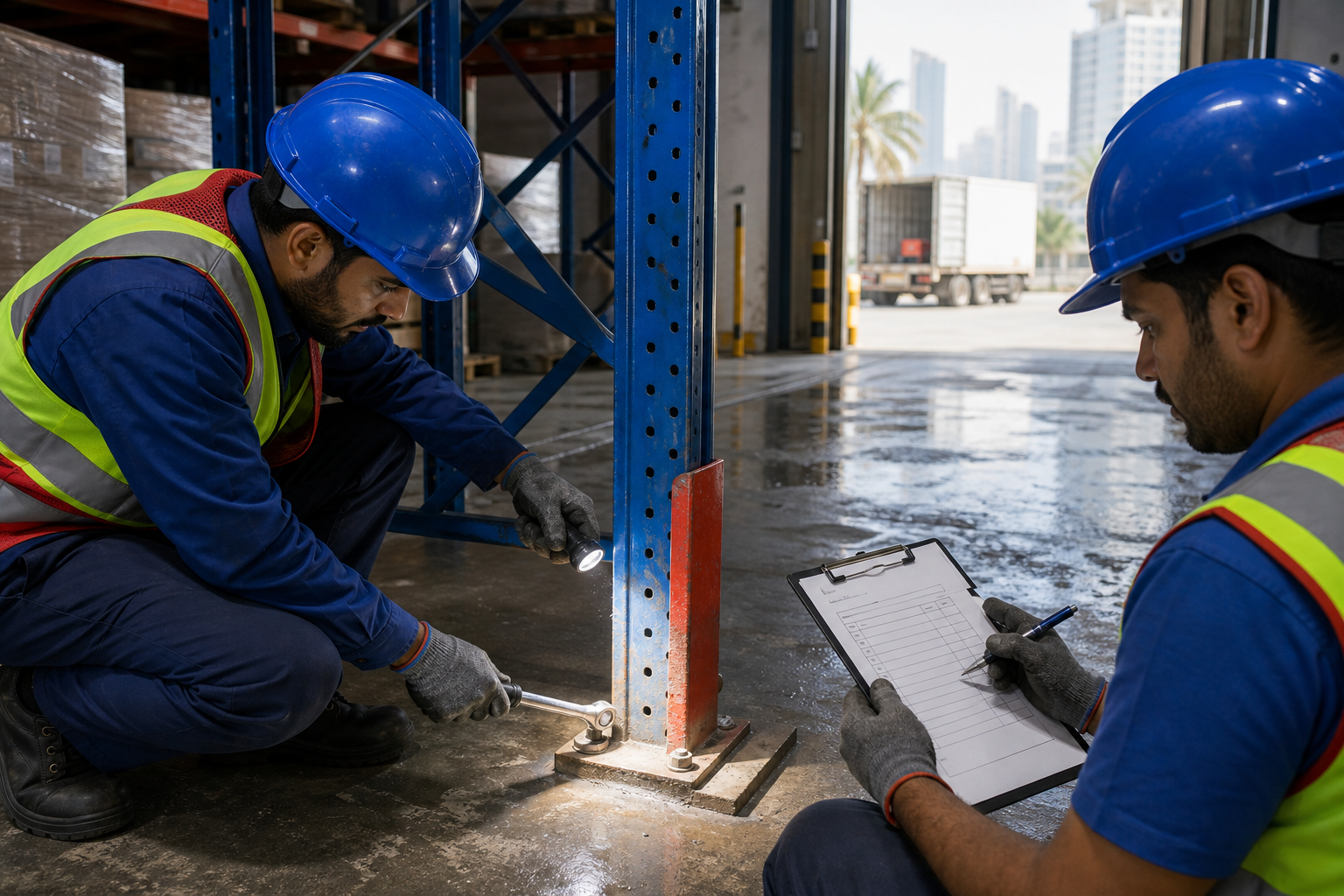
Operating industrial storage systems in the UAE presents environmental challenges. High ambient temperatures combined with coastal humidity in industrial zones like Jebel Ali can accelerate oxidation and structural stress, particularly in non-climate-controlled facilities or ambient dock transit areas.
Because forklifts enter directly inside the rack structure, physical impact rates are inherently higher in drive-in racking than in standard selective configurations. When high humidity meets scraped paint or compromised structural coatings, surface rust rapidly degrades structural integrity.
To ensure long-term durability in Dubai conditions, Planet Racking recommends:
- Heavy-Duty Floor Guide Rails: Installing continuous steel ground rails inside the lanes to keep forklifts precisely centered and protect upright frames from impact.
- Hot-Dip Galvanizing or High-Grade Powder Coating: Utilizing protective surface finishes that withstand thermal cycling and ambient humidity.
- Reinforced Upright Protectors: Fitting heavy-gauge steel column protectors at entry points where driver miscalculation is most likely to occur.
Total Cost of Ownership: Installation, Damage Risk, and Operating Efficiency
Calculating the true Total Cost of Ownership (TCO) over a 10-year period involves balancing structural investment against ongoing operational expense. Standard industry calculations often overlook driver travel times and rack maintenance costs.
The core components of drive-in racking TCO include:
- Capital Expenditure (CapEx): System design, high-spec steel components, freight, seismic/structural engineering, and professional installation compliant with UAE municipality codes.
- Operational Productivity (OpEx): Drive-in lanes require slower, more cautious forklift maneuvers. While travel distances are reduced, driving speed inside narrow lanes drops by roughly 20–30%, impacting hourly pallet throughput rates.
- Maintenance and Structural Repair: Budgeting annual funds for routine inspections, frame replacement, and anchor bolt torque checking. Plan on replacing 2% to 4% of entry-upright components over a 5-year lifecycle under normal heavy industrial use.
When factoring in Dubai land lease rates, the cost per pallet position in a drive-in layout typically amortizes to a lower cost per unit per month within 18 to 24 months of installation despite higher maintenance allowances.
Drive-In Racking vs. Other High-Density Options for Dubai Warehouses
Choosing the right high-density warehouse storage solutions in the UAE requires comparing drive-in systems directly against alternative high-density configurations.
| Racking Type | Density Gain vs Selective | Inventory Access | Relative Cost per Pallet | Best Use Case |
|---|---|---|---|---|
| Drive-In Racking | +60% to +80% | LIFO (Single Access) | Moderate | Bulk, low-SKU, cold storage |
| Double-Deep Racking | +30% to +40% | LIFO (2-Pallet Deep) | Low to Moderate | Medium SKU count, moderate throughput |
| Pallet Shuttle Systems | +75% to +85% | FIFO or LIFO (Automated) | High | High volume, high throughput automation |
| Cantilever Racking | N/A (Specialized) | Direct Access | Moderate | Pipes, lumber, long profiles |
Frequently asked questions
What is drive-in racking and how is it different from selective pallet racking?
Drive-in racking allows forklifts to enter the rack lanes directly to store and retrieve pallets resting on continuous rails. Selective pallet racking keeps all pallets accessible from dedicated aisles, sacrificing overall storage density for immediate 100% selectivity.
How much cheaper or more cost-efficient is drive-in racking in Dubai over time?
While initial equipment costs are higher than standard selective racks, drive-in racking lowers the long-term cost per pallet position by drastically reducing warehouse floor space requirements, reducing real estate rent and cooling bills in prime UAE logistics locations.
How much density gain can a warehouse expect from drive-in racking compared with standard racking?
A properly engineered drive-in racking system increases storage density by 60% to 80% over standard selective pallet racking by eliminating internal access aisles.
When does drive-in racking make sense for importers and FMCG operations in the UAE?
It makes economic sense when handling homogenous inventory with high pallet counts per SKU, seasonal buffer stocks, or temperature-controlled storage where LIFO inventory rotation is operational acceptable.
What are the risks, maintenance needs, and damage considerations in hot, humid Dubai conditions?
The primary risk is forklift collision within narrow lanes. In humid Dubai environments, structural scrapes expose bare steel to corrosion. Regular frame inspections, floor guide rail installation, and durable powder-coated or galvanized finishes are essential maintenance practices.
How do you calculate total cost of ownership and ROI for drive-in racking systems?
Calculate TCO by combining the initial system purchase and installation costs with estimated annual maintenance and reduced operating speeds, offset against total real estate lease savings, reduced cooling costs, and increased storage capacity over a 5 to 10 year horizon.
