
What Is Racking?
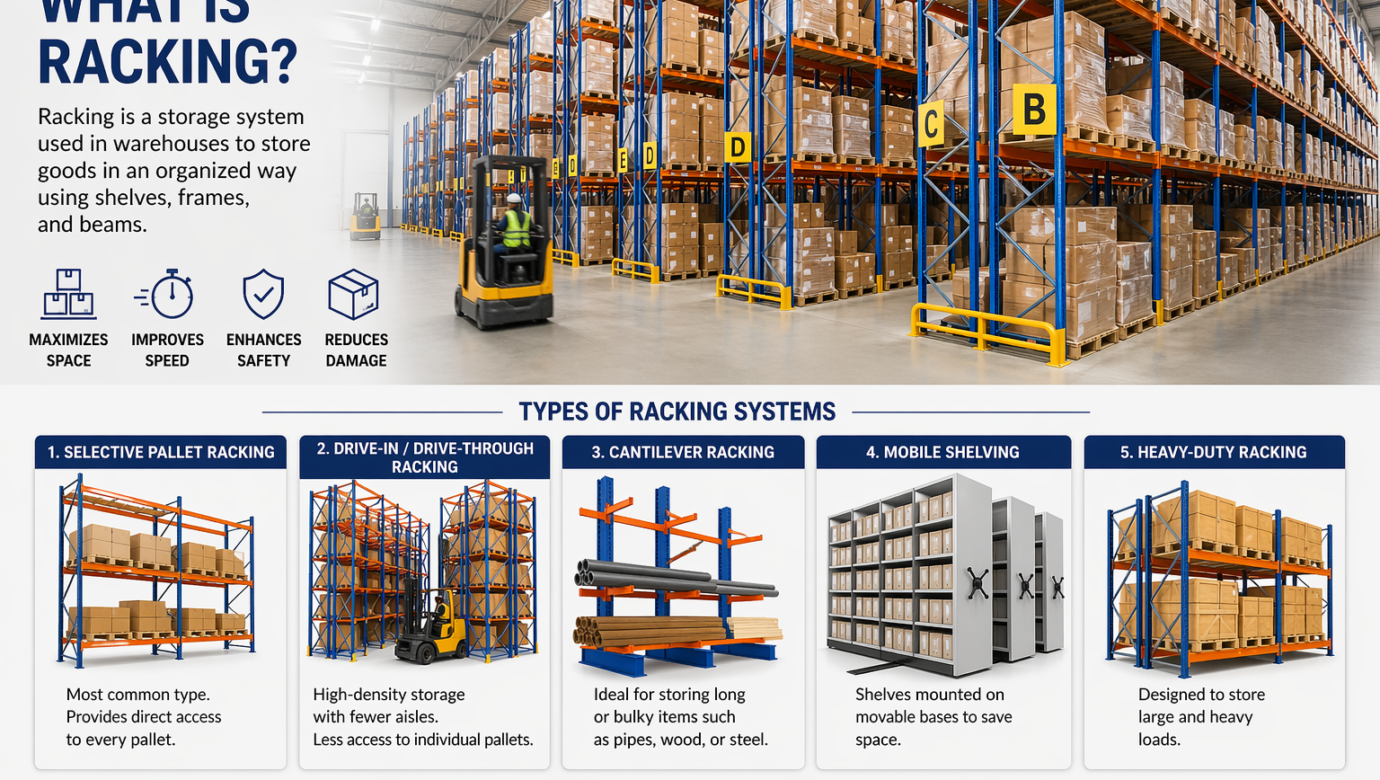
What is racking, and why is it essential in modern storage systems? Racking is a structured storage solution used in warehouses to organize goods using shelves, frames, and beams. It helps businesses maximize vertical space, improve accessibility, and increase operational efficiency.
With the rapid growth of logistics and e-commerce, efficient storage systems have become critical. Studies in supply chain management show that optimized warehouse layouts can significantly reduce operational delays and improve productivity. Racking systems play a key role in achieving these outcomes.
What Is Racking in Warehouse Storage?
Racking refers to a framework designed to store materials in an organized and accessible way. It is commonly used in warehouses, distribution centers, and industrial facilities to manage inventory efficiently.
Unlike traditional floor storage, racking systems:
- Utilize vertical space effectively
- Provide systematic organization
- Enable easy access to goods
- Support efficient warehouse operations
These systems are engineered to handle different load capacities and product types, making them adaptable across industries.
Why Is Racking Important?
Racking systems are essential for improving warehouse performance. Without proper storage systems, warehouses can become disorganized, leading to delays and safety risks.
Key Benefits of Racking Systems
- Maximizes space: Makes use of vertical storage instead of expanding floor area
- Improves picking speed: Organized layouts reduce time spent locating items
- Reduces product damage: Proper storage minimizes handling errors
- Enhances safety: Structured systems lower accident risks
Industry research indicates that efficient storage systems can improve warehouse productivity by up to 20–30%, depending on operational design.
Common Types of Racking Systems
Different storage needs require different racking solutions. The most commonly used types include:
Selective Pallet Racking
This is the most widely used system, offering direct access to each pallet. It is ideal for warehouses with varied inventory and high turnover.
Drive-In and Drive-Through Racking
These systems are designed for high-density storage. Forklifts can enter the racking lanes, making them suitable for bulk storage with fewer product variations.
Cantilever Racking
Cantilever systems are used for long or bulky items such as pipes, timber, and metal bars. They use arms instead of traditional shelves.
Mobile Shelving Systems
Mobile shelving units are mounted on movable bases, reducing unused aisle space. They are often used in compact storage environments.
Heavy-Duty Racking
Heavy-duty systems are built to store large and heavy materials. They are commonly used in industrial and manufacturing settings.
Where Is Racking Used?
Racking systems are widely used across industries that require efficient storage and inventory management.
Common Applications
- Warehouses and distribution centers
- Logistics and supply chain hubs
- Retail storage facilities
- Cold storage and freezer warehouses
- Manufacturing units
In cold storage environments, specialized racking systems are designed to perform under low temperatures while maintaining durability.
Safety and Design Considerations
Proper design and maintenance are essential for safe racking operations. Incorrect usage or overloading can lead to serious safety issues.
Key Considerations
- Load capacity and weight distribution
- Structural design and material quality
- Proper installation procedures
- Regular inspection and maintenance
Safety organizations recommend routine checks to ensure compliance with load limits and structural integrity.
The Role of Racking in Modern Warehousing
Racking systems continue to evolve with advancements in warehouse technology. Many facilities now integrate racking with:
- Automated storage and retrieval systems (AS/RS)
- Warehouse management systems (WMS)
- Robotics and conveyor systems
These technologies help improve inventory accuracy, reduce labor costs, and speed up order fulfillment processes.
In Summary
Racking systems are a fundamental part of efficient storage and logistics operations. They help businesses organize inventory, optimize space, and improve safety.
Key Takeaways
- Racking is a structured storage system used in warehouses
- It improves efficiency, safety, and accessibility
- Multiple racking types serve different storage needs
- It is used across logistics, retail, and manufacturing sectors
- Proper design and maintenance are critical for safe use
FAQs
What is racking in simple terms?
Racking is a storage system used to organize goods in warehouses using shelves and frames. It helps maximize space, especially vertical space, while making it easier to store, access, and manage inventory efficiently.
What are the main types of racking systems?
The main types include selective pallet racking, drive-in and drive-through racking, cantilever racking, mobile shelving, and heavy-duty racking. Each type is designed to meet specific storage needs based on load size, accessibility, and space availability.
Why is racking important in warehouses?
Racking improves warehouse efficiency by organizing goods, reducing search time, and minimizing damage. It also enhances safety by ensuring products are stored securely and systematically, reducing the risk of accidents and operational delays.
Where are racking systems commonly used?
Racking systems are commonly used in warehouses, logistics hubs, retail storage areas, manufacturing facilities, and cold storage units. They are essential wherever efficient storage and inventory management are required.
How does racking improve warehouse safety?
Racking improves safety by providing stable storage structures that prevent items from falling. When properly installed and maintained, it reduces clutter, improves visibility, and ensures safe handling of goods within warehouse environments.
