
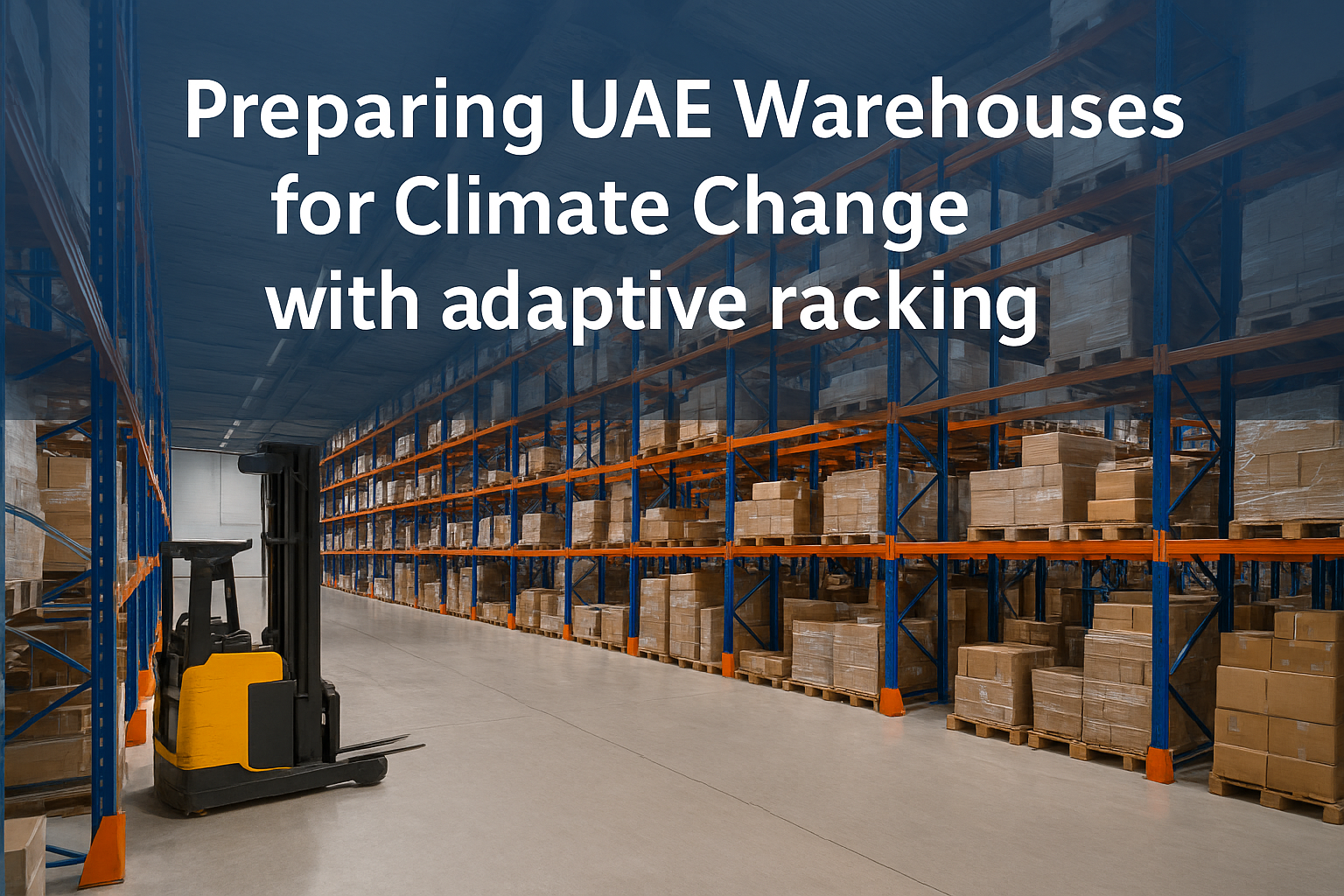
The UAE’s logistics and warehousing sector has long been a symbol of efficiency and innovation. From massive e-commerce hubs in Dubai South to cold storage facilities in Abu Dhabi, the country’s warehouse network powers trade and industry across the Gulf. Yet, as climate change accelerates, UAE warehouses face unprecedented challenges: rising temperatures, humidity fluctuations, and energy-intensive cooling demands.
To stay competitive, businesses are embracing adaptive racking systems that not only enhance storage efficiency but also help climate-proof warehouses against environmental stress. This evolution marks a critical step toward sustainability, operational resilience, and long-term cost efficiency.
The Climate Challenge in UAE Warehouses
Climate change is no longer an abstract concern. According to the UAE Ministry of Climate Change and Environment, the nation could see average temperatures rise by up to 2°C by 2050. While that may sound modest, for warehouse operations, even small thermal shifts can disrupt efficiency, damage goods, and increase energy costs.
Key Environmental Stress Factors
- Extreme Heat: Prolonged exposure to high temperatures can weaken traditional racking materials, cause metal expansion, and increase the risk of structural deformation.
- Humidity Variations: High humidity can accelerate corrosion, particularly in coastal areas like Sharjah and Ras Al Khaimah.
- Energy Dependence: Cooling systems and HVAC units must work harder, driving up operational expenses and carbon emissions.
- Temperature-Sensitive Goods: Industries such as pharmaceuticals, food distribution, and e-commerce rely heavily on stable environments that prevent spoilage or warping.
These conditions underscore the urgency for adaptive racking UAE solutions designed to perform under shifting climatic realities.
What is Adaptive Racking?
Adaptive racking refers to warehouse storage systems engineered with flexibility, material durability, and environmental responsiveness in mind. Unlike conventional racks that are static and standardized, adaptive racking systems evolve with operational needs and climate demands.
Core Features of Adaptive Racking Systems
- High-Strength, Corrosion-Resistant Coatings: Specialized finishes such as epoxy or galvanized steel extend lifespan in humid conditions.
- Temperature-Resilient Materials: Metals and polymers are selected based on their ability to withstand thermal expansion and contraction.
- Configurable Layouts: Modular designs enable warehouse operators to adjust rack heights, depths, and aisles according to changing inventory volumes or equipment types.
- Smart Integration: Adaptive systems can be equipped with sensors to monitor temperature, humidity, and weight distribution in real time.
These design features are critical for ensuring resilience in climate-proof warehouses across the UAE’s diverse environments.
The Economic Imperative for Adaptation
While sustainability is a moral and environmental priority, it is also a financial one. The economic implications of climate-induced damage can be staggering.
A study by the Emirates Green Building Council found that climate adaptation in industrial facilities can reduce maintenance costs by up to 30 percent and energy consumption by 20 percent over ten years.
Return on Investment (ROI) of Adaptive Racking
- Extended Lifespan: Corrosion-resistant racks minimize replacement frequency, saving on capital expenditure.
- Reduced Energy Costs: Smart monitoring allows operators to optimize cooling and lighting systems.
- Lower Maintenance Downtime: Adaptive racks require fewer repairs, ensuring continuous productivity.
- Enhanced Asset Protection: Proper racking prevents product loss from heat exposure or moisture buildup.
In short, investing in adaptive racking is not an expense—it is an insurance policy against the financial volatility caused by climate change.
Technological Innovations Driving Adaptive Racking
UAE warehouse operators are increasingly integrating advanced technologies into racking infrastructure to future-proof their investments.
1. Sensor-Based Monitoring
IoT-enabled racking systems continuously track temperature, humidity, and load stress. The data enables predictive maintenance, ensuring early intervention before issues escalate.
2. Automated Material Handling Systems (AMHS)
Automation complements adaptive racking by enhancing precision and safety. Robotic forklifts, shuttle systems, and vertical lifts can adapt to variable racking heights and narrow aisles, optimizing space use and labor efficiency.
3. Energy-Efficient Materials
Lightweight alloys and thermally stable composites are replacing traditional steel in some applications, cutting both energy use and emissions associated with transportation and assembly.
4. AI-Driven Layout Design
Using AI and digital twin models, warehouse planners can simulate airflow, temperature distribution, and stress loads. These insights guide the installation of adaptive racking systems that perform optimally under UAE’s extreme heat.
Case Study: Adaptive Racking in Dubai Logistics Hub
A major logistics firm in Dubai South recently overhauled its 20,000-square-meter warehouse using adaptive racking technology. The project involved:
- Replacing conventional racks with corrosion-resistant galvanized steel.
- Integrating smart temperature sensors that automatically alert staff to heat anomalies.
- Installing reflective roofing and energy-efficient LED lighting to reduce heat absorption.
Within a year, the facility reported a 15 percent reduction in cooling costs, 25 percent lower maintenance expenses, and a notable improvement in worker safety. The success underscores how adaptive racking can directly support the UAE’s sustainability and net-zero goals.
Designing for Resilience: Key Considerations
To build a truly climate-resilient warehouse in the UAE, businesses must adopt a holistic approach that combines infrastructure, materials, and intelligent systems.
1. Material Selection
Choose racking materials designed for local environmental conditions. Galvanized or powder-coated finishes are essential in coastal or humid zones.
2. Ventilation and Airflow
Strategically designed racking layouts allow for better air circulation, minimizing hot spots that strain cooling systems.
3. Load Optimization
Adaptive systems distribute weight more evenly, reducing stress on structural components and improving seismic and wind resistance.
4. Integration with Energy Systems
Linking racking sensors with building management systems (BMS) enhances energy efficiency and predictive maintenance capabilities.
Government Vision and Sustainability Alignment
The UAE’s National Climate Change Plan 2050 emphasizes industrial resilience as a cornerstone of economic stability. Adaptive racking supports these goals by reducing energy consumption, extending asset life, and promoting circular economy principles.
Additionally, as the COP28 summit reaffirmed, sustainability in logistics is not optional. Companies that invest early in adaptive solutions gain a competitive edge, enhance ESG compliance, and attract environmentally conscious partners and clients.
The Future of Adaptive Racking in the UAE
The next decade will witness a convergence of sustainability, automation, and digital intelligence in warehouse design. Adaptive racking will evolve beyond structural innovation to become part of a connected ecosystem where data, materials, and machines interact seamlessly.
Expect to see:
- AI-integrated maintenance systems that predict corrosion or stress before human inspection.
- Recyclable racking components contributing to circular manufacturing cycles.
- Hybrid energy-efficient warehouses combining solar power with adaptive infrastructure.
For UAE businesses, embracing adaptive racking is not just about preparing for climate change—it is about securing long-term growth in a market that values resilience and innovation.
As climate challenges intensify, UAE warehouses must transition from reactive to proactive resilience strategies. Adaptive racking systems represent that shift—merging technology, sustainability, and cost efficiency into one intelligent framework.
From improving energy management to safeguarding inventory, adaptive racking is transforming the way the UAE’s logistics industry prepares for the future. Warehouses that adapt today will thrive tomorrow.
FAQs
1. What makes adaptive racking suitable for UAE warehouses?
Adaptive racking uses materials and designs built to withstand heat, humidity, and environmental stress, making it ideal for the UAE’s harsh climate.
2. Does adaptive racking require more maintenance than traditional racks?
No. In fact, adaptive racking systems often reduce maintenance needs due to corrosion-resistant materials and sensor-based monitoring.
3. How does adaptive racking improve energy efficiency?
By integrating smart sensors and optimizing airflow, adaptive racking reduces the strain on cooling systems and enhances energy performance.
4. Can adaptive racking be customized for different warehouse sizes?
Yes. These systems are modular and scalable, suitable for everything from small distribution centers to mega warehouses.
5. Is adaptive racking compatible with automation systems?
Absolutely. Adaptive racking pairs seamlessly with automated material handling and AI-driven inventory systems.
6. What is the expected ROI for adaptive racking investments?
ROI typically appears within two to three years, depending on warehouse size and environmental conditions, through energy savings and reduced maintenance costs.