

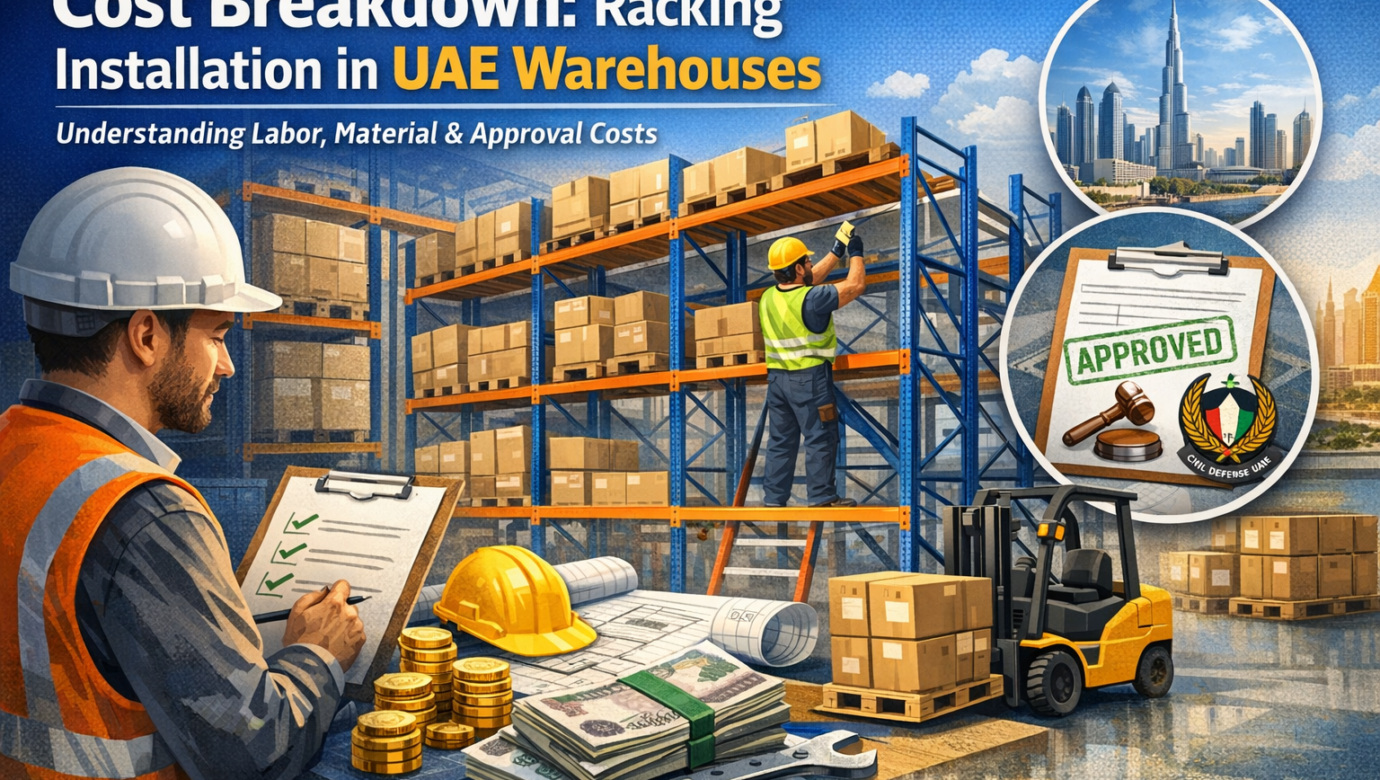
Racking Installation in UAE Warehouses
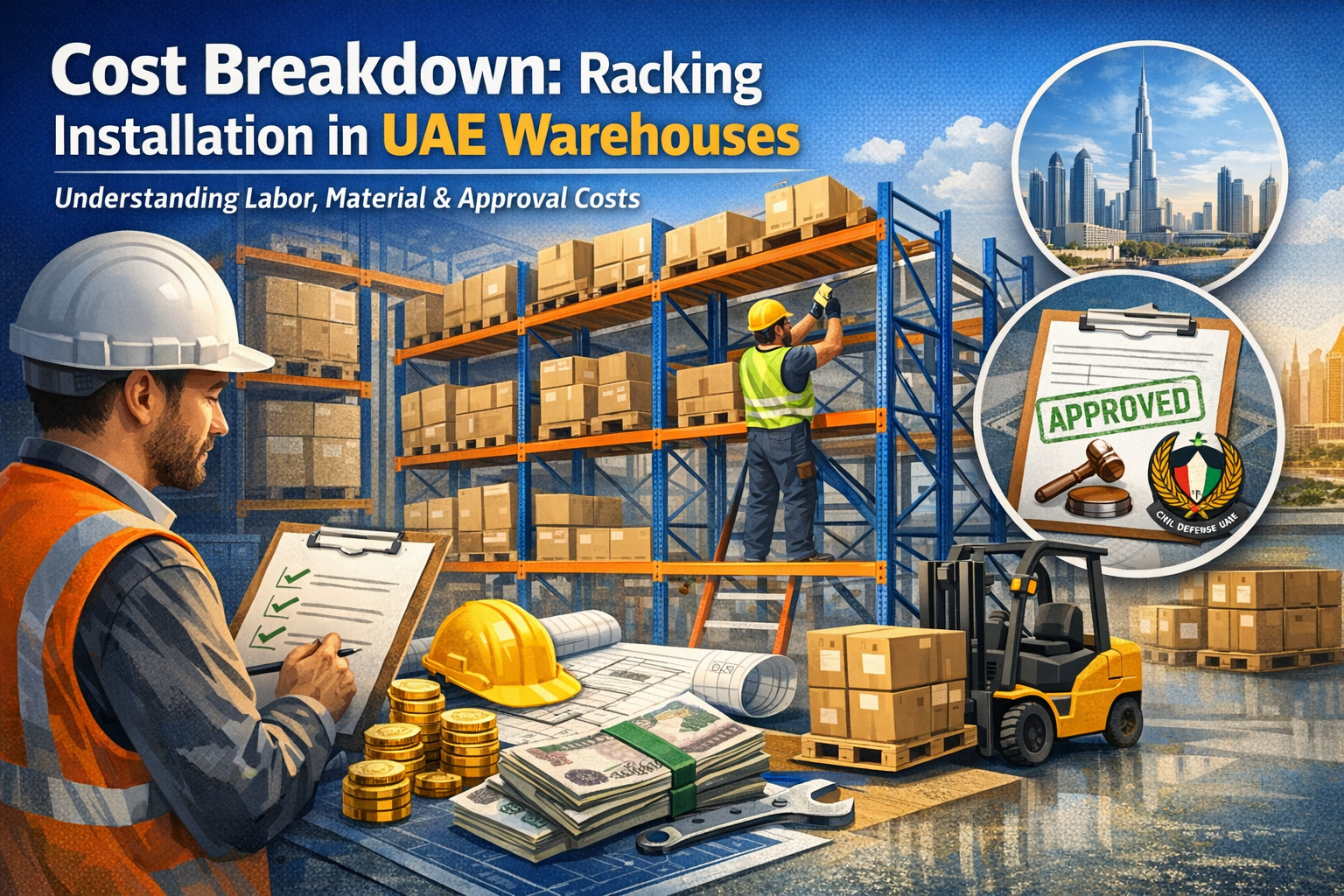
Understanding Racking Installation Costs in the UAE
Warehouse racking is one of the most critical investments for logistics, manufacturing, retail distribution, and cold storage operations across the UAE. From Dubai and Abu Dhabi to Sharjah and Ras Al Khaimah, businesses rely on efficient racking systems to maximize storage density, improve picking speed, and comply with strict safety regulations.
However, one of the most common questions decision-makers ask is: What is the actual racking installation cost in UAE warehouses? The answer is not straightforward. Costs vary significantly depending on warehouse size, racking type, load capacity, location, compliance requirements, and labor conditions.
This in-depth guide provides a transparent cost breakdown of racking installation in the UAE, covering material pricing, installation labor, approvals, optional add-ons, and long-term budgeting considerations. Whether you are planning a new warehouse or upgrading an existing facility, this article will help you make informed financial decisions.
Typical Racking Installation Cost in the UAE
On average, racking installation costs in the UAE can range from:
- AED 350 – AED 900 per pallet position (standard selective pallet racking)
- AED 120 – AED 250 per sqm for light- to medium-duty shelving systems
- AED 1,000+ per pallet position for high-density or automated racking systems
These figures typically include racking material and basic installation but exclude civil works, permits, and advanced safety accessories.
To understand where your budget goes, let’s break the cost into its core components.
1. Cost of Racking Materials in the UAE
Racking material accounts for 50–65% of the total project cost, making it the largest expense.
a) Type of Racking System
Different racking systems have different price points:
- Selective Pallet Racking
The most common and cost-effective option. Ideal for fast-moving SKUs. - Double Deep Racking
Slightly higher cost due to additional structure and reach truck requirements. - Drive-In / Drive-Through Racking
Higher steel usage and reinforced frames increase cost. - Very Narrow Aisle (VNA) Racking
Requires precision engineering and floor flatness compliance. - Cantilever Racking
Designed for long or bulky items; cost varies based on arm length and load. - Cold Storage & Freezer Racking
Special steel coatings and high load ratings increase pricing.
b) Steel Quality and Load Rating
In the UAE, racking systems must comply with FEM, EN, or RMI standards. Higher load capacities and thicker steel profiles significantly increase cost but are mandatory for safety and insurance compliance.
c) New vs Used Racking
- New racking: Higher upfront cost, full warranty, and compliance documentation
- Used racking: 20–40% cheaper but limited availability and compliance risks
For regulated industries, new racking is strongly recommended.
2. Racking Installation Labor Cost in UAE
Installation labor typically accounts for 20–30% of the total cost.
a) Installation Rates in Dubai and UAE
Average installation rates:
- AED 60 – AED 120 per man-hour
- AED 40 – AED 70 per pallet position (basic selective racking)
Costs are higher in Dubai and Abu Dhabi compared to northern emirates due to labor regulations and site access constraints.
b) Complexity of Installation
Factors that increase labor cost:
- High bay warehouses (10m+ height)
- Tight installation timelines
- Night or weekend work
- Working around live warehouse operations
c) Equipment and Access
Installation may require:
- Scissor lifts or boom lifts
- Reach trucks or forklifts
- Anchoring and torque-controlled bolting
Equipment rental is often charged separately.
3. Warehouse Floor Preparation and Civil Work Costs
A commonly overlooked expense is floor readiness.
a) Floor Load Capacity
Most racking systems require:
- Minimum 150–250 mm reinforced concrete flooring
- Verified load-bearing capacity
If reinforcement is needed, costs can rise by AED 50 – AED 150 per sqm.
b) Floor Flatness (FM2 / FM3 Compliance)
VNA and automated systems require extremely flat floors. Grinding or leveling may add substantial cost.
4. Municipality Approvals and Compliance Costs
In the UAE, racking installations often require approvals, especially in Dubai.
a) Civil Defense and Municipality Approvals
Approval costs may include:
- Structural calculations
- Layout drawings
- Fire safety compliance
Estimated cost: AED 5,000 – AED 25,000 depending on warehouse size and authority requirements.
b) Safety Inspections and Certification
Post-installation inspections ensure compliance with safety standards and insurance policies.
5. Safety Accessories and Optional Add-Ons
Safety components are not optional in most UAE warehouses.
Common add-ons include:
- Rack protectors and column guards
- Upright protectors
- Mesh decking
- Pallet backstops
- Row spacers and seismic bracing
These accessories typically add 10–20% to the base racking cost.
6. Cost Differences by Warehouse Type
a) Standard Storage Warehouses
Lower installation cost due to simpler layouts.
b) Cold Storage and Freezer Warehouses
Costs increase due to:
- Specialized coatings
- Installation in sub-zero temperatures
- Higher safety requirements
Expect 20–40% higher costs compared to ambient warehouses.
c) E-commerce Fulfillment Centers
Higher costs due to:
- Mixed racking systems
- Mezzanines
- Picking modules
7. Long-Term Cost Considerations
a) Maintenance and Inspection
Annual racking inspections cost AED 3,000 – AED 10,000, depending on size.
b) Expansion and Reconfiguration
Modular racking systems reduce future costs.
c) Insurance and Risk Reduction
Certified racking systems reduce insurance premiums and operational risk.
Sample Cost Breakdown: Medium-Sized UAE Warehouse
| Cost Component | Estimated Cost (AED) |
|---|---|
| Racking Material | 220,000 |
| Installation Labor | 85,000 |
| Safety Accessories | 35,000 |
| Approvals & Engineering | 15,000 |
| Floor Preparation | 45,000 |
| Total Estimated Cost | 400,000 |
How to Reduce Racking Installation Cost in the UAE
- Optimize warehouse layout
- Choose the right racking system
- Bundle supply and installation
- Plan approvals early
- Invest in quality to reduce long-term costs
Frequently Asked Questions
1. What is the average racking installation cost in UAE?
The average cost ranges from AED 350 to AED 900 per pallet position, depending on racking type, load capacity, and warehouse conditions.
2. Is installation included in racking prices?
Some suppliers include basic installation, but many quote it separately. Always confirm what is included.
3. Are municipality approvals mandatory for racking in Dubai?
Yes, most Dubai warehouses require approvals and compliance documentation, especially for high-bay racking.
4. Is used racking allowed in UAE warehouses?
Used racking may be allowed, but compliance, load certification, and insurance acceptance can be challenging.
5. How long does racking installation take?
A standard project takes 1–4 weeks, depending on warehouse size and complexity.
6. Does cold storage racking cost more?
Yes, cold storage racking installation can cost 20–40% more than standard systems.
7. Can racking be relocated to a new warehouse?
Yes, but dismantling, transport, and reinstallation costs must be considered.
8. How often should racking be inspected?
Annual inspections are recommended, with regular in-house visual checks.
Budgeting Smart for Racking Installation in the UAE
Understanding the true racking installation cost in UAE warehouses requires looking beyond material pricing. Labor, compliance, safety, and long-term operational factors all play a critical role.
By working with experienced racking specialists, planning approvals early, and selecting the right system for your operation, UAE businesses can achieve safe, scalable, and cost-effective warehouse storage solutions.
For warehouse owners, logistics managers, and procurement teams, a well-planned racking investment is not an expense it is a long-term asset that drives efficiency and growth.
