

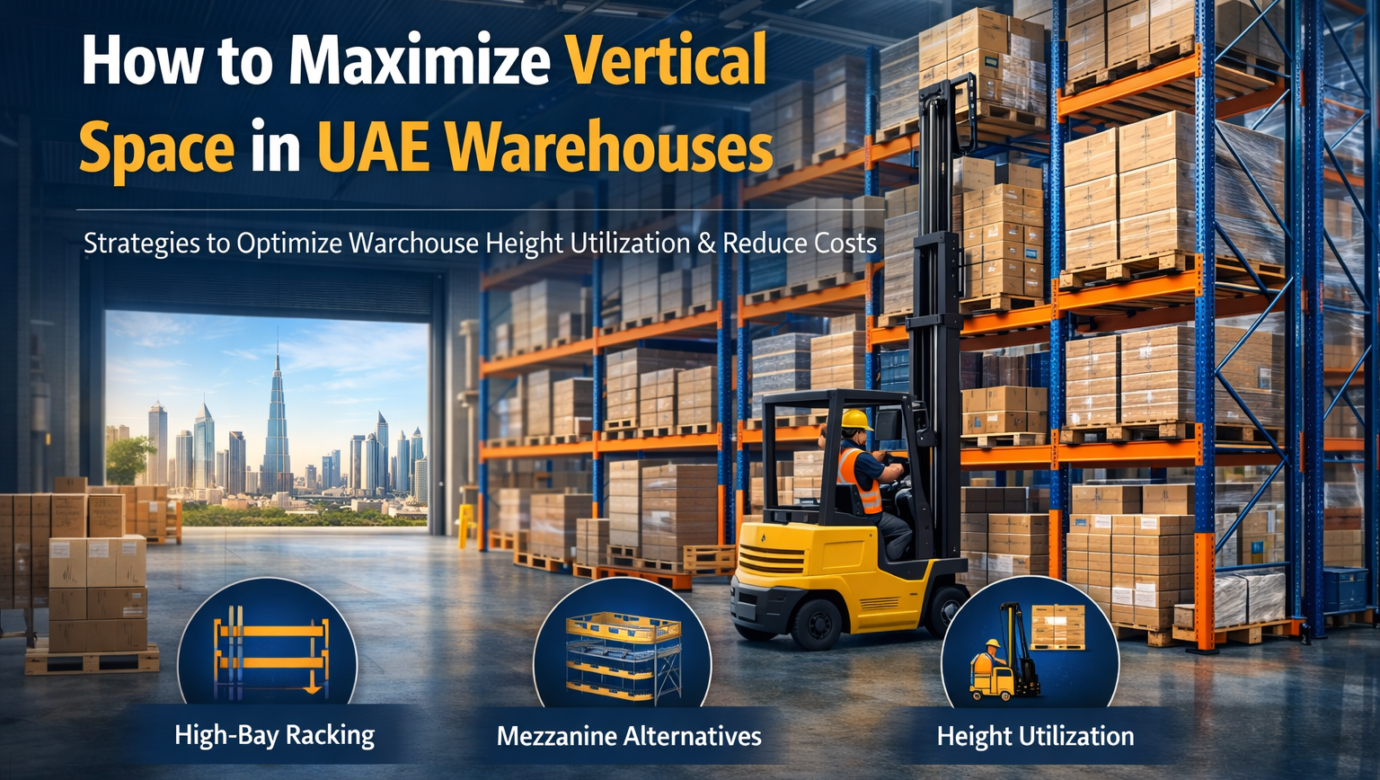
How to Maximize Vertical Space in UAE Warehouses
Why Vertical Space Matters in UAE Warehousing
Warehouse rental costs in the UAE continue to rise, particularly in high-demand industrial zones such as JAFZA, Dubai Industrial City, Al Quoz, DIP, Sharjah, and Abu Dhabi ICAD. For warehouse operators, distributors, and SMEs, expanding floor space is often expensive or impractical.
As a result, maximizing warehouse vertical space in the UAE has become a critical strategy for improving storage capacity, reducing operational costs, and delaying relocation.
Many warehouses underutilize their ceiling height, leaving valuable cubic meters unused. By focusing on vertical storage solutions rather than horizontal expansion, businesses can significantly increase pallet capacity without increasing their footprint.
Understanding Vertical Space Utilization in UAE Warehouses
Vertical space utilization refers to the effective use of a warehouse’s total clear height, from floor level to the lowest obstruction such as lighting, HVAC systems, or fire sprinklers.
Key Height Considerations in UAE Warehouses
- Clear ceiling height
- Fire sprinkler clearance requirements
- Forklift lift height limitations
- Load-bearing capacity of racking systems
- Dubai Civil Defense and municipality regulations
A professional warehouse height assessment is the first step toward successful vertical optimization.
Common Challenges in Maximizing Vertical Storage in the UAE
Despite having tall warehouses, many facilities face challenges such as:
- Inadequate racking design
- Use of low-rise shelving
- Poor aisle planning
- Incorrect forklift selection
- Safety and fire compliance concerns
Addressing these issues allows warehouse operators to unlock unused vertical capacity safely and efficiently.
Proven Methods to Maximize Vertical Space in UAE Warehouses
1. Install High-Bay Pallet Racking Systems
High-bay racking is one of the most effective solutions for vertical storage in UAE warehouses.
Benefits of High-Bay Racking
- Utilizes ceiling heights up to 12 to 15 meters
- Increases pallet density per square meter
- Ideal for bulk storage and fast-moving goods
- Compatible with narrow aisle forklifts
High-bay racking is widely used in logistics hubs, FMCG distribution centers, and industrial warehouses across the UAE.
2. Use Adjustable Pallet Racking for Flexible Height Utilization
Adjustable pallet racking allows beam levels to be repositioned as inventory profiles change.
This system enables:
- Efficient use of vertical space for mixed SKU heights
- Reduced wasted air space between pallet levels
- Easy reconfiguration without structural changes
For businesses with varying pallet heights, adjustable racking is one of the most cost-effective vertical storage solutions.
3. Narrow Aisle Layouts to Unlock Vertical Capacity
Vertical optimization is closely linked to aisle design.
By switching from wide aisles to narrow aisle racking, warehouses can:
- Reduce aisle width
- Add more racking rows
- Increase overall storage height safely
Narrow aisle systems require specialized equipment such as VNA forklifts but deliver substantial space savings in high-rent UAE locations.
4. Replace Low-Level Shelving with Vertical Storage Systems
Many older warehouses still rely on low shelving or floor stacking.
Replacing these with:
- Multi-level racking
- Vertical shelving systems
- High-rise pallet racks
can instantly increase storage capacity without altering the building structure.
5. Mezzanine Alternatives for Vertical Expansion
Traditional mezzanine floors are not always ideal due to cost, permits, or load limitations.
Mezzanine alternatives include:
- Multi-tier racking systems
- Rack-supported platforms
- Pick towers integrated into racking
These solutions provide vertical expansion while maintaining flexibility and regulatory compliance.
6. Optimize Forklift and Material Handling Equipment
Even the best racking system is limited by equipment capability.
To maximize warehouse height utilization in the UAE:
- Use reach trucks or VNA forklifts
- Match lift height to racking height
- Ensure operator training and safety compliance
Upgrading equipment often unlocks additional vertical storage capacity without changing racking.
7. Improve Warehouse Layout and Slotting Strategy
Vertical space optimization is not just structural. It also depends on smart inventory planning.
Best practices include:
- Placing slow-moving items at higher levels
- Reserving lower levels for fast-moving SKUs
- Using pallet flow or push-back systems where applicable
This approach improves both storage density and operational efficiency.
Safety and Compliance for Vertical Storage in the UAE
UAE warehouses must comply with strict safety standards.
Key requirements include:
- Fire sprinkler clearance
- Rack load signage
- Seismic and impact protection
- Floor anchoring and rack protection
Vertical expansion must always be designed and installed by experienced suppliers familiar with Dubai Civil Defense and municipality regulations.
Cost Benefits of Vertical Space Optimization
Maximizing warehouse vertical space in the UAE delivers measurable financial advantages.
Key Cost Savings
- Reduced rental expenses per pallet
- Delayed warehouse relocation
- Improved inventory control
- Higher ROI from existing space
In high-cost industrial zones, vertical optimization can reduce storage costs by 30 to 50 percent compared to horizontal expansion.
Industries in the UAE That Benefit Most from Vertical Storage
Vertical storage solutions are especially valuable for:
- Third-party logistics providers
- E-commerce fulfillment centers
- FMCG distributors
- Automotive parts suppliers
- Cold storage and temperature-controlled warehouses
Each industry benefits from increased density, faster access, and improved scalability.
Choosing the Right Vertical Storage Partner in the UAE
When planning vertical optimization, choose a supplier who offers:
- Site inspection and height analysis
- Custom racking design
- Compliance documentation
- Installation and after-sales support
A professional approach ensures long-term safety and maximum utilization of warehouse height.
Future Trends in Warehouse Vertical Space Utilization
As land and rental costs rise, UAE warehouses are increasingly adopting:
- Taller high-bay facilities
- Semi-automated racking systems
- Smart warehouse management integration
Vertical storage will remain a core strategy for warehouse efficiency across the region.
Frequently Asked Questions
1. What is warehouse vertical space utilization in the UAE?
It refers to using the full height of a warehouse for storage instead of relying only on floor space.
2. Why is vertical storage important in UAE warehouses?
Because warehouse rental costs are high, vertical storage allows businesses to increase capacity without expanding their footprint.
3. What racking system is best for vertical storage in the UAE?
High-bay pallet racking and adjustable pallet racking are among the most effective systems.
4. Is high-bay racking safe in UAE warehouses?
Yes, when designed and installed according to UAE safety and fire regulations.
5. Can existing warehouses be upgraded for vertical storage?
Yes. Most warehouses can be retrofitted with taller racking systems after a structural and safety assessment.
6. Are mezzanine floors required to increase vertical space?
No. Many mezzanine alternatives provide vertical expansion with greater flexibility and lower costs.
7. How much height clearance is needed for vertical racking?
This depends on pallet height, forklift capability, and fire sprinkler requirements, which vary by warehouse.
8. Does vertical storage improve warehouse efficiency?
Yes. It increases capacity, improves inventory organization, and reduces operating costs.
In a region where warehouse space comes at a premium, maximizing vertical space in UAE warehouses is no longer optional. It is a strategic necessity.
By investing in high-bay racking, adjustable storage systems, smart layouts, and compliant designs, businesses can unlock hidden capacity, reduce costs, and future-proof their warehouse operations.
Vertical optimization turns warehouse height into a competitive advantage.
