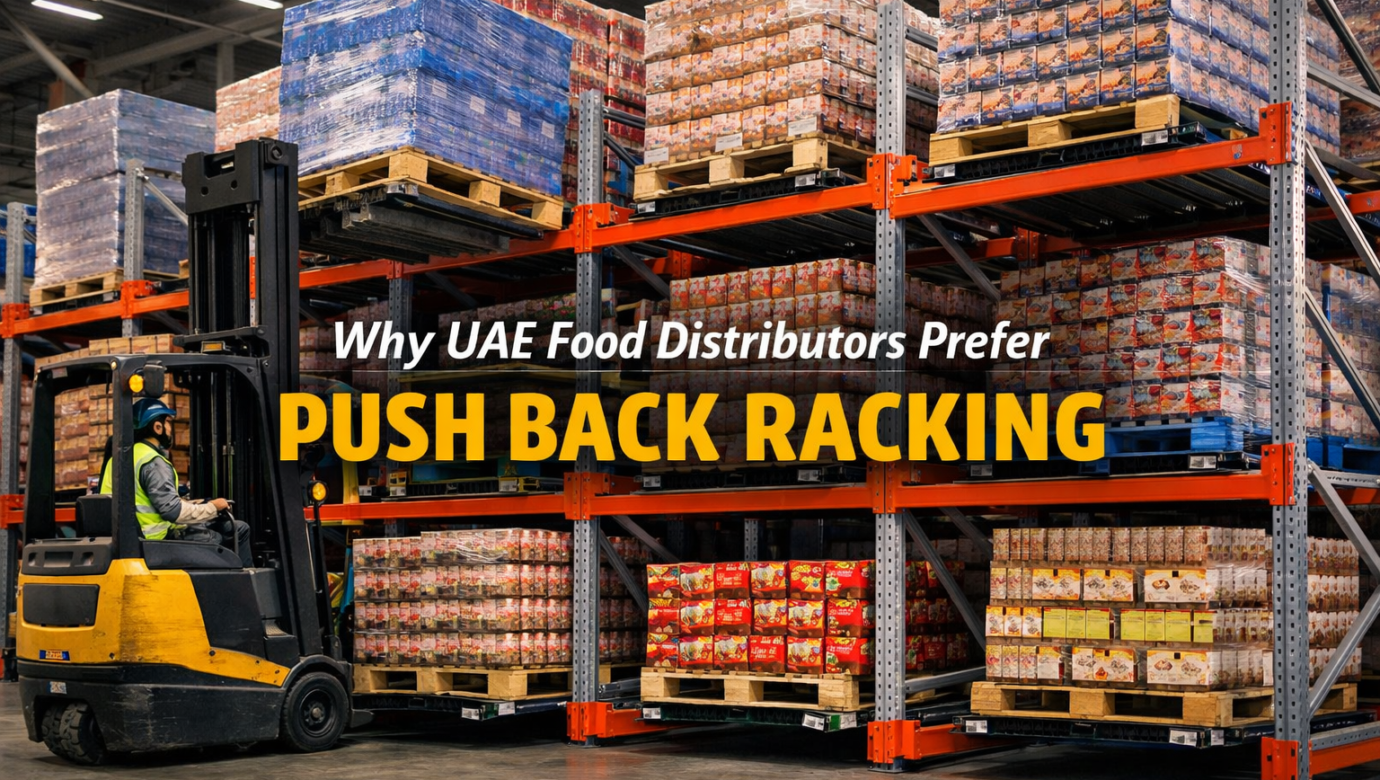
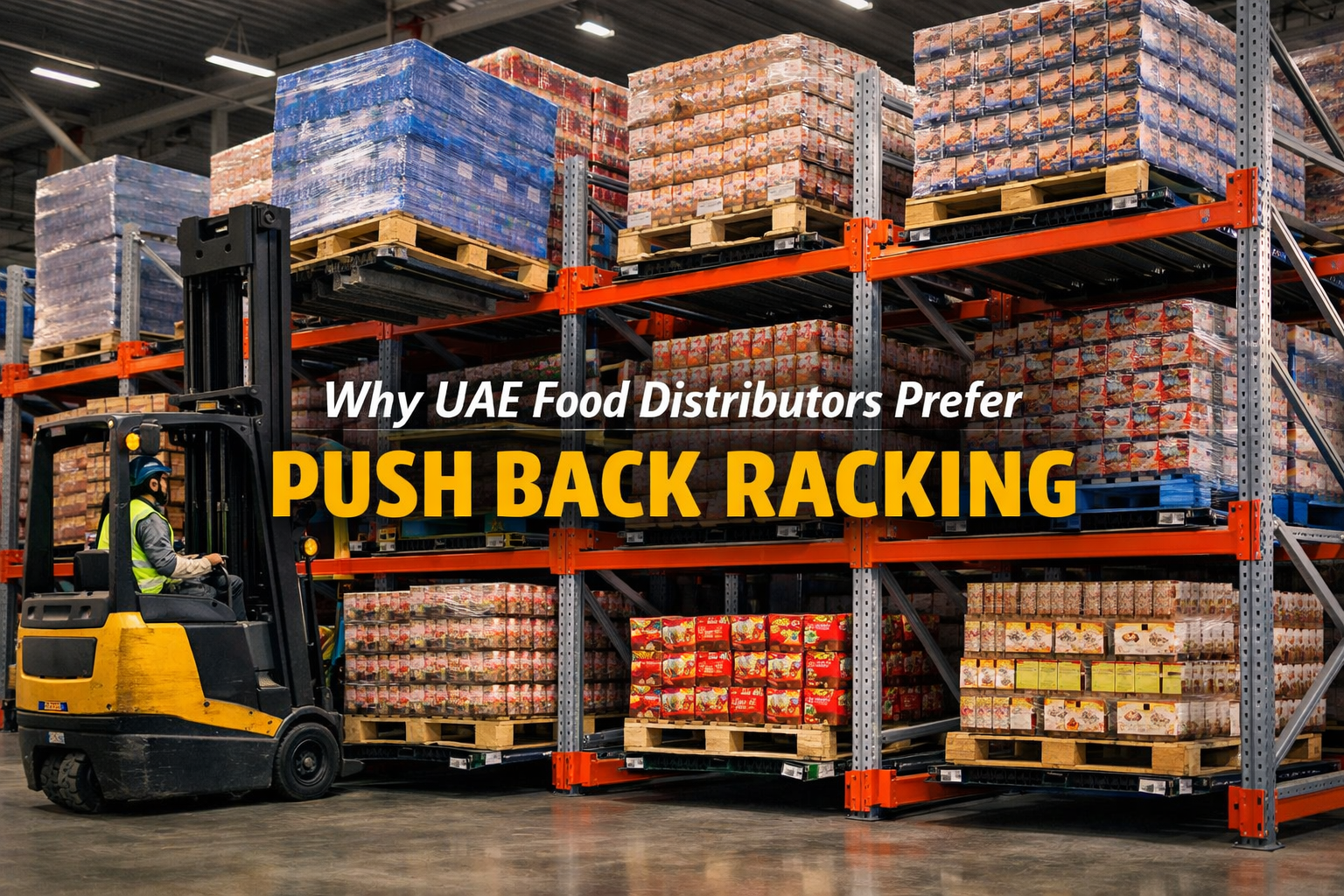
Why UAE Food Distributors Prefer Push Back Racking
If you work in food distribution in the UAE, you already know the story: high customer demand, fast moving SKUs, and warehouses where every pallet position counts. With consumer expectations rising and grocery POS networks expanding across the Emirates, warehouse efficiency is no longer optional. It is essential.
Push back racking has become one of the most popular systems for food distributors in Dubai, Abu Dhabi, Sharjah and the Northern Emirates. It is designed for speed, density and ease of use.
Here is why so many warehouse managers are making the switch.
FIFO or LIFO Push Back Racking Supports Real World Operations
Food distribution moves quickly, and SKU rotation drives replenishment and picking strategy.
Push back racking is primarily a Last In First Out system and is ideal for:
- High turnover grocery items
- Bulk pallet goods
- FMCG products with short lead times
Some UAE operators combine push back with FIFO methods in other warehouse zones. The result is a storage layout tailored to real demand patterns instead of theory.
Designed for UAE Storage Realities
The UAE market presents unique warehouse challenges:
- Expensive land and rental rates
- High SKU velocity
- Cold storage energy costs
- Seasonal demand peaks
Push back racking stores between 2 and 6 pallets deep per lane, reducing the number of aisles and maximizing pallet density. In short, you store more stock within the same footprint.
More pallets in less space means more revenue per square metre.
Faster Loading Improves Throughput and Delivery Times
One of the strongest advantages of push back racking is operational speed. Forklift operators load and unload from a single aisle. Gravity fed carts automatically position pallets, ensuring smooth and quick access.
In a food distribution network where multiple outbound trucks are scheduled daily, this time saving compounds into hours of labour saved each week.
In cold rooms, faster movement also reduces open door time and prevents unnecessary chill loss. This lowers energy consumption and protects product integrity.
Perfect for Chilled and Frozen Foods
Cold storage in Dubai and Abu Dhabi comes at a premium. Many operators report costs up to several times higher than ambient warehouse space.
Food distributors handling:
- Frozen produce
- Meat and poultry cartons
- Dairy and beverages
- Bakery items
- Chilled ready meals
need high density systems that minimise aisle space and forklift movement.
Push back systems are ideal because they:
- Increase pallet storage per cubic metre
- Reduce forklift travel inside cold rooms
- Keep operators out of long aisles
- Improve picking efficiency
This is why many cold chain companies are replacing selective racks with push back solutions.
Lower Costs Over the Lifespan of the System
Push back racking may require slightly higher initial investment than selective pallet racks. However, long term ROI is strong, driven by:
- Reduced forklift travel time
- Lower energy use in cold areas
- Higher pallet density delaying expansion
- Faster stock movement and turnaround
In most UAE food distribution facilities, return on investment is achieved in approximately 18 to 30 months.
Food distributors across the UAE prefer push back racking because it aligns with operational reality. It delivers speed, density, simplicity and efficiency in environments where space is costly and SKU movement is rapid.
Whether you manage a cold storage warehouse, a grocery distribution hub or a fast moving FMCG network, push back racking can help improve throughput and maximise space utilisation.
Frequently Asked Questions
Yes. It is ideal for fast moving SKUs. For strict FIFO requirements, many warehouses use push back in combination with selective racking.
Most systems store between two and six pallets deep depending on operational needs and pallet weight.
Yes. It performs exceptionally well in chilled and frozen environments commonly found in UAE cold chain facilities.
Standard reach trucks are suitable. Only basic training and familiarisation are required.
Push back may cost more initially but offers faster access, fewer forklift impacts and better selectivity. Many UAE facilities achieve higher overall throughput and better lifetime value.
