

Warehouse Floor Load Testing Before Rack Installation

Warehouse floor load testing is a critical step before installing industrial racking systems. Racks concentrate heavy loads into small areas, and not every concrete slab is designed to handle that stress. Without proper evaluation, facilities risk slab cracking, settlement, or even structural failure.
As global warehousing expands to meet e-commerce and supply chain demands, many older facilities are being retrofitted with higher-density storage. This makes understanding floor capacity more important than ever. Engineers and safety authorities consistently emphasize that floor performance must match operational demands.
Why Warehouse Floor Load Testing Matters
Warehouse floors are not uniform. Load capacity depends on slab thickness, reinforcement, subgrade quality, and original design intent. A slab designed for light storage may not support modern high-bay pallet racking.
Testing and evaluation help determine:
- Maximum allowable load per square meter
- Point load capacity at rack base plates
- Risk of cracking or differential settlement
- Suitability for future automation or mezzanines
According to structural engineering standards referenced by organizations such as the American Concrete Institute (ACI), industrial slabs must be assessed for both distributed and concentrated loads. Racking systems often create high point loads that exceed typical floor assumptions.
Understanding Structural Load vs. Slab Rating
What Is Structural Load?
Structural load refers to the total weight imposed on the floor system. In a warehouse, this includes:
- Stored goods
- Racking structure
- Material handling equipment
- Dynamic forces from forklifts
What Is Slab Rating?
A slab rating describes the floor’s load-bearing capacity. It is based on engineering calculations and soil support conditions. However, many facilities lack accurate documentation, especially older buildings. This is where warehouse floor load testing becomes essential.
Warehouse Floor Load Testing in Practice
1. Site Audit and Documentation Review
Engineers begin with a site audit. They review original construction drawings, if available. These documents show slab thickness, reinforcement details, and design load criteria.
If drawings are missing, physical verification becomes necessary. This may include non-destructive scanning or selective core sampling.
2. Visual Inspection
A visual inspection identifies existing issues such as:
- Cracks or joint separation
- Surface spalling
- Uneven settlement
- Moisture-related damage
These conditions may reduce effective load capacity and must be considered before rack installation.
3. Non-Destructive Testing Methods
Modern warehouse floor load testing often relies on non-invasive methods, including:
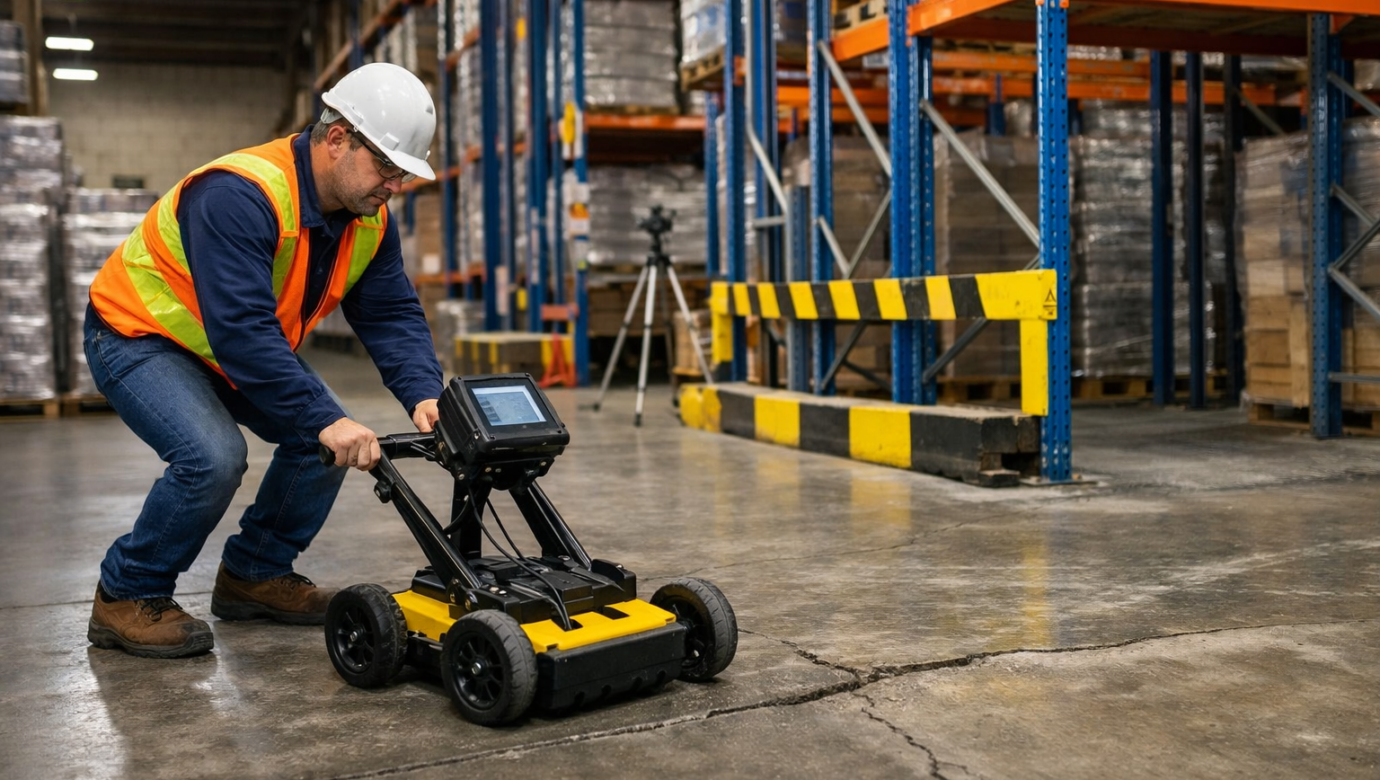
- Ground Penetrating Radar (GPR): Detects reinforcement depth and spacing
- Rebound Hammer Tests: Estimates surface concrete strength
- Ultrasonic Pulse Velocity: Assesses internal concrete integrity
These techniques provide insight without damaging the slab.
4. Core Sampling and Lab Analysis
When higher accuracy is required, engineers extract small concrete cores. Laboratory testing measures compressive strength and confirms slab thickness. This data improves the reliability of load calculations.
5. Subgrade and Soil Evaluation
The slab’s performance depends heavily on the soil beneath it. Weak or poorly compacted subgrade can cause settlement even if the concrete itself is strong. Geotechnical testing may be recommended where heavy loads are planned.
Load Types That Affect Rack Installations
Warehouse rack systems apply different kinds of stress compared to general storage.
Static Loads
These include the weight of pallets, goods, and racking frames. Static loads are predictable but can be extremely high in high-density storage.
Dynamic Loads
Forklifts, pallet jacks, and automated guided vehicles create moving loads. These forces can exceed static loads during acceleration, braking, or turning.
Point Loads
Rack columns transfer weight through small base plates. This creates concentrated pressure that can exceed the slab’s local capacity, even when overall floor load seems acceptable.
Risks of Skipping Floor Load Testing
Ignoring slab evaluation can lead to serious operational and safety issues.
Potential consequences include:
- Cracking beneath rack uprights
- Progressive floor settlement
- Rack misalignment and instability
- Increased maintenance costs
- Safety hazards for workers
The Occupational Safety and Health Administration (OSHA) highlights the importance of maintaining safe storage structures. Floor failure can compromise rack stability and create falling object risks.
When Is Warehouse Floor Load Testing Required?
Testing is strongly recommended in the following situations:
- Installing new heavy-duty pallet racks
- Converting light storage areas to high-density systems
- Adding mezzanines or automated storage systems
- Operating in buildings older than 20 years
- Observing visible slab damage
Even in newer facilities, design assumptions may differ from current operational needs.
How Engineers Calculate Safe Load Capacity
Engineers combine field data with structural models. They consider:
- Concrete compressive strength
- Slab thickness and reinforcement
- Subgrade modulus (soil stiffness)
- Load distribution from rack base plates
Software modeling helps predict slab behavior under various load scenarios. Safety factors are applied to account for uncertainties and long-term wear.
Integrating Results Into Rack Design
Warehouse floor load testing does not happen in isolation. Results guide the racking layout and specifications.
Possible design adjustments include:
- Larger base plates to distribute loads
- Load spreader plates beneath uprights
- Reduced rack height or bay load limits
- Relocating racks to stronger floor zones
These measures improve safety while maintaining storage efficiency.
Regulatory and Industry Guidance
While building codes vary by region, most refer to structural engineering standards for floor design and evaluation. Organizations such as ACI and local building authorities provide guidance on slab performance. Insurance providers may also require documented floor capacity for high-value storage.
Compliance with these standards reduces liability and supports long-term facility performance.
Key Takeaways
Warehouse floor load testing provides essential data before rack installation. It helps prevent structural damage, supports worker safety, and ensures that storage systems perform as intended. As warehouses evolve toward higher density and automation, understanding slab capacity is no longer optional—it is part of responsible facility management.
FAQs
Warehouse floor load testing is the process of evaluating a concrete slab’s ability to support storage racks and operational loads. Engineers assess slab thickness, concrete strength, and soil conditions to determine safe load limits and prevent structural damage.
Slab rating defines how much weight a warehouse floor can safely carry. Racking systems create high point loads at column bases, which may exceed the slab’s local capacity even if overall floor loading seems acceptable.
Engineers use visual inspections, ground penetrating radar, rebound hammer tests, and sometimes concrete core samples. These methods help determine slab thickness, reinforcement, and compressive strength without major disruption to operations.
Not always. Older floors were often designed for lighter storage loads. Warehouse floor load testing is necessary to confirm whether upgrades are safe or if reinforcement measures are required.
Exceeding floor capacity can lead to cracking, settlement, and rack instability. Over time, this may create safety hazards, increase repair costs, and disrupt warehouse operations.
