
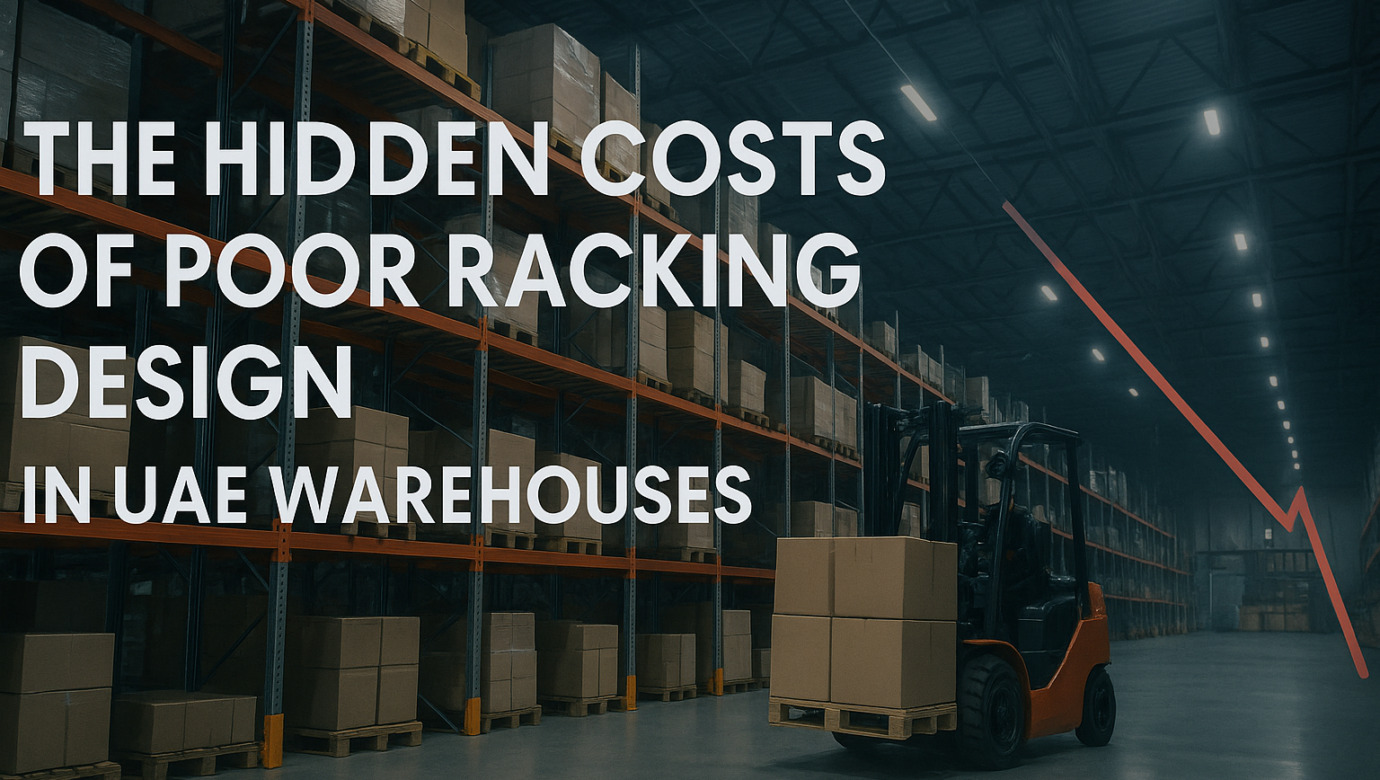
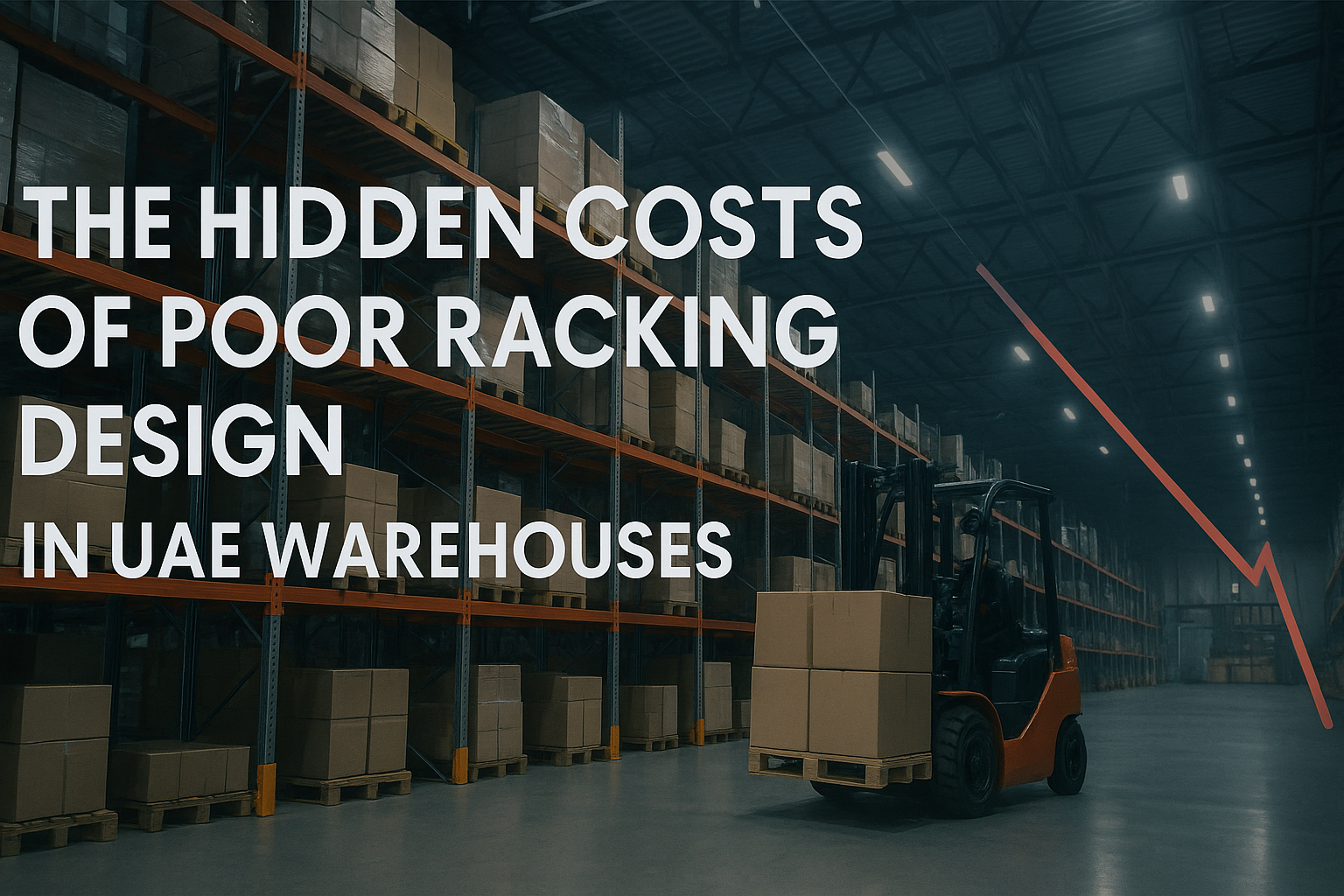
The Hidden Costs of Poor Racking Design in UAE Warehouses
In today’s fast-paced logistics environment, where warehouse efficiency defines profitability, racking design often sits at the heart of operations. Yet, in many UAE warehouses from Dubai’s logistics hubs to Sharjah’s industrial parks poor racking design quietly drains profits, compromises safety, and limits scalability.
Warehouse managers often focus on capacity and cost per pallet, but the true cost of a poorly designed racking system is far more complex. From hidden operational inefficiencies to product damage and safety violations, every design flaw eventually translates into measurable financial losses.
This article explores the hidden costs of poor racking design in UAE warehouses, revealing how strategic planning and professional expertise can turn a potential liability into a long-term competitive advantage.
1. The True Cost of Poor Racking Design: Beyond Installation
1.1 The Illusion of Cost Savings
At first glance, it might seem cost-effective to opt for cheaper racking solutions or to reuse outdated systems during warehouse expansions. However, what appears as a saving on paper often triggers a ripple effect of long-term losses.
Poor racking design doesn’t only reduce storage density it compromises workflow, increases maintenance expenses, and elevates accident risks.
In the UAE, where warehouse real estate comes at a premium, even a 10% loss in usable space can translate to thousands of dirhams wasted monthly.
Example:
A 5,000 m² warehouse in Dubai Industrial City with inefficient aisle spacing could lose approximately 500 m² of potential storage space, resulting in AED 50,000–70,000 per month in opportunity costs when considering rent, utilities, and lost productivity.
2. Operational Inefficiencies: The Hidden Burden
2.1 Inefficient Space Utilization
A key symptom of poor design is underutilized vertical and horizontal space. Many facilities in the UAE still rely on standard rack heights that fail to align with their building’s maximum clear height.
By not optimizing vertical space, warehouses pay for cubic meters of air rather than usable capacity.
2.2 Increased Picking Time and Labor Costs
Improper racking layouts often force operators to travel longer distances or handle goods inefficiently. Over time, this translates to higher labor costs and lower throughput.
According to industry studies, a 10% increase in travel distance can reduce order picking productivity by up to 20%, adding significant recurring expenses in high-volume warehouses.
2.3 Disrupted Workflow
Racking that doesn’t align with operational flow receiving, storage, and dispatch creates bottlenecks. This affects warehouse KPIs like:
- Order accuracy
- Cycle time
- Throughput efficiency
In the competitive logistics markets of Dubai and Abu Dhabi, these inefficiencies directly affect customer satisfaction and contract renewals.
3. Product Damage and Inventory Losses
3.1 Misaligned Beam Levels and Load Inconsistency
When racking systems are not engineered to handle specific product dimensions or weights, product damage becomes inevitable. Bent beams, leaning uprights, and pallet overhangs all contribute to compromised inventory integrity.
A single accident involving damaged goods can wipe out months of perceived savings from cutting corners on design or installation.
3.2 Increased Insurance Premiums and Claims
Insurers in the UAE are increasingly factoring warehouse safety compliance into their premium structures. Poorly designed or unverified racking systems can result in higher premiums or even denied claims in case of collapse or accident.
3.3 The Cost of Downtime
A racking collapse doesn’t just cause physical damage it halts operations. In high-volume facilities, even a few hours of downtime can result in losses exceeding AED 100,000 due to halted dispatches, delayed orders, and emergency repairs.
4. Safety and Compliance Risks
4.1 Violation of UAE Fire and Safety Codes
The UAE Civil Defense enforces strict safety regulations for warehouse layouts, fire exits, and access routes. Poor racking design that doesn’t adhere to these standards can result in fines, forced shutdowns, or loss of operating licenses.
4.2 Worker Safety
A poorly planned racking system increases the risk of accidents from falling pallets to forklift collisions. The human cost is immeasurable, but the financial implications are equally severe: worker compensation, medical expenses, and potential legal liabilities.
4.3 Regular Maintenance and Safety Audits
Without proper design documentation, periodic racking inspections become harder and costlier. Certified racking audits now a mandatory best practice across UAE logistics zones often reveal hidden structural weaknesses stemming from non-engineered installations.
5. The Financial Impact: What the Numbers Say
Let’s break down the estimated financial impact of poor racking design for a mid-sized UAE warehouse:
| Hidden Cost Factor | Annual Estimated Loss (AED) |
|---|---|
| Inefficient space utilization | 120,000 – 300,000 |
| Increased labor costs | 80,000 – 150,000 |
| Product damage | 50,000 – 100,000 |
| Safety incidents/downtime | 100,000 – 200,000 |
| Compliance penalties & audits | 25,000 – 50,000 |
| Total Annual Loss | 375,000 – 800,000+ |
That’s up to nearly AED 1 million in preventable losses annually—simply due to poor planning and execution.
6. How to Avoid These Hidden Costs
6.1 Engage a Professional Racking Designer
Professional racking engineers especially those experienced in UAE warehouse codes factor in:
- Load-bearing requirements
- Seismic ratings
- Fire exits and sprinkler spacing
- Forklift maneuverability
- SKU turnover rates
This ensures your racking is not just compliant, but optimized for performance and longevity.
6.2 Choose Modular and Scalable Designs
Future growth is inevitable. Modular racking systems allow UAE businesses to expand or reconfigure layouts as demand evolves, avoiding costly redesigns later.
6.3 Invest in Regular Inspections
Routine inspections and maintenance schedules prevent minor issues like loose bolts or leaning uprights from escalating into costly failures.
6.4 Prioritize Training and Safety Protocols
A well-designed system is only as safe as the people operating it. Comprehensive training for warehouse staff ensures compliance with safety standards and reduces accident risks.
7. Case Study: Redesigning for Profitability in Dubai
A logistics company in Dubai South struggled with high operational costs despite ample warehouse space. After an audit revealed poor racking design and misaligned aisles, Planet Racking redesigned their layout using narrow aisle selective racking and optimized pallet positions.
Results within 6 months:
- 30% increase in storage capacity
- 20% reduction in labor hours
- Eliminated product damage incidents
- ROI achieved in under 9 months
This transformation underscores how strategic racking design directly drives profitability in high-demand logistics environments like the UAE.
8. The Long-Term Advantage of Good Racking Design
Investing in high-quality, professionally designed racking isn’t just about avoiding losses it’s about enabling long-term success.
Benefits include:
- Higher space efficiency
- Lower operational costs
- Improved safety and compliance
- Enhanced warehouse valuation
- Greater scalability for future growth
In an era where automation and AI-driven warehousing are becoming the norm, the foundation of your storage infrastructure must be strong, adaptable, and precise.
The hidden costs of poor racking design in UAE warehouses extend far beyond the visible damages or inefficiencies they silently erode profitability, productivity, and safety over time.
By investing in engineered racking systems and partnering with experts like Planet Racking, businesses can safeguard their operations, reduce unnecessary expenses, and build a warehouse that performs today and scales tomorrow.
Frequently Asked Questions (FAQs)
Q1. What are the main signs of poor racking design?
Common indicators include frequent product damage, inefficient space use, misaligned aisles, and recurring safety incidents.
Q2. How often should racking systems be inspected in UAE warehouses?
Ideally every 6 to 12 months, depending on load frequency and operational intensity. Annual audits by certified inspectors are recommended.
Q3. Can existing racking systems be optimized without a full replacement?
Yes. Many systems can be reconfigured or upgraded using modular extensions, better beam spacing, and layout redesigns.
Q4. How does poor racking affect insurance coverage?
Insurers may increase premiums or reject claims if the racking system fails compliance or safety standards.
Q5. Why is professional racking design especially critical in the UAE?
The UAE’s high-cost real estate, strict safety regulations, and hot climate make precision engineering and compliance essential for cost-efficient, safe operations.
