
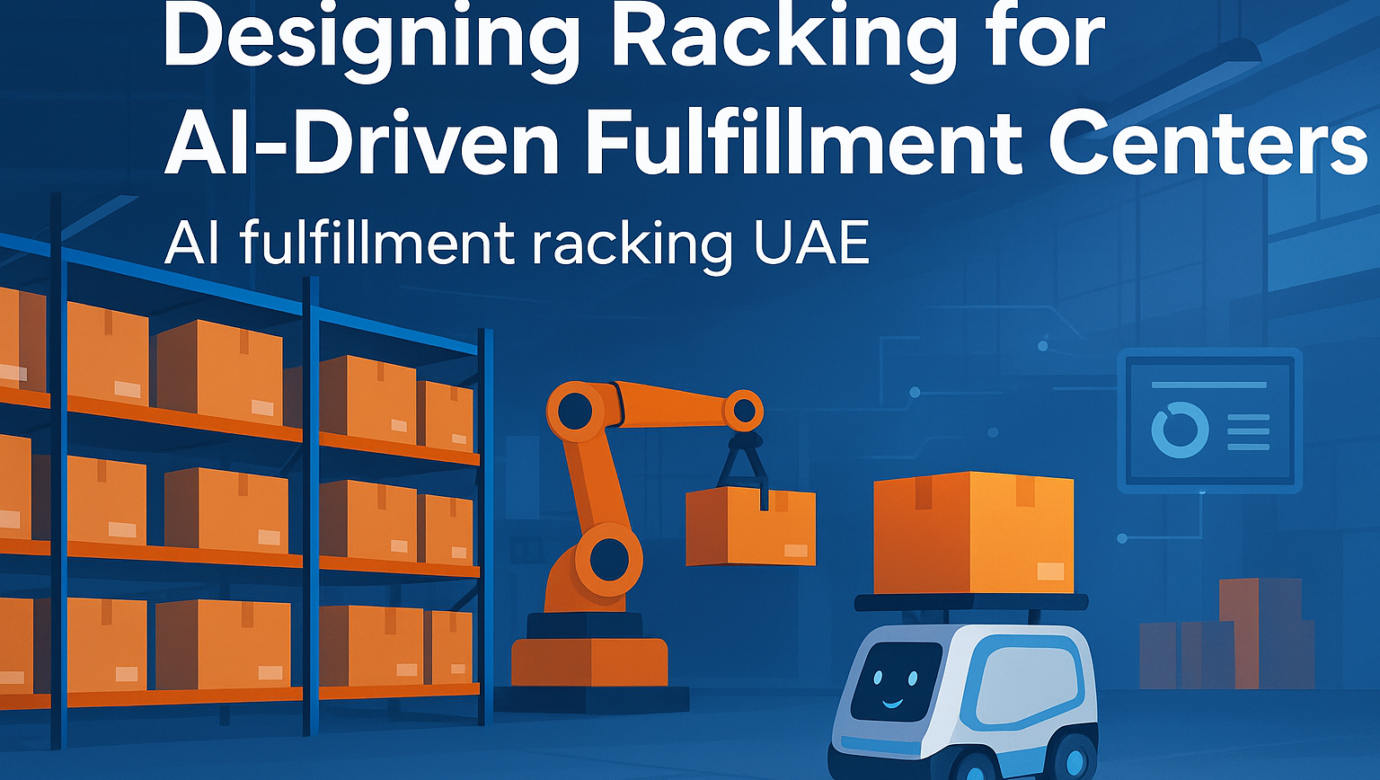
Designing Racking for AI-Driven Fulfillment Centers
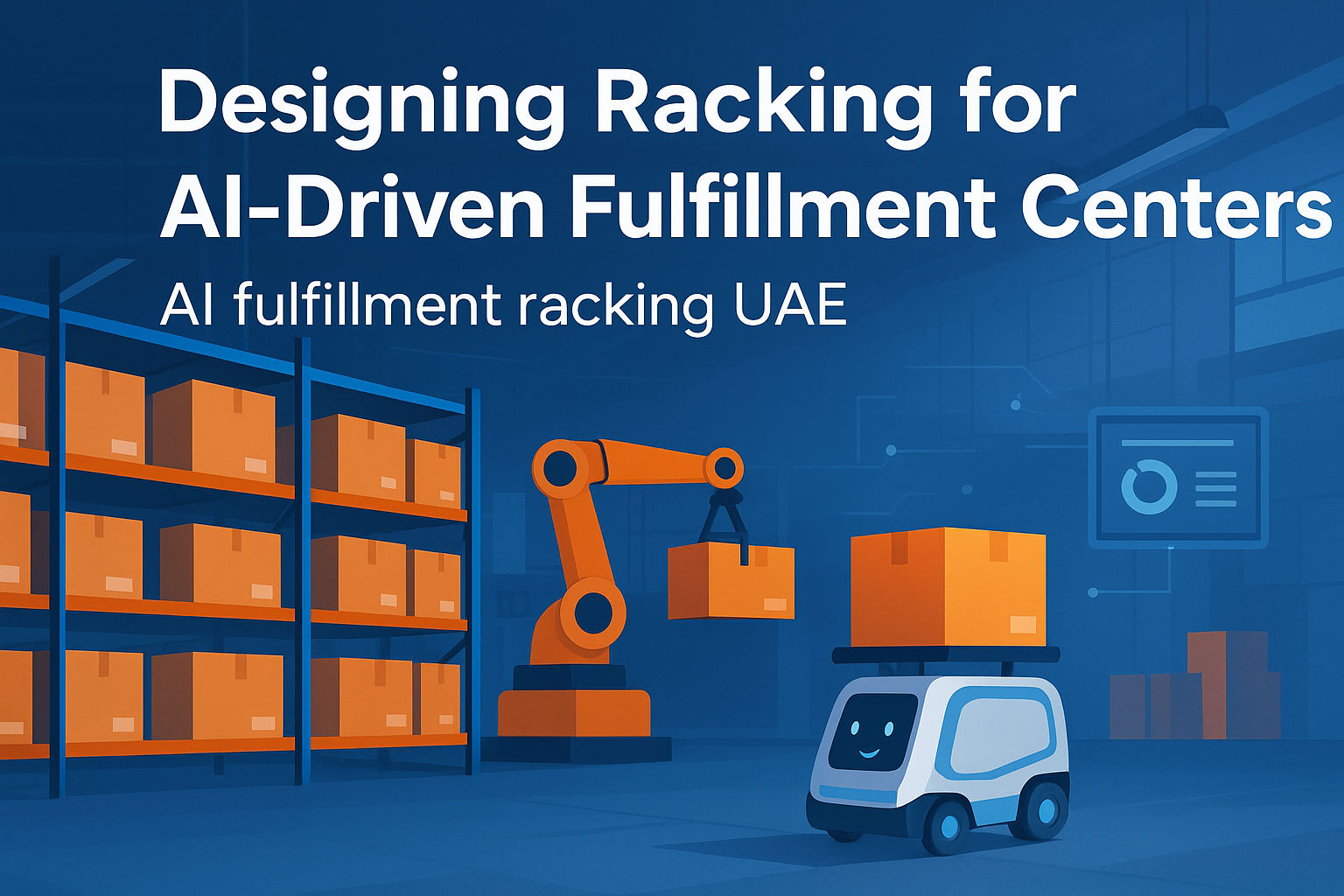
Designing Racking for AI-Driven Fulfillment Centers
The world of warehouse logistics is undergoing a profound transformation. As artificial intelligence (AI) reshapes supply chains and automation redefines fulfillment, racking systems, the backbone of every warehouse, must evolve to meet the demands of speed, precision, and adaptability.
In the UAE, where smart logistics initiatives are part of the country’s vision for an AI-powered future, the design of racking systems for AI-driven fulfillment centers has become a strategic imperative. These modern warehouses demand intelligent storage layouts that seamlessly integrate robotics, data analytics, and automated processes.
This article explores how to design racking systems that are optimized for AI-driven fulfillment centers in the UAE, highlighting design principles, automation compatibility, safety considerations, and emerging technologies that are shaping the future of logistics infrastructure.
1. Understanding the AI Fulfillment Landscape
Artificial Intelligence in fulfillment centers goes beyond robots moving boxes. It is about data-driven decision-making, predictive logistics, and real-time optimization.
AI-powered systems in UAE fulfillment centers perform functions such as:
- Automated picking and storage guided by computer vision and machine learning
- Predictive inventory management where AI forecasts demand to optimize stock levels
- Dynamic routing of goods as algorithms determine the fastest route for order completion
- Energy-efficient operations as smart systems reduce idle time and power consumption
For these technologies to function efficiently, racking systems must be compatible with robotics and automation equipment, ensuring smooth navigation, quick access, and minimal human intervention.
2. The Role of Racking in AI Fulfillment
Racking is no longer just about maximizing vertical space. In AI-driven environments, it serves as an integral part of the automation ecosystem.
Key roles of modern racking systems:
- Integration with AI robotics: Racks are designed to align with automated guided vehicles (AGVs), robotic arms, and shuttle systems.
- Data synchronization: Sensors and IoT devices embedded within racks provide real-time inventory visibility.
- Operational efficiency: Smart racks communicate with AI systems to indicate product availability, expiration, or location.
- Safety and maintenance: AI systems monitor racking stability and predict potential failures before they occur.
In the UAE’s logistics hubs such as Dubai South Logistics District and JAFZA free zone warehouses, these AI-integrated designs are rapidly becoming the standard for high-performance fulfillment operations.
3. Core Design Principles for AI-Compatible Racking Layouts
Designing racking for AI-driven fulfillment centers requires precision, foresight, and flexibility. The following principles define how engineers and logistics planners approach racking design for AI environments:
A. Modularity and Scalability
Racks must be modular to accommodate growth. AI systems constantly evolve, and racking should scale easily without disrupting operations. Modular racking allows quick adaptation for new product types or automation systems.
B. Robot-Friendly Architecture
Aisle widths, rack heights, and shelf placements are designed based on the operational footprint of AGVs and AMRs (Autonomous Mobile Robots). Even millimeter-level precision matters when robots navigate at high speed.
C. High-Density Storage Efficiency
AI algorithms optimize inventory placement for velocity and accessibility. To complement this, racking layouts must balance storage density with retrieval speed, allowing AI to execute dynamic slotting strategies effectively.
D. Smart Sensors and IoT Integration
Modern racks integrate RFID, weight sensors, and IoT modules that feed live data into warehouse management systems (WMS). This supports AI-driven decision-making for restocking, picking, and damage detection.
E. Safety and Predictive Maintenance
AI-driven analytics monitor racking stress levels, load distribution, and potential structural weaknesses. Predictive alerts minimize downtime and accidents, enhancing worker and asset safety.
4. Technologies Enhancing AI Fulfillment Racking
1. Robotics and Automated Systems
- Shuttle-based storage systems where robots move horizontally and vertically within racks for high-speed picking
- Pallet shuttles and stacker cranes that are efficient for high-bay racking in cold storage and heavy-duty warehouses
- Collaborative robots (cobots) that work alongside humans for mixed-mode operations
2. Digital Twin Technology
Digital twins create virtual replicas of warehouses, enabling simulation of racking layouts, traffic patterns, and robot routes before implementation. UAE logistics firms increasingly use digital twins to test AI fulfillment efficiency.
3. Machine Vision and AI Analytics
AI-driven cameras identify products, track shelf life, and detect misplaced items, enhancing accuracy and reducing human error.
4. Edge Computing and Real-Time Control
Edge devices process AI data locally within the warehouse, ensuring instantaneous communication between racks, robots, and control systems, which is essential for large-scale UAE operations handling thousands of SKUs daily.
5. Regional Adaptation: AI Fulfillment in the UAE
The UAE is a global logistics hub, home to some of the most technologically advanced fulfillment centers in the Middle East.
Government initiatives like Dubai’s Smart Logistics Strategy and Abu Dhabi’s Industrial 4.0 Program are driving the adoption of AI-integrated warehousing.
Designing racking for these fulfillment centers involves unique regional considerations:
A. Climate-Control Integration
Due to the UAE’s high temperatures, AI racking designs often integrate temperature sensors, heat-resistant materials, and automated cooling management, especially for e-commerce, pharmaceuticals, and food logistics.
B. Compliance with Local Safety Standards
Racking systems must align with Dubai Civil Defense fire safety codes and ISO-certified seismic load requirements.
C. Localized AI Customization
AI models are trained for Arabic labeling, custom barcode systems, and regional product mixes, requiring flexible rack labeling and tracking design.
6. Future of AI Racking Design: Trends to Watch
- Self-Learning Warehouses where racking systems autonomously adjust shelf heights or reconfigure sections based on AI predictions
- Sustainability in Design using eco-friendly, recyclable racking materials aligned with UAE’s Net Zero 2050 goals
- 5G-Powered Fulfillment enabling ultra-fast communication for microsecond AI coordination between racks and robotics
- Human-AI Collaboration where AI-driven visual guidance systems help human workers interact safely with automated racks
7. Implementation Strategy: Steps to Design AI Fulfillment Racking
- AI Readiness Assessment to evaluate automation compatibility of existing warehouse infrastructure
- Digital Layout Simulation to create virtual models of racking layouts for AI validation
- Material and Load Design to choose high-strength steel with AI-specified load balancing
- Automation Integration to sync racking systems with warehouse management software (WMS) and robotics systems
- Testing and Calibration to deploy AI algorithms for dynamic load testing and route optimization
- Ongoing Optimization through continuous data analysis to refine layout and performance over time
8. Business Advantages of AI Fulfillment Racking
| Advantage | Impact |
|---|---|
| Faster Order Fulfillment | AI-driven storage reduces retrieval time by up to 60% |
| Optimized Space Utilization | Smart layout algorithms increase storage capacity |
| Error Reduction | Automated scanning eliminates manual inventory mistakes |
| Energy Efficiency | Intelligent routing minimizes travel paths and power consumption |
| Operational Resilience | Predictive maintenance prevents costly downtime |
These benefits directly support the UAE’s logistics competitiveness, especially as e-commerce, re-exports, and manufacturing expand under Vision 2031.
9. Case Insight: UAE’s Smart Warehouse Revolution
Companies in Dubai and Abu Dhabi are already embracing AI-driven racking innovations.
For example, DP World’s BoxBay system, a fully automated high-bay storage solution, uses AI and robotics to increase throughput by 200% while reducing land footprint by 70%.
Such projects show how AI racking design can transform fulfillment operations in the UAE, setting a global benchmark for smart warehousing excellence.
10. Conclusion
Designing racking systems for AI-driven fulfillment centers in the UAE is not merely a technical upgrade. It is a strategic investment in the future of logistics.
By merging AI intelligence with racking innovation, businesses gain a competitive advantage in operational speed, accuracy, and sustainability.
As the UAE accelerates toward becoming a global logistics powerhouse, AI-optimized racking layouts will remain at the heart of every successful fulfillment operation.
FAQs
1. What is AI-driven fulfillment?
AI-driven fulfillment uses artificial intelligence to automate warehouse tasks such as picking, sorting, and inventory management, ensuring faster and more accurate order processing.
2. Why is AI important for racking design in the UAE?
AI enables smarter warehouse layouts, real-time monitoring, and predictive maintenance which are essential for optimizing operations in the UAE’s high-volume logistics hubs.
3. How do robots interact with AI-optimized racks?
Robots use computer vision and sensors to locate products, while AI systems manage their routes and prioritize tasks for maximum efficiency.
4. Are AI racking systems cost-effective?
Yes. While initial investment is higher, long-term savings from reduced labor, errors, and energy usage make AI racking systems highly cost-efficient.
5. What industries benefit most from AI fulfillment racking?
E-commerce, pharmaceuticals, cold storage, and retail distribution centers benefit most, especially in the UAE’s fast-growing logistics sector.
