
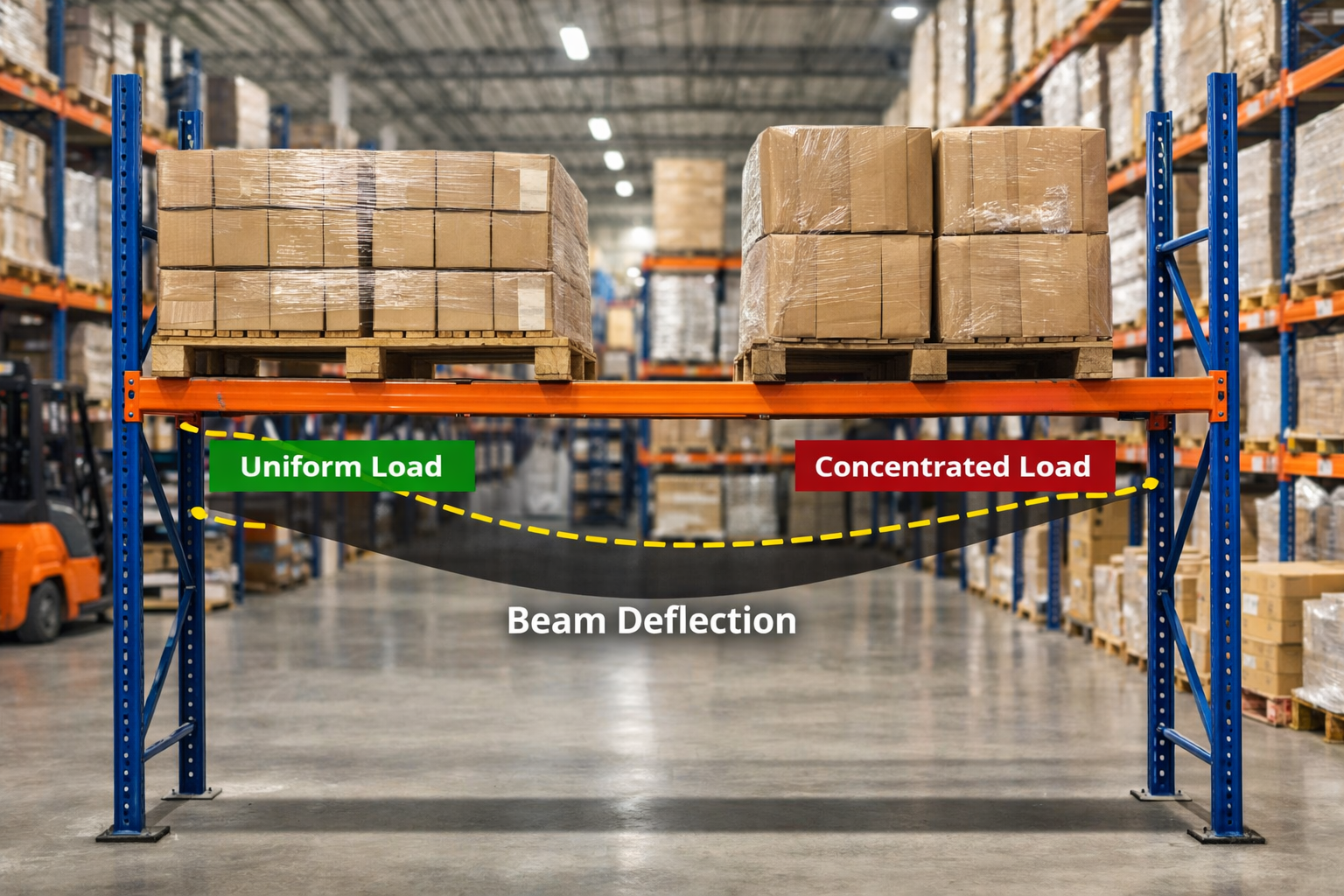
Beam deflection in racks plays a critical role in warehouse safety and structural reliability. Storage systems are designed to support heavy pallet loads, but the way those loads are distributed can significantly influence how beams bend over time. Even when weight limits are not exceeded, uneven or dynamic loading can cause measurable deflection that affects performance and longevity.
Understanding how load patterns influence bending helps engineers, safety managers, and warehouse planners make informed decisions. It also reduces the risk of premature component fatigue and operational hazards.
What Is Beam Deflection?
Beam deflection refers to the vertical displacement that occurs when a load is applied to a horizontal structural member. In pallet racking systems, beams span between upright frames and support stored goods.
Some level of deflection is expected. Industry standards, such as those referenced by the Rack Manufacturers Institute (RMI), provide allowable deflection limits to ensure structural safety and serviceability. Problems arise when deflection exceeds recommended thresholds or occurs repeatedly in ways that accelerate material fatigue.
How Load Patterns Influence Beam Deflection in Racks
The shape, placement, and movement of loads directly affect beam deflection in racks. Even identical total weights can create different bending forces depending on how they are positioned.
1. Uniformly Distributed Loads
A uniformly distributed load spreads weight evenly across the beam’s length. This is the ideal loading condition and is typically assumed in structural design calculations.
Key characteristics:
- Predictable bending behavior
- Lower peak stress compared to concentrated loads
- Reduced long-term fatigue risk
In real warehouses, however, perfectly uniform loading is rare.
2. Concentrated Loads
Concentrated loads occur when weight is focused at one or more points, such as when pallets have narrow runners or when loads sit off-center.
Impacts include:
- Higher localized bending stress
- Greater mid-span deflection
- Increased potential for permanent deformation
Repeated exposure to concentrated loads can shorten beam service life, even if the total load remains within rated capacity.
3. Uneven or Eccentric Loads
Eccentric loading happens when weight is not centered between the uprights. This creates asymmetric forces that cause both vertical deflection and twisting.
Common causes include:
- Misaligned pallets
- Mixed pallet sizes
- Partial pallet loading
This type of loading increases the risk of:
- Beam rotation
- Connection stress at end connectors
- Progressive structural fatigue
4. Dynamic and Impact Loads
Not all loads are static. Forklift placement, pallet drops, and shifting goods create dynamic forces that exceed the weight of the load itself for brief moments.
Dynamic loading can:
- Cause sudden deflection spikes
- Loosen beam-to-upright connections
- Contribute to cumulative fatigue damage
Over time, these repeated stress cycles may reduce structural reliability.
The Role of Beam Span and Material
Load patterns interact with beam design features.
Beam Span Length
Longer spans experience more deflection under the same load. Even small changes in span length can significantly increase bending.
Material Properties
Steel grade and beam profile determine stiffness. High-strength steel resists bending better, but geometry also matters. Step beams, box beams, and structural channels each respond differently to concentrated or uneven loads.
Why Excessive Deflection Matters
Some deflection is acceptable. However, excessive or repeated bending can lead to operational and safety concerns.
Potential consequences include:
- Reduced load clearance between levels
- Pallet instability
- Connection wear and loosening
- Permanent beam deformation
- Accelerated fatigue cracking
In severe cases, these issues may compromise system integrity.
Industry Guidelines and Inspection Practices
Industry groups such as RMI and FEM (European Federation of Materials Handling) provide deflection criteria to ensure racks perform safely under design loads.
Typical guidance includes:
- Limiting deflection to a fraction of beam span (often around L/180 under load)
- Conducting regular visual inspections
- Replacing beams that show permanent deformation
Routine inspections should look for:
- Noticeable sagging
- Twisted beams
- Cracked welds or connectors
- Dislodged safety locks
Strategies to Reduce Risk
Warehouse operators can minimize issues related to beam deflection in racks by improving load management practices.
Practical steps include:
- Centering pallets on beams
- Avoiding overhang that shifts weight off the support line
- Using pallets suited to beam spacing
- Training forklift operators on proper load placement
- Conducting periodic engineering reviews for layout changes
When storage requirements change, load assumptions should be re-evaluated rather than relying on original designs.
Key Takeaways
Load distribution matters as much as total weight. Uniform loads create predictable bending, while concentrated, uneven, and dynamic forces increase stress and long-term fatigue. Monitoring beam condition, following inspection guidelines, and promoting correct pallet placement all help maintain structural reliability and workplace safety.
FAQs
Beam deflection often grows due to repeated loading cycles, uneven weight placement, and material fatigue. Dynamic impacts from forklifts also contribute. Over time, these factors can cause permanent deformation, especially if loads are frequently off-center or concentrated in small areas.
Yes. Structural beams are designed to flex slightly under load. Industry standards define acceptable deflection limits to ensure safety and performance. Problems arise when deflection exceeds those limits or when beams do not return to their original position after unloading.
Concentrated loads create higher stress at specific points along the beam. This increases bending at mid-span and raises the risk of localized deformation. Uniform loads distribute stress more evenly, which reduces peak deflection and helps extend beam service life.
Improper placement, such as off-center or partially supported pallets, can create eccentric loading. This adds twisting forces and uneven bending. Over time, these stresses may weaken connectors, increase fatigue, and reduce the overall stability of the rack system.
Visual inspections should be conducted regularly, often monthly, with formal expert inspections at least annually. Any noticeable sagging, twisting, or permanent deformation should be evaluated promptly to determine whether beam replacement or load adjustments are necessary.