
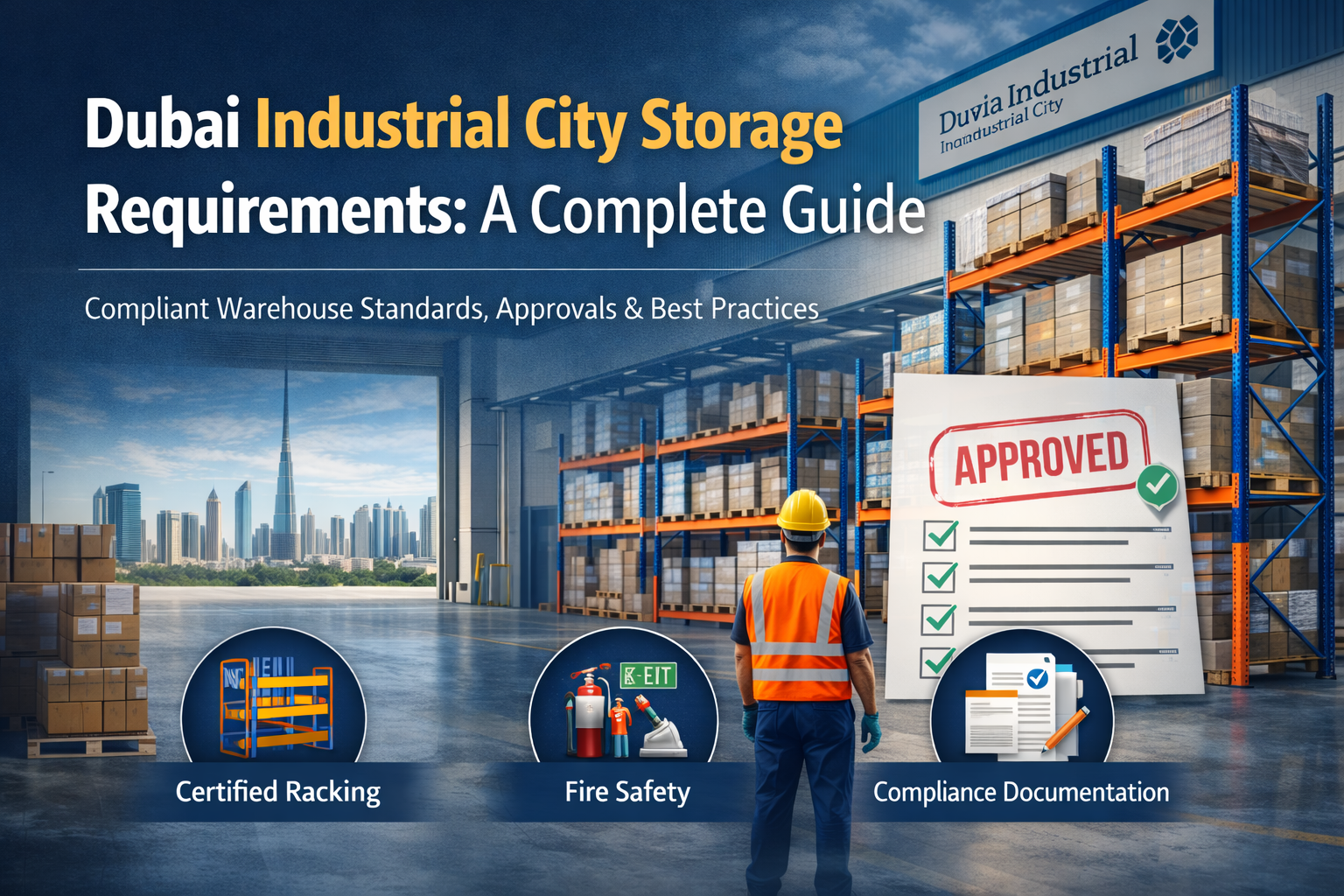
Why Storage Compliance Matters in Dubai Industrial City
Dubai Industrial City (DIC) is one of the UAE’s most important manufacturing and logistics hubs, supporting sectors such as food and beverage, chemicals, construction materials, automotive, and heavy industry. Warehouses operating within DIC must follow strict storage, racking, and safety regulations to ensure operational efficiency, worker safety, and regulatory compliance.
Failure to meet Dubai Industrial City storage requirements can lead to project delays, penalties, insurance issues, or rejection of Civil Defense approvals. This guide provides a clear, practical overview of storage rules, racking standards, and best practices for setting up compliant warehouses in DIC.
Understanding Dubai Industrial City Storage Regulations
Dubai Industrial City operates under regulations aligned with:
- Dubai Municipality guidelines
- Dubai Civil Defense fire and safety codes
- UAE industrial zoning requirements
- International racking standards such as EN and FEM
All storage systems must be designed, installed, and documented according to these regulatory frameworks.
Approved Storage Systems in Dubai Industrial City
Warehouses in DIC are permitted to use only approved and certified storage systems.
Commonly Approved Storage Systems
- Selective pallet racking
- Adjustable pallet racking
- High-bay racking systems
- Drive-in and drive-through racking
- Cantilever racking for long loads
- Rack-supported mezzanine systems
Each system must be engineered for the specific load, height, and operational conditions of the warehouse.
Racking Standards Applicable in DIC Warehouses
All racking installed in Dubai Industrial City must comply with recognized standards.
Key Racking Standards
- EN 15512 for steel static storage systems
- FEM 10.2.02 design standards
- Load rating and beam deflection guidelines
- Manufacturer certification and test reports
Racks without proper load signage or certification may be rejected during inspections.
Fire Safety and Civil Defense Requirements
Fire safety compliance is mandatory for all DIC warehouses.
Key Fire Safety Rules
- Minimum sprinkler clearance above top storage level
- Fire-rated aisle spacing
- Smoke and heat detection compatibility
- No obstruction of fire exits and emergency routes
Storage layouts must be approved by Dubai Civil Defense before warehouse operations begin.
Height and Vertical Storage Regulations
Maximizing vertical space is encouraged but regulated.
Height Utilization Rules
- Storage height must not exceed approved building limits
- Clearance must be maintained below sprinklers and lighting
- Forklift lift height must match rack design
- Structural floor load capacity must be verified
Unauthorized height extensions are not permitted in DIC facilities.
Load Capacity and Structural Safety Requirements
Every racking system must display:
- Maximum bay load
- Maximum beam load
- Pallet weight limits
Structural calculations must account for seismic loads, impact protection, and uneven pallet loading.
Floor and Aisle Planning Requirements
Proper floor and aisle planning ensures safety and efficiency.
DIC Warehouse Layout Guidelines
- Clearly marked aisles and pedestrian zones
- Adequate turning radius for forklifts
- Rack end protectors and column guards
- Anchored racking systems
Floor flatness is especially important for high-bay racking installations.
Special Storage Rules for Industrial and Regulated Goods
Certain industries in DIC face additional storage requirements.
Examples
- Food and beverage warehouses require hygienic, corrosion-resistant racking
- Chemical storage requires spill containment and fire separation
- Heavy manufacturing requires reinforced racking and floor analysis
Industry-specific approvals may be required before installation.
Documentation Required for Storage Approval in DIC
To obtain warehouse approval, operators must submit:
- Racking layout drawings
- Load calculations and certifications
- Fire safety compliance documents
- Installation method statements
Incomplete documentation is a common reason for approval delays.
Common Storage Compliance Mistakes in DIC Warehouses
Warehouses are often flagged for:
- Using uncertified racking
- Exceeding approved rack height
- Blocking fire access or exits
- Missing load signage
- Improper anchoring
Avoiding these mistakes ensures smoother inspections and approvals.
Choosing a DIC-Approved Storage Partner
Selecting an experienced storage supplier is critical.
A qualified partner should offer:
- DIC and Civil Defense–compliant designs
- Engineering calculations
- Installation and inspection support
- After-sales maintenance
This reduces compliance risk and long-term operational issues.
Future Trends in Dubai Industrial City Storage
As DIC continues to expand, storage solutions are evolving toward:
- Taller high-bay warehouses
- Semi-automated racking systems
- Greater focus on safety documentation and audits
Compliance-driven storage planning will remain a top priority.
Frequently Asked Questions
1. What are the main Dubai Industrial City storage requirements?
Warehouses must use certified racking systems, comply with fire safety rules, maintain load signage, and obtain Civil Defense approval.
2. Are all racking systems allowed in Dubai Industrial City?
No. Only approved and certified storage systems that meet UAE and international standards are permitted.
3. Is Dubai Civil Defense approval mandatory for DIC warehouses?
Yes. Storage layouts and fire safety systems must be approved before operations begin.
4. What standards should racking comply with in DIC?
Racking should comply with EN and FEM standards and include proper load calculations.
5. Can warehouse height be increased in Dubai Industrial City?
Only within approved building limits and with proper fire and structural clearance.
6. Are mezzanine floors allowed in DIC warehouses?
Yes, but they require structural approval, load analysis, and fire safety compliance.
7. What happens if storage systems do not meet DIC requirements?
Non-compliance can result in inspection failure, penalties, or operational delays.
8. How can businesses ensure storage compliance in DIC?
By working with experienced suppliers who understand DIC rules and provide full documentation.
Understanding Dubai Industrial City storage requirements is essential for any business operating within this industrial zone. From racking standards and fire safety to load capacity and documentation, compliance affects safety, approvals, and long-term operational success.
By investing in approved storage systems and working with experienced providers, businesses can build efficient, compliant, and future-ready warehouses in Dubai Industrial City.