
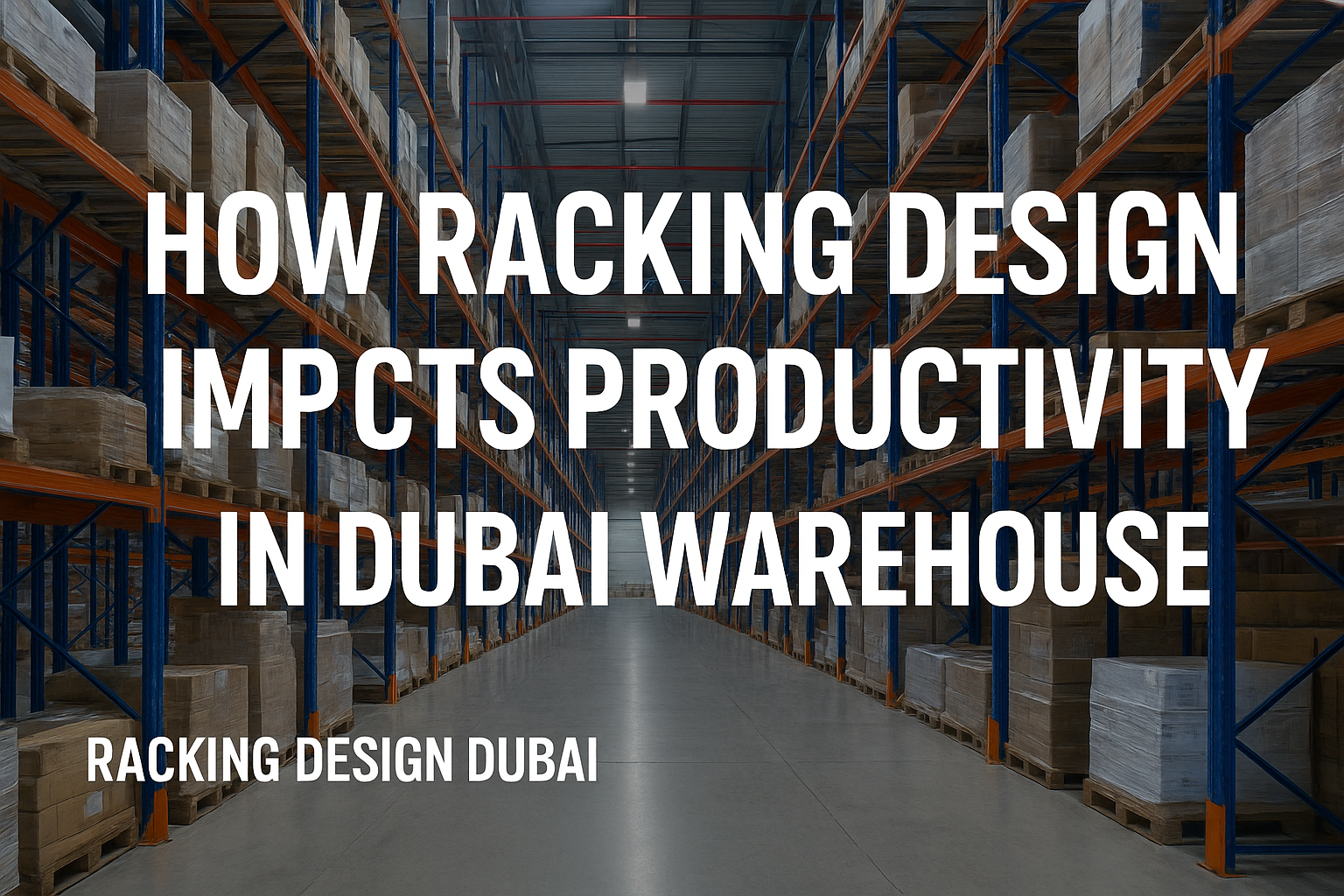
Warehouse productivity in Dubai depends on far more than manpower and material handling equipment. Today, one of the biggest contributors to operational efficiency is the warehouse racking design. With Dubai quickly becoming a global logistics hub, businesses must optimize storage layouts to keep pace with rapid inventory turnover, rising labor costs, and increasing customer expectations for fast delivery.
A well-engineered racking design in Dubai can increase usable space, improve travel routes, reduce picking errors, and drastically enhance safety. This directly impacts overall warehouse productivity, cost efficiency, and long-term scalability.
This detailed guide explains how racking design influences productivity and offers strategies for optimizing layout, spacing, and storage systems inside Dubai warehouses.
1. Why Racking Design Is Critical for Dubai Warehouse Productivity
Racking is the structural backbone of any warehouse. In Dubai, where land costs are high and space utilization is crucial, racking layout and design determine whether a warehouse runs smoothly or suffers from congestion, slow movement, and operational inefficiencies.
Key Productivity Areas Influenced by Racking Design
- Storage capacity
- Picking and put-away speed
- Forklift travel distance
- Inventory accuracy
- Worker safety
- Material flow
Poor racking design results in wasted space, frequent traffic bottlenecks, employee fatigue, and limited storage depth. Optimized racking design, on the other hand, ensures every square meter is utilized efficiently.
2. Understanding the Unique Challenges of Dubai Warehouses
Dubai warehouses face various operational and environmental challenges. These challenges make racking design decisions more critical than in many other regions.
Common Challenges in Dubai Facilities
- High warehouse rental costs
- Large SKU variations across sectors
- Seasonal order spikes
- Frequent demand for fast-moving goods
- High temperature and humidity levels
- Need for compliance with local fire regulations
- Increasing use of automation and digital systems
Each of these factors must be considered when designing a racking system to enhance productivity and maximize pallet positions.
3. The Link Between Racking Layout and Warehouse Productivity
The layout of the warehouse greatly affects picking speed, movement flow, and forklift maneuverability.
3.1 Aisle Width Planning
Aisle configuration determines how easily workers and equipment move through the warehouse.
| Aisle Type | Width Range | Impact |
|---|---|---|
| Wide Aisle | 3.2 m to 4.0 m | Flexible, suitable for all forklift types |
| Narrow Aisle | 2.0 m to 2.8 m | Increases storage capacity by reducing wasted space |
| Very Narrow Aisle | 1.5 m to 1.8 m | Ideal for maximizing pallet positions |
Choosing the wrong aisle width can lead to constant traffic jams and forklift downtime. In Dubai, many warehouses switch to narrow and very narrow aisle systems to increase pallet density without expanding the facility.
4. How Different Racking Systems Affect Productivity
Every warehouse has a unique SKU profile. Choosing the right racking system directly influences efficiency and workflow.
4.1 Selective Pallet Racking
- Ideal for high SKU variety
- Offers 100 percent direct access
- Improves picking speed and accuracy
4.2 Drive-In and Drive-Through Racking
- Best for bulk storage with low SKU variety
- Provides high density
- Reduces travel time per pallet
4.3 Push-Back Racking
- Suitable for medium turnover products
- LIFO operation
- Faster pallet handling
4.4 Pallet Flow Racks
- FIFO compliant
- Ideal for perishables and cold storage
- Increases picking speed with gravity-driven lanes
4.5 Cantilever Racking
- Designed for long or irregular goods
- Improves safety and handling
- Minimizes product damage
4.6 Mezzanine Racking Systems
- Increases floor surface without expanding footprint
- Widely used in e-commerce and retail distribution
- Improves picking efficiency by creating defined zones
Each system influences accessibility, workflow speed, and operational costs. Choosing the correct system is essential for optimizing productivity.
5. Slotting Optimization and Its Impact on Performance
Slotting refers to assigning specific locations to SKUs based on movement and priority.
Slotting Best Practices
- Place fast movers closer to dispatch zones
- Avoid storing heavy items on upper levels
- Group similar SKUs together
- Use ABC analysis to categorize inventory
- Align SKU storage with picking patterns
Effective slotting can reduce picking time by 25 percent and minimize worker fatigue.
6. Material Flow and Movement Efficiency
A productive Dubai warehouse requires smooth traffic flow from inbound to outbound processes. Racking design strongly contributes to this.
Key Flow Optimization Strategies
- Clearly defined inbound and outbound zones
- Unidirectional forklift travel paths
- Minimized cross-traffic points
- Proper staging areas near docks
- Dedicated pedestrian pathways
Optimized material flow reduces accidents, delays, and mispicks.
7. How Racking Design Enhances Warehouse Safety
Safety has a direct impact on productivity. Accidents lead to downtime, damaged goods, increased insurance costs, and disruptions.
Safety Benefits of Proper Racking Design
- Prevents overloading issues
- Eliminates blind spots for forklift drivers
- Reduces pallet instability
- Ensures compliance with fire and safety standards
- Minimizes worker injury risk
Dubai Civil Defence requires proper spacing, certified materials, and safe load capacities, which must be factored into the racking design.
8. Environmental Factors in Dubai That Influence Racking
Dubai’s climate is harsh on warehouse materials. High heat and humidity can cause steel to expand or corrode over time.
Environmental Considerations
- Use of galvanized or powder-coated racking
- Moisture and heat-resistant materials
- Proper ventilation systems
- Dust-proofing for automation sensors
These elements ensure long-term structural stability and smooth operations.
9. Technology and Automation in Racking Design
Automation is becoming increasingly common in Dubai warehouses. Racking must be compatible with advanced systems.
Popular Technologies
- Warehouse Management Systems
- Automated Storage and Retrieval Systems
- RFID tracking
- Pick-to-light systems
- Barcode automation
Integrating technology results in faster throughput, reduced errors, and predictive inventory planning.
10. Common Racking Design Mistakes That Lower Productivity
Many warehouses in the UAE suffer productivity losses due to preventable design errors.
Major Mistakes
- Incorrect aisle widths for existing forklifts
- Mixed pallet sizes
- Insufficient safety barriers
- Poor lighting around racks
- Inadequate space near loading docks
- Choosing cheaper but weaker rack materials
- Ignoring future expansion plans
Addressing these issues improves safety and efficiency immediately.
11. Calculating Productivity Gains and ROI from Racking Design
Investing in racking design produces measurable operational benefits.
Typical Outcomes
- 20 to 50 percent faster picking times
- 30 to 60 percent more pallet positions
- 15 to 25 percent labor cost reduction
- Fewer forklift incidents
- Lower rack and pallet damage
- Higher inventory accuracy
ROI is generally achieved within 12 to 24 months.
12. Future Trends in Racking Design for Dubai Warehouses
Dubai continues to adopt global best practices and new technologies.
Key Trends
- Robotics-assisted picking
- Artificial intelligence in slotting
- Smart racks with real-time load sensors
- Fully automated cold storage systems
- Modular racks that allow fast reconfiguration
Adopting these trends ensures competitiveness and long-term warehouse efficiency.
Racking design is one of the most powerful tools for improving productivity inside Dubai warehouses. A well-designed racking system optimizes travel paths, increases pallet positions, supports automation, and ensures worker safety. Whether you are redesigning an existing warehouse or building a new facility, focusing on racking design will significantly enhance operational performance.
Dubai’s fast-growing logistics sector demands efficient, scalable warehouse infrastructure, and strategic racking design is essential for meeting that demand.
Frequently Asked Questions
1. How does racking design improve productivity in Dubai warehouses?
It reduces travel time, enhances accessibility, increases storage density, and ensures smooth material flow.
2. What is the most efficient racking system for Dubai warehouses?
Selective racking is best for SKU variety, while VNA and drive-in racks offer high density for bulk storage.
3. How can I increase pallet positions without expanding warehouse size?
Use VNA systems, double-deep racks, mezzanine floors, or optimized slotting strategies.
4. What aisle width is ideal for Dubai warehouses?
- Wide Aisle: 3.2 m to 4.0 m
- Narrow Aisle: 2.0 m to 2.8 m
- Very Narrow Aisle: 1.5 m to 1.8 m
5. Does Dubai’s climate affect racking systems?
Yes. High heat and humidity require corrosion-resistant materials and proper ventilation.
6. How soon can I see ROI after redesigning warehouse racking?
Most businesses see positive ROI within 12 to 24 months due to labor savings and increased storage efficiency.