
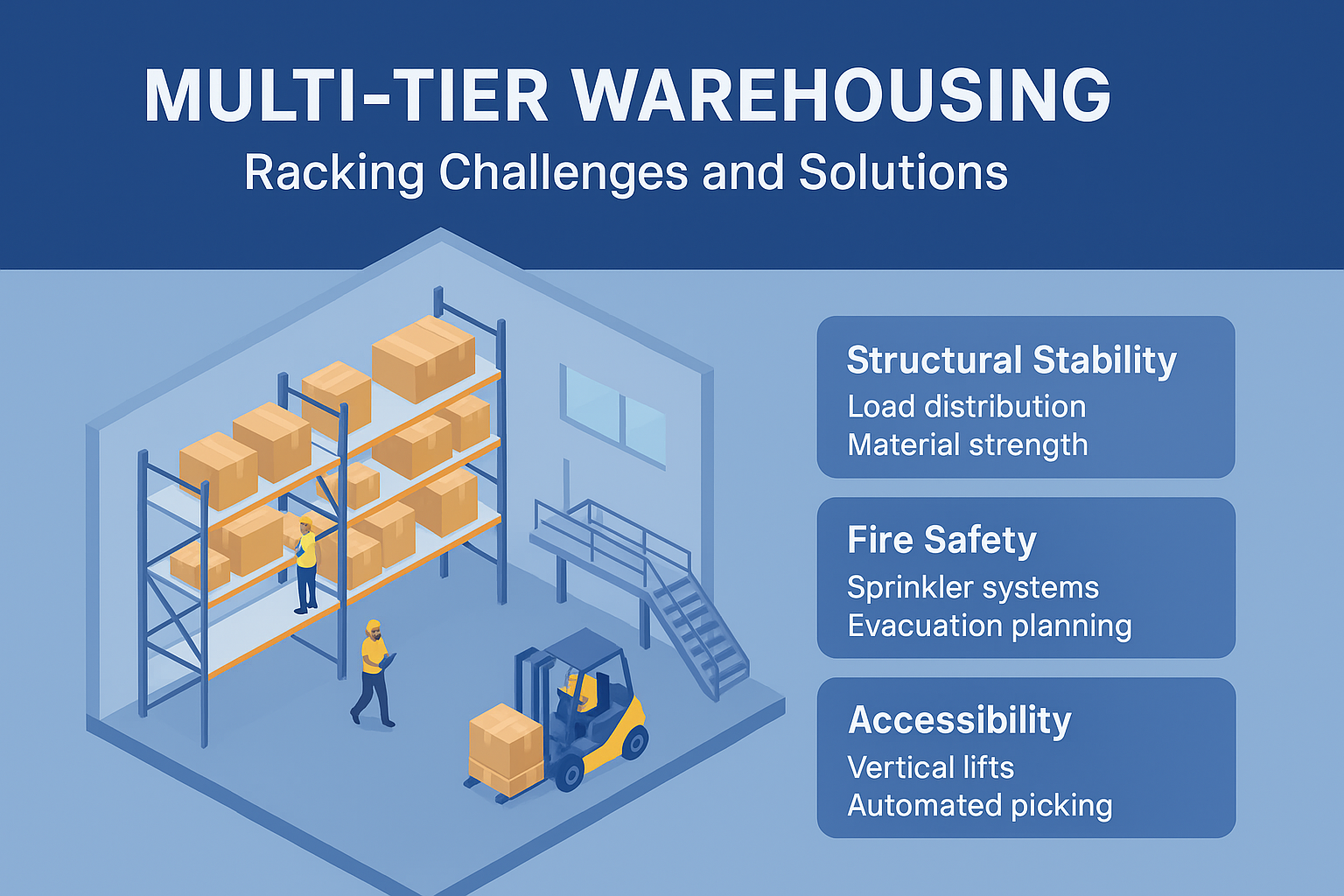
As logistics demands in the UAE continue to accelerate, multi-tier warehousing has emerged as a preferred strategy to optimize space and enhance storage capacity. With land costs and operational pressures rising, businesses are increasingly turning to multi-tier warehouse designs to maximize vertical space and streamline operations.
However, this approach also brings a unique set of racking challenges from structural stability to worker safety and inventory accessibility. In this article, we explore the key design hurdles of multi-tier racking systems in UAE warehouses and examine the smart solutions that can transform these challenges into opportunities for efficiency and safety.
Understanding Multi-Tier Warehousing
Multi-tier warehousing involves constructing storage systems with multiple levels, often using mezzanine floors or integrated racking platforms. These setups allow businesses to utilize vertical space within the warehouse, effectively multiplying storage capacity without expanding the building footprint.
In markets like Dubai and Abu Dhabi, where land and construction costs are premium, multi-tier designs are increasingly popular in sectors such as e-commerce, cold storage, automotive parts, and retail logistics.
A multi-tier system can include:
- Two to four levels of racking platforms
- Integrated staircases and lifts for access
- Lighting, ventilation, and safety barriers
- Load-bearing flooring for manual or automated picking
While the benefits are clear, the implementation is far from simple.
Key Racking Challenges in Multi-Tier Warehousing
1. Structural Stability and Load Distribution
The biggest concern in multi-tier systems is the load-bearing capacity of racks and floors. Each level adds weight, and improper load distribution can compromise the structural integrity of the entire system.
In the UAE, where warehouses must also withstand high temperatures and occasional seismic activity, material strength and design precision are crucial.
Solution:
Partner with certified rack manufacturers who comply with FEM and SEMA standards. Conduct rack inspections and load testing before and after installation. Use finite element analysis (FEA) software to simulate load conditions and prevent structural stress.
2. Fire Safety and Evacuation Planning
With multiple tiers, fire safety becomes a more complex issue. Limited access points and elevated floors can hinder quick evacuation and firefighting operations. The UAE’s Civil Defence regulations require warehouses to maintain proper fire escape routes, alarms, and sprinkler systems across all levels.
Solution:
Integrate fire-rated materials, install automated fire suppression systems, and ensure clear signage and access paths. Conduct safety audits regularly and maintain open communication with local authorities for compliance certification.
3. Accessibility and Workflow Efficiency
As storage levels increase, accessibility can suffer. Manual pickers and forklifts face longer retrieval times, and improper layout design can cause bottlenecks.
Solution:
Incorporate automated picking systems, vertical lifts, or conveyor integrations for smoother movement of goods. Optimize rack design with SKU-based zoning, ensuring frequently accessed products are stored at ground or mid-level tiers.
4. Lighting and Ventilation Challenges
Multi-tier warehouses often face poor lighting on upper and lower levels, leading to visibility issues and reduced worker efficiency. Likewise, enclosed rack tiers can restrict airflow, increasing heat accumulation.
Solution:
Use LED motion-sensor lighting and industrial fans or ducted HVAC systems for consistent air circulation. Transparent flooring or skylight panels can also help distribute natural light efficiently across tiers.
5. Maintenance and Inspection Difficulties
As racking systems become more complex, regular maintenance becomes harder to execute. Inspecting each tier, joint, and beam requires specialized equipment and trained staff.
Solution:
Adopt predictive maintenance technologies using IoT sensors that monitor rack stress and vibrations. Implement digital maintenance logs for real-time condition tracking and automated inspection reminders.
Best Practices for Multi-Tier Racking in the UAE
- Comply with UAE Fire & Safety Codes: Always verify that the system adheres to Dubai Civil Defence and Abu Dhabi Occupational Safety and Health requirements.
- Choose Quality Materials: Galvanized or powder-coated steel racks perform better under high humidity and temperature conditions.
- Design for Scalability: Plan layouts that can accommodate future automation upgrades, such as AS/RS or shuttle systems.
- Employee Safety Training: Conduct regular safety drills and provide proper harnessing and PPE for workers operating on elevated platforms.
- Work with Certified Installers: Partner with experienced racking specialists in the UAE who provide design, installation, and load testing as a complete service.
Future Trends in Multi-Tier Warehousing UAE
The UAE’s logistics landscape is moving toward smart warehouses, powered by automation and AI-driven management systems. The next evolution of multi-tier warehousing will involve:
- Robotic picking systems that navigate multiple levels autonomously.
- Digital twins for real-time performance monitoring.
- Energy-efficient LED and solar lighting for sustainability.
- Hybrid storage solutions integrating pallet, carton, and vertical carousels within one modular system.
These innovations will help UAE warehouses overcome current design challenges while improving safety and cost efficiency.
Conclusion
Multi-tier warehousing is transforming how UAE businesses utilize space, reduce costs, and meet growing supply chain demands. However, without addressing the unique racking challenges — such as load stability, safety compliance, and workflow optimization — these systems can pose significant risks.
The key lies in thoughtful design, regulatory compliance, and smart technology integration. With the right planning and partners, multi-tier racking systems can deliver exceptional performance, safety, and scalability for the future of logistics in the UAE.
Frequently Asked Questions (FAQs)
1. What is a multi-tier warehouse?
A multi-tier warehouse is a storage facility that uses multiple levels of racking or mezzanine floors to increase vertical storage capacity without expanding the building footprint.
2. Why is multi-tier racking popular in the UAE?
Due to high land costs and growing logistics demand, UAE businesses use multi-tier systems to maximize space efficiency and improve inventory management.
3. How can I ensure safety in a multi-tier warehouse?
Follow UAE Civil Defence standards, conduct regular rack inspections, and install fire protection, safety barriers, and proper lighting across all levels.
4. What materials are best for multi-tier racks in UAE?
Galvanized steel or powder-coated metal racks perform best in UAE’s hot and humid climate, providing durability and corrosion resistance.
5. Can multi-tier warehouses support automation?
Yes. They can integrate with automated storage and retrieval systems (AS/RS), conveyor belts, and robotic picking solutions for faster, safer operations.