
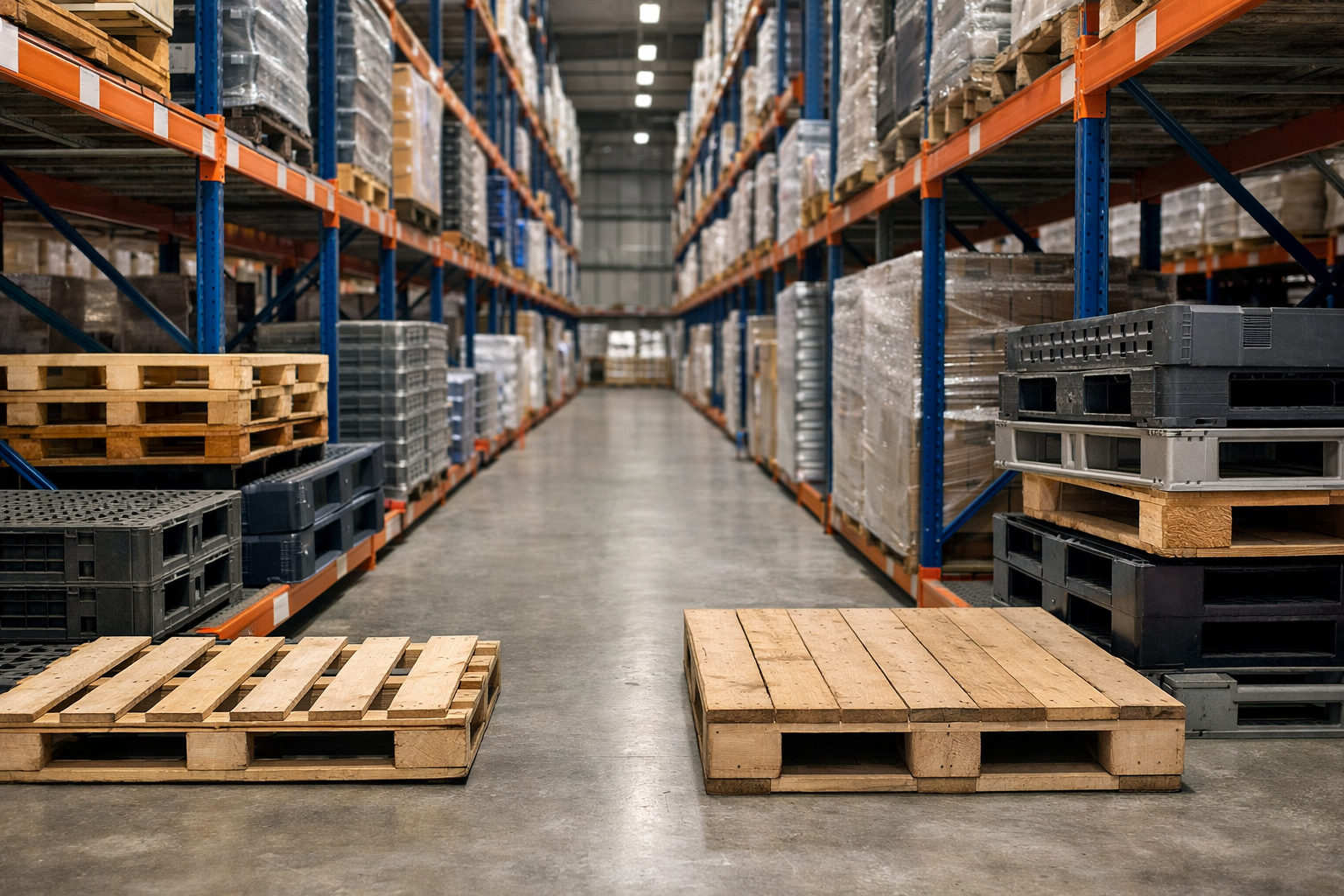
Pallet geometry plays a critical role in how safely and efficiently goods are stored inside a warehouse. Many facilities invest in racking systems but overlook how pallet geometry affects rack fit, space planning, and load handling. Pallet sizes, construction types, and load support dimensions shape how storage systems perform. Careful attention to pallet geometry helps businesses improve safety, reduce product damage, and maximize storage density.
Why Pallet Geometry Matters in Modern Storage
Warehousing conditions continue to change as supply chains grow more complex. Pallets are now used across automated, refrigerated, and mixed-load facilities. Because each pallet design interacts differently with steel racking, understanding key measurements is essential for maintaining safe clearance and preventing costly damage.
Key Geometry Factors to Consider
Important pallet features that affect rack fit include:
- Length and width (footprint dimensions)
- Deck board spacing
- Overhang or undersizing
- Bottom support design
- Load-bearing capacity
- Material type such as wood, plastic, or metal
Even small dimensional variations can lead to misalignment or create weight imbalance across beams.
Standard Pallet Sizes and Their Implications
Globally used pallets do not follow one universal sizing rule.
Widely referenced formats include:
- 1,200 x 1,000 mm – common in Europe and Asia
- 48 x 40 inches (GMA Standard) – prevalent in North America
- Australian Standard 1,165 x 1,165 mm
- 1,100 x 1,100 mm for high-density stack configurations
These variations influence aisle widths, forklift access, and beam spacing.
How Pallet Geometry Influences Rack Fit
Ensuring Safe Support on Beams
A pallet that is too short may not rest properly on rack beams, leaving loads partially unsupported. On the other hand, excessive overhang risks instability, especially under heavy weights or in mobile racking systems.
Compatibility with Different Rack Types
Pallet geometry becomes even more important in:
- Selective racking
- Drive-in or drive-through systems
- Push-back racks
- Pallet flow and gravity systems
- Shuttle and AS/RS installations
Automated environments often require precise alignment to minimize damage to conveyors, shuttle tracks, and sensors.
Material and Construction Differences
Wood pallets flex more than molded plastic pallets. Metal pallets hold shape, but can add weight. These material behaviours influence:
- Beam loading
- Deflection under strain
- Fit tolerance
Designing Warehouse Layouts Around Pallet Geometry
Facility planners increasingly use data tools to simulate pallet movement. The right pallet size leads to:
- Better cube utilization
- Lower handling times
- Reduced rack repair
- Safer operational practices
- More predictable maintenance schedules
In contrast, mixed pallet fleets may require reinforcement bars, deck panels, or hybrid storage solutions.
What This Means for Warehouse Operators
Small changes in pallet geometry can have large effects on rack performance and safety. Facilities that standardize pallet sizes often gain measurable improvements in efficiency. Where standardization is not possible, understanding the geometric constraints helps operators adjust rack spacing, introduce support accessories, or design specialized storage zones.
Key Takeaways
- Pallet geometry directly affects rack fit, safety, and material flow.
- Dimensional variation requires careful assessment before palletizing goods.
- Standard pallet sizes differ across regions and sectors.
- Rack type and pallet construction should always be evaluated together.
- Standardizing or auditing pallets can reduce long-term operational risk.
FAQs
Pallet geometry refers to the size, shape, and construction features of a pallet, including length, width, top deck spacing, and bottom support. These characteristics determine how well a pallet sits inside a racking system and how safely it carries loads in active warehouse environments.
Pallet geometry influences how securely a pallet rests on beams and support structures. Undersized or overhanging pallets can create imbalances, elevate the risk of product damage, or require operators to add safety reinforcements such as wire decking or pallet supports.
Regional standards include GMA 48×40 inches in North America, 1200×1000 mm in Europe and Asia, and 1165×1165 mm in Australia. Industries often adopt other configurations depending on handling methods, packaging formats, and equipment compatibility.
Mixed pallets can be used, but operators must evaluate rack spacing and load distribution. Uneven geometry may require accessories such as mesh decks, safety clips, or dedicated zones to ensure proper support and prevent goods from falling or shifting during movement.
Standardising pallet geometry simplifies inventory flow, reduces operational risks, and supports predictable loading. Facilities benefit from faster pallet handling, fewer system incompatibilities, and lower maintenance costs because racking components are used within intended capacity and alignment ranges.