
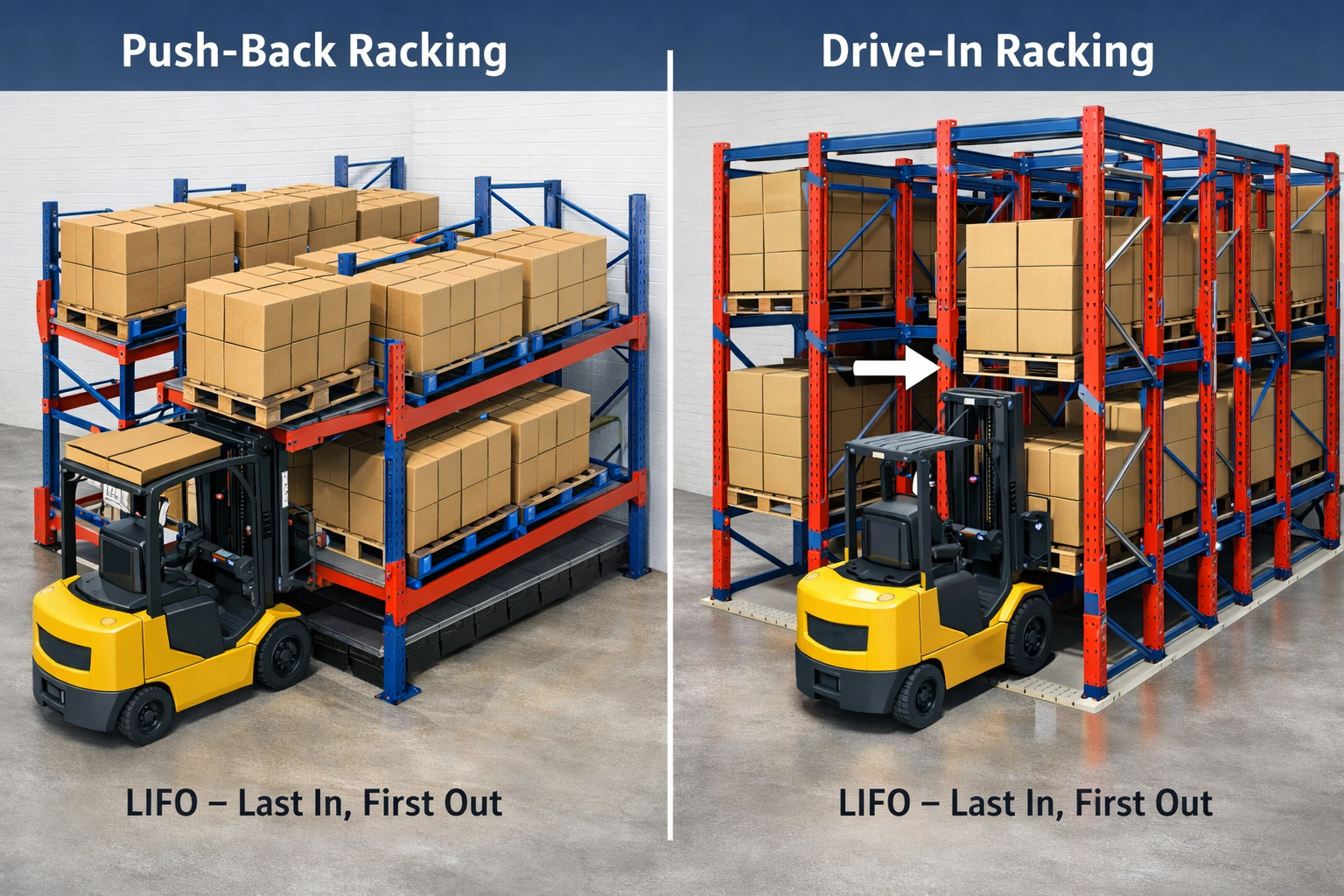
Warehouse designers often face a key decision when planning high-density pallet storage: push-back vs drive-in racking. Both systems maximize storage capacity, but they serve different operational needs. Selecting the right option can improve throughput, reduce product damage, and support inventory accuracy.
As supply chains grow more complex in 2026, storage strategy has become a performance factor, not just a space-saving measure. Industry groups such as MHI and WERC note that storage density must be balanced with accessibility, safety, and stock rotation requirements.
Understanding Push-Back vs Drive-In Racking Systems
Both systems reduce aisle space to increase pallet positions, yet they differ in how forklifts interact with stored loads.
What Is Push-Back Racking?
Push-back racking is a LIFO (Last-In, First-Out) storage system. Pallets sit on nested carts that roll along inclined rails. When a new pallet is loaded, it pushes the previous one back.
Key features include:
- Storage depth typically 2–6 pallets
- Forklifts remain in the aisle
- Faster pallet access than drive-in
- Lower risk of rack damage from forklift impact
This design suits operations with multiple SKUs and moderate selectivity needs.
What Is Drive-In Racking?
Drive-in racking is also a LIFO system, but forklifts drive directly into storage lanes to place or retrieve pallets.
Typical characteristics:
- Deep storage lanes, often 6–10 pallets deep
- High density for uniform products
- Lower upfront cost per pallet position
- Slower access times
Because forklifts enter the structure, this system requires strict operator training and rack protection measures.
Operational Differences That Matter
Inventory Flow: FIFO vs LIFO
Both systems generally operate under LIFO. However, push-back racks can sometimes be adapted to support limited FIFO in specific layouts. Drive-in systems rarely support FIFO without major design adjustments.
If product shelf life or lot control is critical, designers often explore alternatives like pallet flow racks instead.
Selectivity and SKU Variety
Push-back systems offer better selectivity because each lane can hold different SKUs. Drive-in racks work best when:
- There are few SKUs
- Products are stored in large batches
- Turnover rates are consistent
Facilities handling seasonal or promotional goods often favor push-back systems for flexibility.
Throughput and Labor Efficiency
Push-back racks allow forklifts to stay in the aisle, which reduces travel time and improves visibility. According to warehouse operations studies cited by WERC, minimizing forklift entry into racks can improve productivity and lower accident risk.
Drive-in systems, by contrast, slow down loading and retrieval because operators must carefully navigate inside lanes.
When to Specify Push-Back vs Drive-In
Choose Push-Back Racking When:
- SKU variety is moderate to high
- Faster picking or replenishment is required
- Product damage risk must be minimized
- Labor efficiency is a priority
- Storage depth of 2–6 pallets is sufficient
Choose Drive-In Racking When:
- Large volumes of the same SKU are stored
- Maximum density outweighs selectivity
- Inventory turns are predictable
- Budget constraints favor lower cost per position
- Cold storage environments require compact layouts
Cold storage facilities often use drive-in racks because reducing aisle space lowers refrigeration costs. However, push-back systems are increasingly used in temperature-controlled warehouses where faster access is needed.
Safety and Maintenance Considerations
Because forklifts enter drive-in structures, rack impact risk increases. Industry safety guidance, including OSHA-aligned practices, recommends:
- Rack protectors and guide rails
- Clear load signage
- Regular structural inspections
Push-back systems reduce structural contact but require proper cart maintenance to ensure smooth movement and load stability.
Cost Comparison Over Time
Initial installation costs for drive-in racks are usually lower. However, total cost of ownership can shift depending on:
- Labor time per pallet move
- Rack repair frequency
- Product damage rates
- Throughput demands
Facilities with high handling frequency may find push-back racks deliver better long-term value despite higher upfront investment.
Push-Back vs Drive-In in Modern Warehouse Design
Automation and data-driven slotting are influencing dense storage choices. Designers increasingly consider:
- SKU velocity data
- Seasonal demand fluctuations
- Labor availability
- Safety performance metrics
In mixed-SKU environments, push-back systems align better with flexible, data-informed layouts. Drive-in racks remain effective in stable, high-volume storage zones.
Key Takeaways
- Both systems increase pallet density by reducing aisle space
- Push-back racks offer better selectivity and faster access
- Drive-in racks provide maximum density for uniform SKUs
- Operational flow, safety, and labor efficiency should guide the decision
- Long-term performance often outweighs initial cost differences
FAQs
The main difference lies in forklift interaction and selectivity. Push-back racks keep forklifts in the aisle and use rolling carts for storage, while drive-in racks require forklifts to enter storage lanes. Push-back systems offer faster access and greater SKU flexibility, whereas drive-in racks maximize density for uniform inventory.
Both systems are used in cold storage, but for different reasons. Drive-in racks reduce aisle space, which can lower refrigeration costs. Push-back racks, however, improve access speed and reduce rack impact, making them suitable for temperature-controlled facilities with higher SKU variety or faster turnover.
Push-back racks are typically LIFO systems, but certain layouts can support limited FIFO with careful lane design. True FIFO performance is more reliably achieved with pallet flow systems. Drive-in racks generally operate strictly as LIFO due to deep lane configurations.
Push-back racks are often considered safer because forklifts remain outside the rack structure, reducing collision risk. Drive-in systems require forklifts to enter lanes, increasing the chance of structural impact. Proper training, rack protection, and inspections are essential for both systems.
Drive-in racks usually have a lower upfront cost per pallet position. However, push-back systems may lower long-term expenses through faster handling, reduced product damage, and fewer rack repairs. The best financial choice depends on throughput, SKU variety, and labor efficiency needs.