
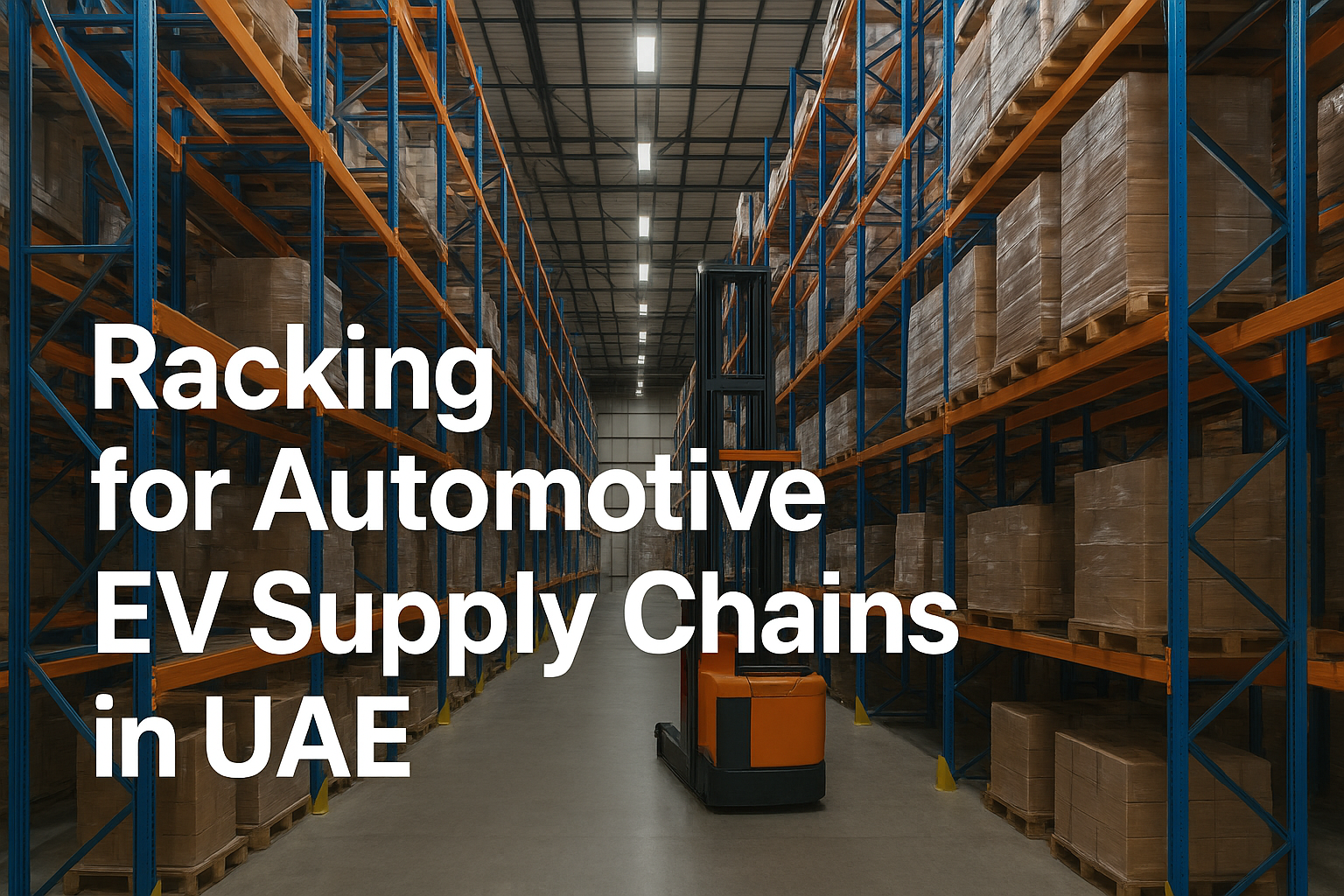
The EV Boom Meets Supply Chain Challenges
The United Arab Emirates (UAE) has positioned itself as a frontrunner in adopting and supporting the electric vehicle (EV) revolution. With ambitious sustainability goals, government incentives, and a rapidly growing consumer base, the EV sector in the UAE is expanding at an unprecedented rate. However, this growth brings a significant challenge: how to manage the specialized storage, logistics, and supply chain demands of EV components particularly batteries, chargers, and sensitive automotive parts.
This is where advanced racking systems play a crucial role. From temperature-controlled battery storage to high-density warehouse solutions, racking infrastructure is evolving to meet the specific needs of EV supply chains.
This article explores how EV supply chain racking in the UAE is transforming warehousing and logistics, enabling businesses to keep pace with the demands of the automotive industry.
1. The UAE’s EV Market Landscape
The UAE government has pledged to reduce carbon emissions by 40% by 2030, aligning with its Net Zero 2050 strategy. Part of this commitment is accelerating the adoption of EVs. Dubai’s Roads and Transport Authority (RTA) and Abu Dhabi’s Department of Energy are pushing policies that encourage EV adoption.
- Growing demand: Analysts project that EV sales in the UAE will triple by 2030.
- Infrastructure development: Charging stations are expanding across Dubai, Abu Dhabi, and Sharjah.
- Investment surge: Logistics providers and automakers are investing in specialized warehouses for EV components.
This momentum places new pressure on supply chains, particularly in ensuring safe storage and efficient handling of EV parts especially lithium-ion batteries, which require highly controlled environments.
2. Why EV Supply Chains Need Specialized Racking in the UAE
Unlike traditional automotive parts, EV supply chains require racking systems that can handle unique challenges:
- Battery sensitivity: Lithium-ion EV batteries are heavy, hazardous, and must be stored in fire-resistant, temperature-controlled racks.
- High-value inventory: EV components like motors and controllers are expensive, requiring secure and organized racking solutions.
- Space optimization: As warehouse real estate in the UAE is costly, high-density racking systems are essential to maximize storage.
- Sustainability requirements: Businesses must reduce energy use while maintaining efficient logistics, making automation and smart racking systems vital.
This makes EV supply chain racking UAE a niche but rapidly growing field that demands innovation.
3. Types of Racking Systems Suitable for EV Supply Chains
Different racking systems address the complex needs of the EV automotive sector in the UAE:
a. Selective Pallet Racking
- Ideal for storing bulky EV parts with easy accessibility.
- Works best for small-to-medium EV suppliers managing multiple SKUs.
b. Drive-In and Drive-Through Racking
- Provides high-density storage, saving valuable warehouse space.
- Effective for large volumes of similar EV parts such as charging stations or motor assemblies.
c. Cantilever Racking
- Perfect for storing long and irregular items like EV chassis components.
d. Cold Storage Racking for Batteries
- Essential for temperature-controlled environments, reducing risks of fire and degradation of EV batteries.
- UAE warehouses are increasingly integrating specialized insulated racks for lithium-ion storage.
e. Automated Racking Systems (AS/RS)
- UAE warehouses are adopting automated storage and retrieval systems to reduce labor costs and increase safety.
- Smart racking systems track battery health, location, and condition in real time.
4. Role of Technology in EV Supply Chain Racking in the UAE
The EV industry thrives on innovation, and warehousing is no exception.
- IoT-Enabled Racking: Smart sensors monitor temperature, humidity, and fire risks.
- Robotics Integration: Automated guided vehicles (AGVs) and robotic pickers streamline EV part movement.
- AI & Predictive Analytics: AI-driven warehouse management systems (WMS) help predict demand for batteries and critical parts.
- Blockchain Tracking: Ensures traceability in EV supply chains, crucial for both compliance and customer trust.
5. Safety Standards for EV Battery Racking in the UAE
Lithium-ion EV batteries present unique risks such as thermal runaway, leaks, and fires. Racking systems in the UAE must comply with international safety standards like:
- NFPA 855 (Standard for Energy Storage Systems)
- FM Global Safety Guidelines
- Dubai Civil Defence regulations for hazardous materials
Warehouses invest in fire-resistant racks, sprinkler integration, and partitioned storage zones to mitigate risks.
6. The Sustainability Connection
EVs themselves are part of a sustainable future, but their supply chains must also be eco-friendly.
- Energy-efficient racking (powered conveyors, solar-assisted automation).
- Recyclable racking materials like steel and aluminum.
- Circular supply chains where racks are designed for reuse and modular expansion.
This aligns with the UAE’s Green Economy Vision 2030.
7. Case Study: UAE Logistics Providers Leading the Way
Several leading logistics companies in Dubai and Abu Dhabi are investing in EV supply chain warehouses:
- DP World is integrating automated racking to handle EV imports.
- DHL UAE has developed a dedicated EV logistics division, focusing on secure battery storage.
- Local 3PLs are building hybrid facilities combining cold storage and conventional racking for EV parts.
8. Future of EV Supply Chain Racking in the UAE
Looking ahead, the UAE will continue to see innovation in racking systems for the EV sector:
- AI-powered predictive storage to optimize warehouse layouts.
- Green warehouses with solar-powered automated racking.
- Regional hubs in Dubai and Abu Dhabi serving the entire GCC EV market.
- Custom-built battery vaults within warehouses for ultra-safe storage.
The evolution of EV supply chain racking in UAE is not just about storage it’s about efficiency, safety, and sustainability driving the future of automotive logistics.
FAQs: EV Supply Chain Racking in UAE
Q1: Why is racking important in the EV supply chain?
Racking systems provide safe, efficient, and space-optimized storage for EV components, especially sensitive lithium-ion batteries.
Q2: What type of racking is best for EV battery storage in the UAE?
Cold storage or temperature-controlled racking is essential for maintaining battery safety and performance in UAE’s hot climate.
Q3: How do UAE warehouses ensure EV battery safety?
Warehouses use fire-resistant racks, IoT monitoring, and strict compliance with international and UAE safety regulations.
Q4: Are automated racking systems being used in EV logistics?
Yes, many UAE warehouses are adopting AS/RS, robotics, and AI-driven systems to manage EV parts with higher efficiency.
Q5: What role does sustainability play in racking systems for EVs?
Sustainable racking uses recyclable materials, modular designs, and energy-efficient automation, supporting UAE’s green goals.
The EV supply chain in the UAE is evolving rapidly, and racking systems are at the heart of this transformation. From cold storage solutions for batteries to AI-powered automated systems, racking is enabling UAE warehouses to meet the demands of a growing EV industry.
Businesses that invest in specialized EV supply chain racking UAE solutions will not only ensure safety and compliance but also gain a competitive advantage in the future of automotive logistics.