
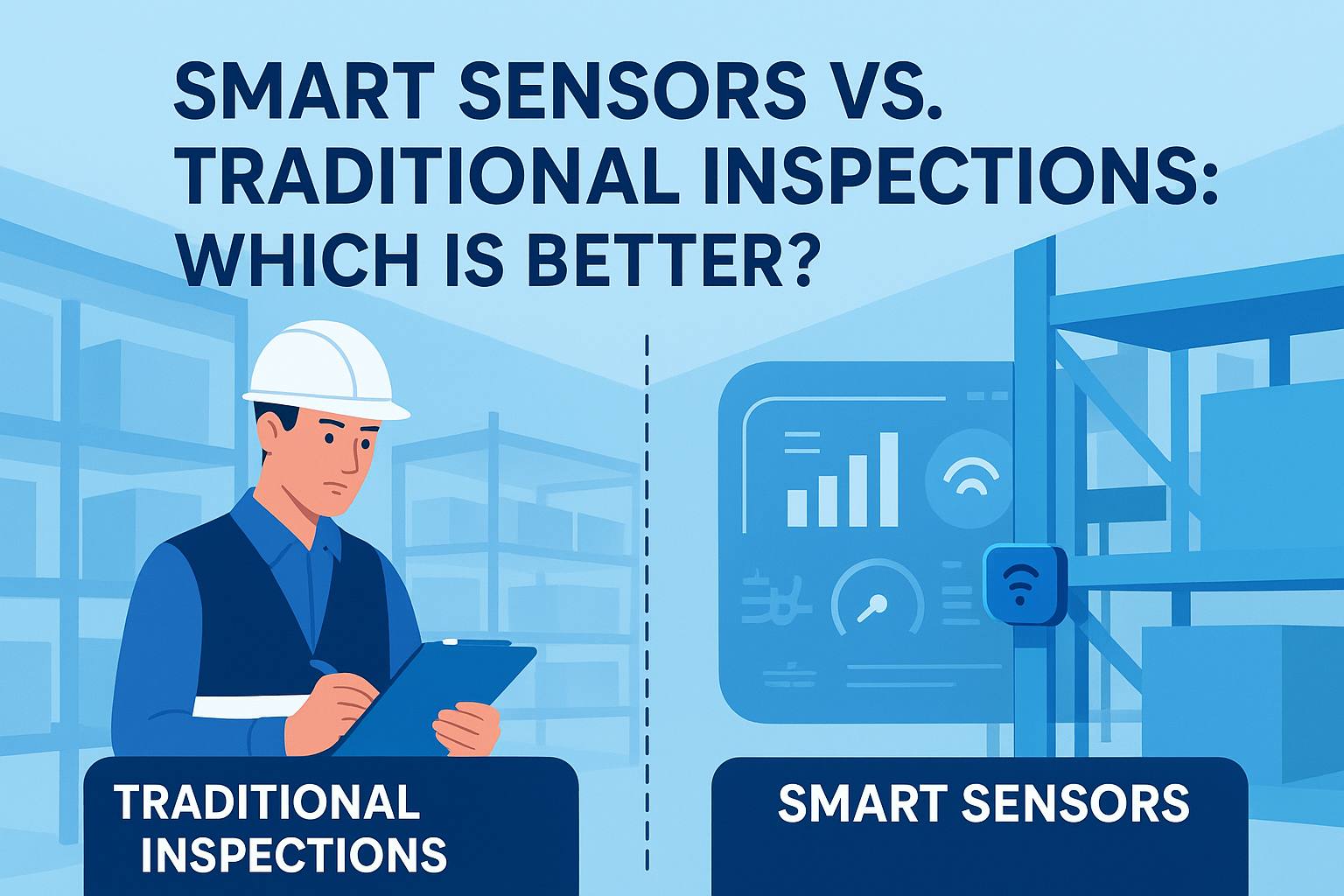
The Evolution of Racking Inspections in UAE Warehouses
The logistics and warehousing sector in the UAE has evolved rapidly in the past decade. With the rise of smart warehousing, the traditional methods of maintaining racking systems are being challenged by cutting-edge smart sensors and data-driven inspection tools.
For decades, manual racking inspections conducted periodically by trained inspectors were the backbone of warehouse safety. However, as warehouse operations scale up in regions like Dubai, Abu Dhabi, and Sharjah, manual methods are becoming increasingly inefficient, time-consuming, and prone to human error.
Enter the era of smart sensors devices capable of providing real-time data on racking stability, load stress, temperature fluctuations, and even vibration patterns. These sensors are transforming how warehouse operators monitor structural integrity and safety.
This article explores the key differences, benefits, and limitations of both systems—traditional inspections and smart sensors helping UAE warehouse owners make an informed choice about the future of their racking maintenance strategy.
1. Understanding Traditional Racking Inspections
What Are Traditional Racking Inspections?
Traditional inspections involve manual checks carried out by certified inspectors who visually assess racks for:
- Damage from forklifts or material handling equipment
- Misalignments and bent beams
- Loose or missing bolts
- Rust, corrosion, or fatigue in the structure
These inspections are typically scheduled monthly, quarterly, or annually depending on operational intensity.
Advantages of Traditional Inspections
- Human Expertise – Trained inspectors can identify issues that may not be captured by sensors, such as subtle deformation or poor rack installation.
- Regulatory Compliance – Manual reports are accepted as evidence for compliance with UAE warehouse safety standards and international norms like SEMA and FEM.
- Low Initial Cost – Requires minimal upfront investment compared to sensor infrastructure.
Limitations of Traditional Inspections
- Reactive Approach: Problems are detected after damage occurs.
- Time-Intensive: Large warehouses can take days to inspect manually.
- Human Error: Visual inspections can miss minor but critical signs of stress.
- Data Gaps: Lacks continuous monitoring and real-time insights.
In the high-speed logistics environment of the UAE, where downtime can cost thousands of dirhams per hour, relying solely on manual inspection is becoming less practical.
2. What Are Smart Sensors in Racking Systems?
Definition and Functionality
Smart sensors are IoT-enabled devices designed to monitor racking systems in real time. They collect data on:
- Load distribution and pressure
- Vibration and impact
- Structural strain and deflection
- Temperature and humidity (for cold storage facilities)
These sensors are connected to a central monitoring system that alerts facility managers instantly if any anomaly or risk is detected.
How Smart Sensors Work
Each sensor is attached strategically to rack beams, uprights, and braces. The sensors send continuous data to a cloud-based platform using wireless connectivity. Using AI analytics and predictive algorithms, the system can:
- Identify early warning signs of potential rack collapse
- Predict maintenance needs
- Track historical performance trends
Benefits of Smart Sensors for Racking Systems in UAE
- Real-Time Monitoring: Detects structural issues instantly, preventing accidents.
- Predictive Maintenance: Reduces downtime by forecasting when a rack needs repair or replacement.
- Enhanced Safety Compliance: Provides digital audit trails that align with UAE’s workplace safety laws.
- Cost Efficiency: Though initial setup is high, the ROI is significant through reduced damage, downtime, and insurance costs.
- Integration with Warehouse Management Systems (WMS): Data from sensors can feed directly into inventory and operations dashboards.
Smart Sensors in UAE Warehouses
In the UAE, smart sensor technology is increasingly adopted in Dubai Industrial City, JAFZA, KIZAD, and other logistics hubs. Major logistics companies and cold chain operators are integrating IoT monitoring to meet ESG goals and enhance asset longevity.
3. Key Differences: Smart Sensors vs. Traditional Inspections
| Feature | Traditional Inspections | Smart Sensors |
|---|---|---|
| Inspection Frequency | Periodic (monthly/quarterly) | Continuous (real-time) |
| Detection Speed | Reactive | Proactive |
| Accuracy | Depends on human expertise | Sensor-based precision |
| Cost | Low initial cost, high long-term maintenance | Higher upfront cost, lower long-term cost |
| Reporting | Manual reports | Automated digital dashboards |
| Data Availability | Limited historical data | Full data analytics and trends |
| Compliance Support | Manual documentation | Digital records for audit and ISO compliance |
| Suitability | Small-scale warehouses | Large-scale, automated facilities |
4. Why UAE Warehouses Are Moving Toward Smart Sensors
A. Rise of Smart Logistics
The UAE government’s Smart Dubai and Abu Dhabi Industrial Strategy 2031 initiatives encourage digital transformation across sectors, including logistics. Implementing smart sensors aligns with this vision by creating data-driven, safe, and sustainable warehouse operations.
B. High Cost of Warehouse Accidents
A single racking failure can lead to product losses worth hundreds of thousands of dirhams, not to mention potential injuries and downtime. Smart sensors minimize such risks through early detection.
C. Insurance and Compliance Benefits
Insurance providers in the UAE are beginning to recognize sensor-equipped warehouses as lower-risk assets, potentially offering better premiums. Additionally, digital inspection records simplify compliance with OSHA, ISO 45001, and local Civil Defense requirements.
D. Scalability
As e-commerce and cold storage demands grow, UAE warehouses are scaling up vertically and horizontally. Smart sensors enable monitoring across multiple sites from one centralized platform—something manual inspections cannot achieve efficiently.
5. Challenges of Implementing Smart Sensors
While the advantages are compelling, UAE businesses must consider the practical aspects:
- Initial Investment: Installing sensor systems can cost significantly more than manual inspection in the short term.
- Training Needs: Staff must be trained to interpret sensor data effectively.
- Connectivity Issues: Warehouses in remote or metallic environments may experience signal interference.
- Data Overload: Without proper analytics, too much data can overwhelm operations teams.
Despite these challenges, the long-term gains in safety, efficiency, and predictability make smart sensors a wise investment for modern UAE warehouses.
6. The Hybrid Approach: The Best of Both Worlds
Forward-thinking warehouse operators in the UAE are adopting a hybrid inspection model that blends:
- Smart sensors for real-time monitoring
- Periodic manual inspections for visual checks and compliance validation
This dual approach ensures full coverage combining the intuition of human inspectors with the precision of technology.
For example, in cold storage racking environments, sensors can detect temperature-related stress, while inspectors can identify corrosion or wear caused by condensation. Together, they create a comprehensive, failsafe system.
7. ROI and Long-Term Value of Smart Sensor Integration
Adopting smart sensors for racking systems in the UAE provides tangible returns:
- Reduced Downtime: Early detection prevents shutdowns.
- Extended Rack Lifespan: Preventative maintenance extends usability.
- Operational Efficiency: Real-time insights optimize load management.
- Enhanced Worker Safety: Reduces accident rates, fostering a safe workplace culture.
A recent study from the Middle East Facility Management Association (MEFMA) shows that smart monitoring can reduce warehouse maintenance costs by up to 30% annually.
8. Future Outlook: The Next Decade of Racking Safety in UAE
By 2030, experts predict that over 70% of large warehouses in the UAE will integrate IoT-based monitoring systems. As the logistics sector continues to expand driven by Expo City Dubai, Etihad Rail logistics, and e-commerce growth smart sensors will become an industry standard, not an option.
Planet Racking is at the forefront of this transformation, offering sensor-integrated racking systems and IoT-compatible safety solutions designed specifically for the UAE’s regulatory and environmental conditions.
Which Is Better for Your UAE Warehouse?
The answer depends on your operational scale and budget.
- For smaller warehouses, traditional inspections may still suffice provided they are frequent and well-documented.
- For large-scale or automated warehouses, smart sensors are clearly superior, offering unmatched precision, efficiency, and long-term cost savings.
In a market like the UAE, where safety, innovation, and compliance define success, the shift toward smart sensors in racking systems is not just a trend it’s the future.
FAQs
1. Are smart sensors mandatory for UAE warehouses?
Not yet, but regulatory authorities increasingly recommend adopting IoT-based monitoring to comply with safety standards and insurance requirements.
2. How often should traditional racking inspections be done?
Ideally every 3 to 6 months, depending on traffic, load capacity, and operational intensity.
3. Do smart sensors replace manual inspections entirely?
No. Smart sensors enhance traditional inspections by providing real-time data, but manual checks remain vital for visual assessment and compliance.
4. How much do smart sensors for racking systems cost in the UAE?
Prices vary based on technology and scale—typically between AED 100–300 per sensor, excluding installation and monitoring software costs.
5. Can smart sensors work in cold storage or freezer environments?
Yes, advanced sensors are designed to operate in extreme temperatures, making them ideal for cold chain logistics and freezer racking systems.
6. What kind of data do smart sensors collect?
They measure load stress, vibration, impact, temperature, and humidity, providing a 360-degree view of rack health and performance.