
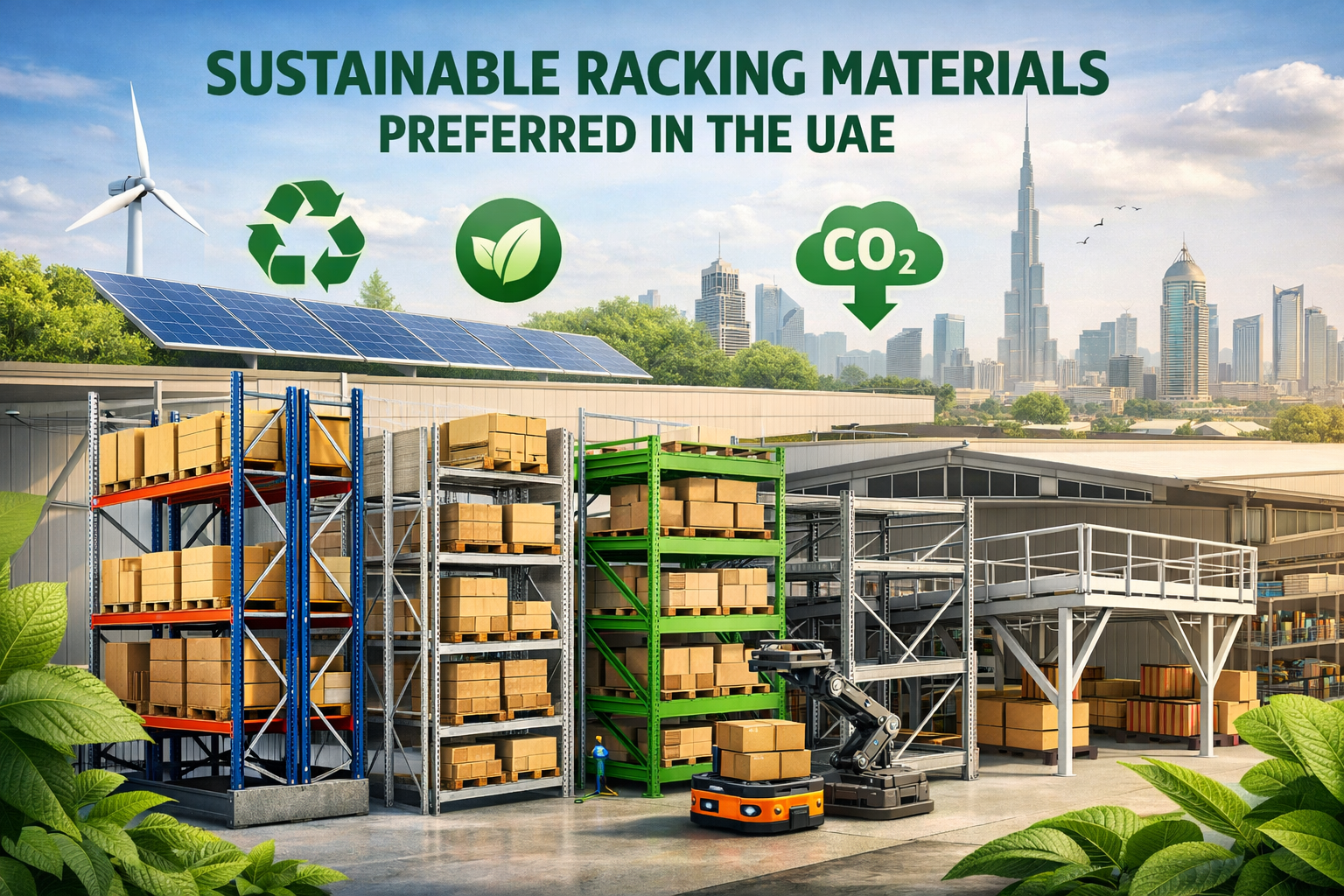
Why Sustainability Matters in UAE Warehousing
Sustainability is no longer a trend in the UAE. It is a strategic priority. From Dubai’s Clean Energy Strategy 2050 to Abu Dhabi’s sustainability frameworks, businesses across logistics, manufacturing, and retail are actively reducing their environmental footprint. Warehousing, a cornerstone of the UAE’s supply chain ecosystem, is undergoing a major transformation, and storage racking systems play a critical role in this shift.
Today, warehouse developers and operators are increasingly prioritising sustainable racking materials that offer durability, recyclability, energy efficiency, and compliance with environmental standards. Sustainable racking in the UAE is not only about reducing emissions. It is also about long-term cost efficiency, regulatory compliance, and corporate responsibility.
This article explores the most preferred sustainable racking materials in the UAE, why they are gaining popularity, and how businesses can future-proof their warehouses with eco-friendly storage solutions.
What Is Sustainable Racking?
Sustainable racking refers to storage systems designed, manufactured, and installed using environmentally responsible materials and processes. These systems aim to:
- Reduce raw material consumption
- Lower carbon emissions during manufacturing
- Maximise recyclability and reuse
- Improve warehouse energy efficiency
- Extend product lifespan to minimise waste
In the UAE context, sustainable racking also means heat resistance, corrosion protection, and structural longevity due to the region’s climate.
Key Drivers Behind Sustainable Racking Adoption in the UAE
1. Government Regulations and Long-Term Sustainability Goals
The UAE government strongly supports green infrastructure through initiatives such as UAE Net Zero by 2050, Dubai Industrial Strategy 2030, and the Estidama Pearl Rating System. Warehouses built with sustainable materials benefit from smoother approvals and long-term compliance.
2. Rapid Growth of Logistics and E-Commerce
As the UAE strengthens its position as a global logistics hub, warehouses must expand responsibly. Sustainable racking allows high-density storage while keeping environmental impact low.
3. Rising Corporate ESG Commitments
Many companies operating in the UAE follow global ESG standards. Environmentally responsible warehouse infrastructure has become a business requirement rather than an option.
Most Preferred Sustainable Racking Materials in the UAE
1. Recyclable Structural Steel
Structural steel remains the most widely preferred sustainable racking material in the UAE.
Why Steel Is Sustainable
- Fully recyclable without loss of strength
- Long lifespan exceeding 25 to 30 years
- Reduced need for frequent replacement
- Supports heavy and high-density storage
In the UAE, steel racking systems often contain recycled steel, significantly reducing carbon emissions.
Best Applications
- Pallet racking systems
- Drive-in and drive-through racks
- High-bay warehouse racking
- Automated storage systems
2. Galvanised Steel with Eco-Friendly Coatings
Galvanised steel is increasingly used due to its corrosion resistance and long service life, especially in coastal regions such as Dubai, Sharjah, and Abu Dhabi.
Sustainable Advantages
- Prevents rust without toxic chemical treatments
- Reduces maintenance and repainting requirements
- Extends racking lifespan in humid environments
Modern galvanisation processes in the UAE rely on low-emission zinc coatings that meet green manufacturing standards.
3. Powder-Coated Steel with Low VOC Emissions
Powder coating has replaced traditional liquid paints in sustainable warehouse racking.
Environmental Benefits
- Very low or zero VOC emissions
- No harmful solvents
- Recyclable overspray material
- Improved durability and scratch resistance
Powder-coated racking systems also improve indoor air quality, supporting worker health and safety.
4. Modular and Reconfigurable Racking Systems
Modular racking design plays a key role in sustainability.
Sustainability Benefits
- Minimises material waste during expansion
- Enables reuse during warehouse relocation
- Reduces demand for new raw materials
- Supports circular economy practices
UAE warehouses increasingly prefer adjustable and boltless racking systems that adapt to operational changes.
5. Aluminium Components for Light-Duty Storage
Aluminium is used selectively in light-duty and mezzanine racking applications.
Why Aluminium Is Sustainable
- Lightweight structure reduces transport emissions
- Highly recyclable material
- Naturally corrosion resistant
Although aluminium is not suitable for heavy pallet loads, it supports eco-friendly secondary storage solutions.
Sustainable Racking for Specialized UAE Warehouses
Cold Storage and Freezer Facilities
Sustainable racking for cold storage focuses on high-strength steel, thermal efficiency, and long-term performance in sub-zero environments. Eco-friendly freezer racking improves airflow and reduces energy consumption.
Automated Warehouses
Automated storage systems depend on precision-engineered recyclable steel and optimised material usage. Sustainable racking improves automation efficiency and lowers energy demand.
How Sustainable Racking Reduces Carbon Footprint
Sustainable racking systems help warehouses reduce emissions through lower embodied carbon, efficient layouts that cut electricity usage, reduced waste generation, and longer product lifecycles. Over time, these benefits significantly lower the environmental impact of warehouse operations.
Cost Benefits of Sustainable Racking in the UAE
While sustainable racking may have a slightly higher initial investment, it delivers strong long-term value through lower maintenance costs, extended service life, reduced energy consumption, and higher resale potential. In the UAE logistics sector, sustainability has become a cost-efficient strategy.
Choosing the Right Sustainable Racking Supplier in the UAE
When selecting a supplier, businesses should look for the use of recyclable materials, compliance with international standards, low-VOC coatings, modular designs, and proven experience in green warehouse projects.
Future of Sustainable Racking in the UAE
The future of sustainable racking includes AI-driven material optimisation, carbon-labelled products, renewable-energy integration, and fully circular racking systems designed for reuse. Eco-friendly racking is expected to become the industry standard across the UAE.
Frequently Asked Questions
What is the most sustainable racking material in the UAE?
Recyclable structural steel is the most sustainable and widely used option due to its durability and recyclability.
Is sustainable racking more expensive?
Initial costs may be higher, but long-term savings from durability and reduced maintenance offset the investment.
Can sustainable racking support heavy pallet loads?
Yes. Sustainable steel racking systems are engineered for heavy industrial storage.
Is sustainable racking suitable for cold storage warehouses?
Yes. Eco-friendly steel racking performs well in freezer and cold storage environments.
How does sustainable racking support UAE sustainability goals?
It reduces emissions, supports green building initiatives, and aligns with national net-zero targets.
Can existing racking systems be upgraded sustainably?
Yes. Many warehouses retrofit systems using modular components and eco-friendly coatings.
Is powder-coated racking environmentally friendly?
Yes. Powder coating produces minimal VOC emissions and allows material reuse.
Conclusion
Sustainable racking in the UAE is a smart investment for businesses aiming to improve efficiency, meet regulatory requirements, and reduce environmental impact. By choosing recyclable steel, eco-friendly coatings, and modular designs, warehouses can build resilient and future-ready storage infrastructure.