
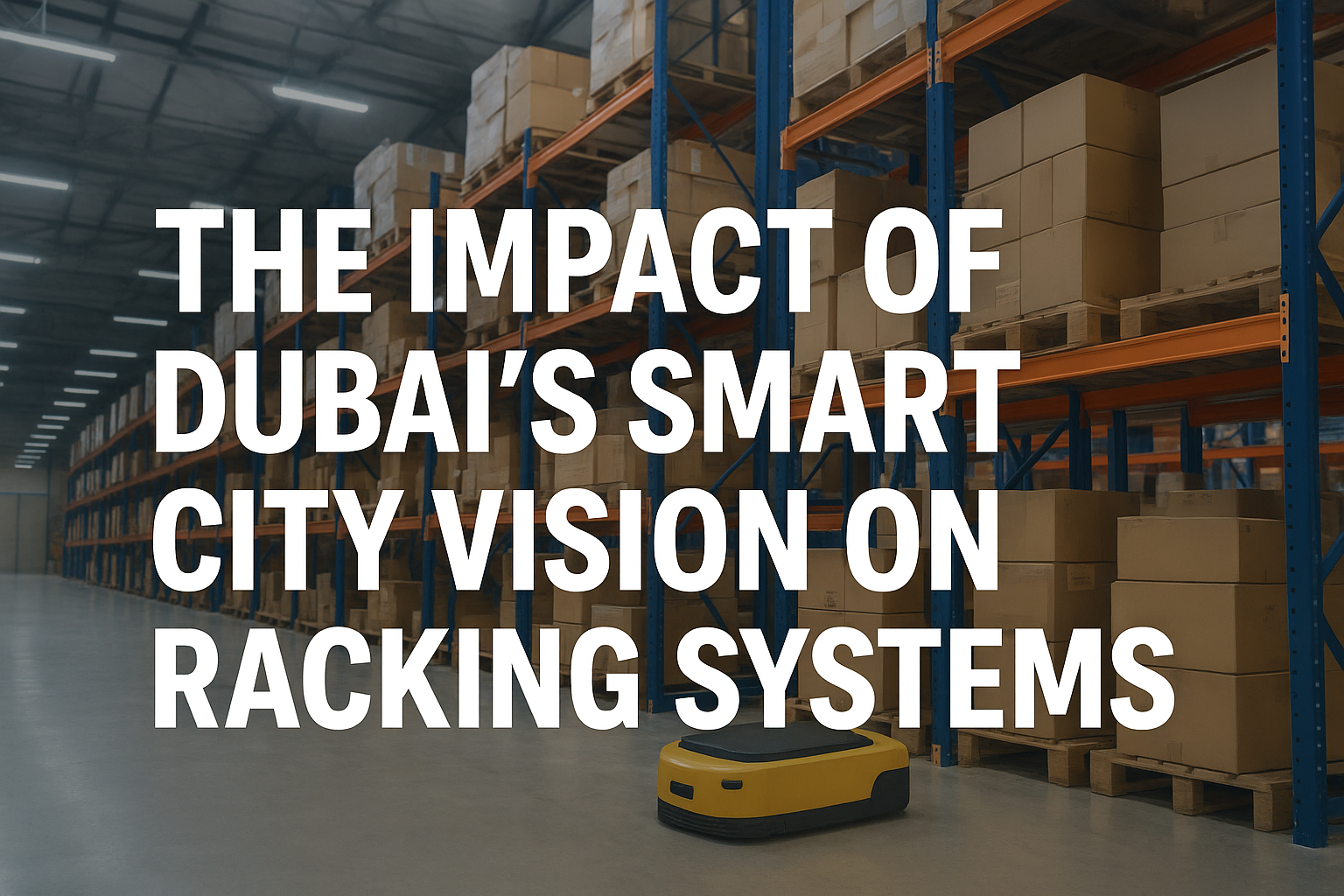
Smart City Meets Smart Storage
Dubai’s Smart City Vision is not merely a technological initiative it’s a transformative blueprint reshaping every layer of the city’s infrastructure, from transportation and energy to warehousing and logistics. As one of the world’s fastest-growing logistics hubs, Dubai’s shift toward digital, automated, and sustainable operations is redefining how goods are stored, tracked, and distributed.
At the heart of this transformation lies a silent yet critical component racking systems. The evolution of Dubai smart city racking underscores how technology, data, and automation converge to create next-generation warehouses that are leaner, faster, and smarter.
Dubai’s Smart City Vision: The Foundation of a Digital Economy
In 2014, the Dubai Government launched the Smart Dubai initiative, a bold program aimed at making Dubai the smartest and happiest city in the world. This vision is built on three key pillars:
- Efficiency through innovation
- Sustainability through smart resource management
- Connectivity through digital integration
Under this framework, industries across Dubai including logistics, cold storage, retail, and manufacturin are being encouraged to integrate IoT (Internet of Things), AI-driven systems, and data-centric decision-making into their operations.
For the warehousing sector, this means racking systems are no longer static steel structures they are becoming intelligent frameworks capable of communication, self-monitoring, and optimization.
Smart Warehousing: The Backbone of Dubai’s Logistics Future
Dubai’s strategic geographic position linking Asia, Europe, and Africa has made it a natural logistics hub. However, as e-commerce and just-in-time supply chains rise, traditional warehousing models are no longer sufficient.
Smart warehousing, powered by Dubai smart city technologies, is emerging as the answer. Here’s how:
1. IoT-Enabled Racking Systems
IoT sensors embedded within racks can monitor:
- Load weights
- Temperature and humidity (especially in cold storage)
- Rack integrity and maintenance needs
This enables real-time visibility and predictive maintenance minimizing downtime and increasing safety.
2. Automated Storage and Retrieval Systems (AS/RS)
These systems integrate with Warehouse Management Systems (WMS) to automate storage, retrieval, and dispatching of goods. In Dubai, many logistics players are investing in AS/RS to reduce labor dependency and increase efficiency by up to 30-40%.
3. AI-Driven Optimization
AI algorithms can analyze order patterns and warehouse layouts to recommend optimal racking configurations, enhancing storage density and retrieval speed.
4. Digital Twin Integration
Dubai’s Smart City framework promotes the use of digital twins virtual replicas of physical infrastructure. When applied to warehouses, digital twins simulate racking performance, predict wear and tear, and model space utilization scenarios.
The Role of Racking Systems in Dubai’s Smart Infrastructure
In a smart logistics ecosystem, racking systems play a foundational role. They bridge the gap between physical goods and digital operations. Let’s explore the key functions:
1. Data-Driven Efficiency
With sensors embedded into racks, every pallet position becomes a data point. This transforms racking from a passive structure to an active node within the logistics network.
2. Sustainability and Green Warehousing
Sustainability is a core part of Dubai’s vision. Smart racking contributes by:
- Optimizing vertical space, reducing warehouse footprint.
- Supporting energy-efficient automation systems.
- Integrating with solar-powered smart warehouses in industrial zones like JAFZA and Dubai Industrial City.
3. Safety and Compliance
Real-time alerts from smart racks can detect structural stress, temperature spikes, or overloading helping facilities comply with Dubai Civil Defense and ESMA safety standards.
How Dubai’s Smart City Initiatives Influence Warehouse Design
Smart city logistics demand a fusion of architecture, automation, and analytics. Modern warehouses in Dubai are being designed to reflect these principles:
1. Vertical Warehousing
Given land scarcity, vertical storage solutions enabled by high-bay racking systems are becoming the norm. These are integrated with robotic cranes and shuttle systems.
2. Modular and Scalable Racking
Smart warehouses are adopting modular racking systems that can be reconfigured as business needs evolve. This flexibility aligns with Dubai’s agile infrastructure philosophy.
3. Integration with Smart Transportation
Racking systems are linked with autonomous forklifts, drones, and AGVs (Automated Guided Vehicles), ensuring seamless inventory movement from rack to truck.
4. Energy-Efficient Lighting and Automation
IoT-linked lighting systems activate only in occupied zones, reducing energy consumption by up to 60%.
Technological Innovations Driving Dubai Smart City Racking
The convergence of AI, IoT, robotics, and blockchain is creating a new era in warehousing. Below are key innovations shaping racking systems:
1. RFID-Enabled Racks
These track product movements across the supply chain—enhancing traceability, especially in pharmaceutical and food logistics.
2. Predictive Analytics for Maintenance
AI systems can predict when a racking structure might require inspection or reinforcement reducing unplanned downtime.
3. Blockchain-Based Inventory Management
Smart contracts verify and record each storage transaction, increasing transparency and security.
4. AR (Augmented Reality) for Warehouse Navigation
AR-powered glasses help workers quickly locate inventory by visually highlighting rack positions and paths.
Case Studies: Smart Racking in Action in Dubai
1. DP World’s Smart Logistics Hub
DP World’s Jebel Ali Free Zone warehouses use automated storage systems and IoT-linked racking for real-time asset tracking and optimized operations.
2. Dubai South Logistics District
The district integrates smart infrastructure and sustainability with digital warehousing systems achieving faster turnaround and reduced energy consumption.
3. E-Commerce Fulfillment Centers
Major players like Amazon MENA and Namshi utilize intelligent racking to handle fluctuating inventory volumes efficiently.
The Economic Ripple Effect
Smart racking isn’t just improving operations it’s reshaping Dubai’s industrial economy.
- Efficiency Gains: Reduced labor costs and faster inventory turnover.
- Sustainability: Lower carbon footprint through space optimization.
- Investment Appeal: Global logistics firms are drawn to Dubai’s tech-ready ecosystem.
- Job Evolution: Shift from manual labor to tech-oriented warehouse management roles.
By 2030, analysts predict that over 80% of warehouses in Dubai will adopt some form of smart automation or IoT-driven racking.
Challenges and Considerations
While the transition to Dubai smart city racking is promising, it also presents challenges:
- High Initial Investment: Smart systems require significant upfront costs.
- Technical Skill Gaps: Workforce training in data management and system operation is critical.
- Cybersecurity Risks: IoT connectivity introduces new vulnerabilities.
- Regulatory Compliance: Ensuring adherence to UAE safety and building standards remains essential.
Planet Racking and similar solution providers play a pivotal role in helping businesses navigate these complexities through customized smart racking solutions tailored for Dubai’s industrial ecosystem.
The Future: Fully Connected Supply Chains
Looking ahead, Dubai’s warehouses are expected to evolve into fully autonomous logistics hubs where AI, robotics, and 5G connectivity converge. Racking systems will serve as the structural spine of these intelligent networks enabling instant inventory tracking, predictive stocking, and carbon-neutral operations.
In alignment with Dubai’s Vision 2040, the warehousing industry will continue embracing sustainable and data-driven innovation, ensuring the Emirate remains a global leader in smart logistics.
The impact of Dubai’s Smart City Vision on racking systems goes far beyond warehouse efficiency it signifies a transformation in how industries think about infrastructure, data, and sustainability.
From IoT-enabled racks to AI-powered logistics, the Dubai smart city racking revolution is setting new benchmarks for the Middle East’s industrial sector. For businesses operating in or entering Dubai, investing in intelligent racking infrastructure isn’t optional it’s essential for staying competitive in the era of smart logistics.
Frequently Asked Questions (FAQs)
1. What is Dubai’s Smart City Vision?
Dubai’s Smart City Vision is a government initiative aimed at integrating technology and data into every aspect of urban life to enhance efficiency, sustainability, and quality of life.
2. How does the Smart City initiative affect warehousing?
It promotes the adoption of automation, IoT, and AI in warehousing leading to more efficient, sustainable, and data-driven operations.
3. What are smart racking systems?
Smart racking systems are advanced storage structures embedded with sensors and connectivity features that monitor performance, safety, and inventory in real-time.
4. Why are smart racking systems important in Dubai?
As Dubai evolves into a logistics powerhouse, smart racking ensures faster, safer, and more sustainable warehousing aligned with the city’s Smart Vision goals.
5. What technologies drive Dubai smart city racking?
Key technologies include IoT sensors, AI optimization, robotics, digital twins, and blockchain for transparent inventory management.
6. How can companies implement smart racking in Dubai?
By partnering with specialized providers like Planet Racking, businesses can design customized racking solutions that integrate IoT and automation in compliance with UAE regulations.