
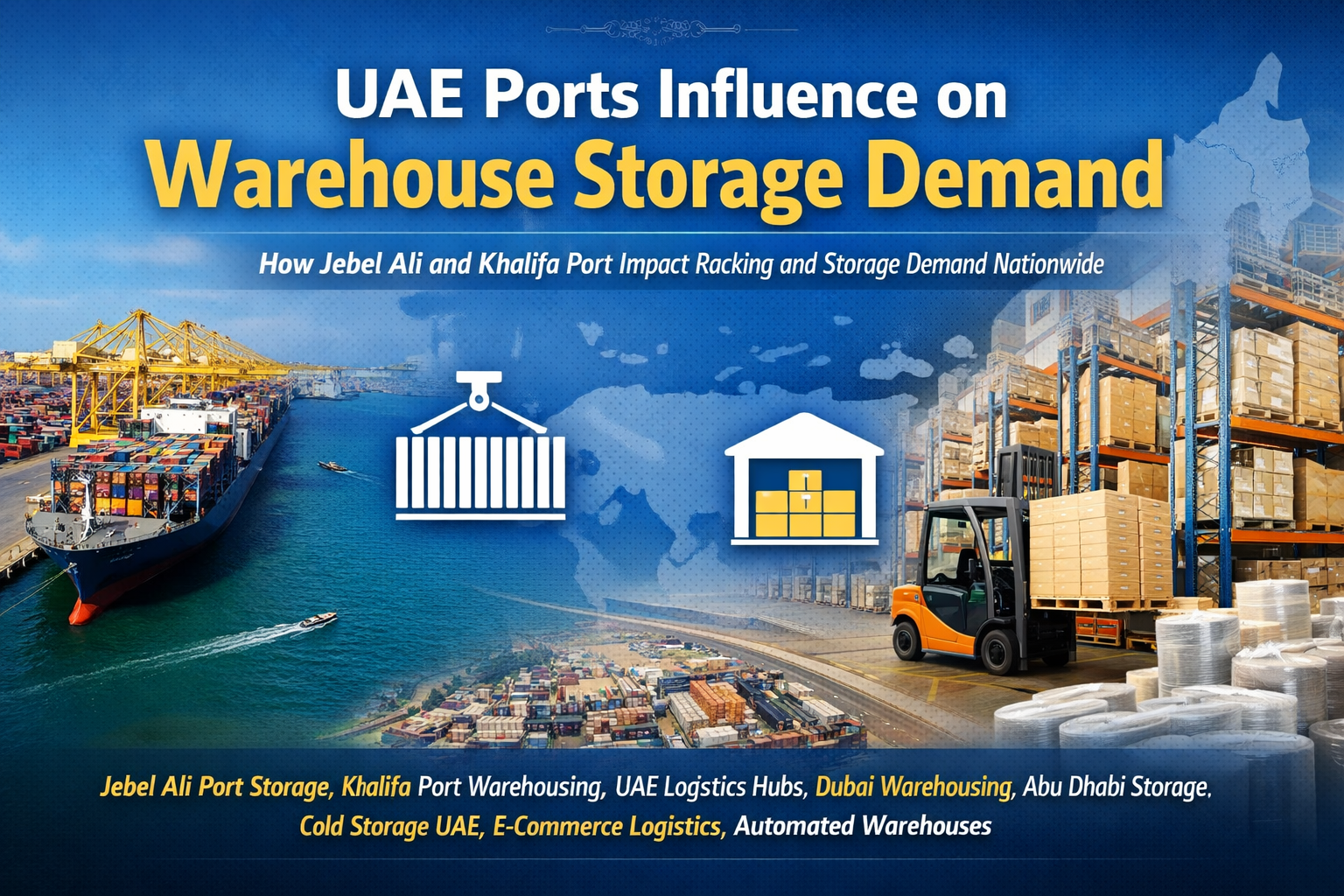
Why UAE Ports Matter to Warehouse Storage
The United Arab Emirates has evolved into one of the world’s most strategic logistics and trading hubs. At the heart of this transformation are its globally competitive ports most notably Jebel Ali Port in Dubai and Khalifa Port in Abu Dhabi. These ports do far more than move containers; they directly shape UAE warehouse demand, influence industrial real estate trends, and define how modern storage and racking systems are designed and deployed across the country.
As global trade volumes increase, supply chains shorten, and e-commerce accelerates, the role of UAE ports in driving warehouse storage demand has never been more critical. From free zones and bonded warehouses to cold storage and high-density pallet racking, port-led logistics ecosystems are reshaping how businesses store, move, and manage inventory nationwide.
This article explores in detail how UAE ports influence warehouse storage demand, the types of storage systems required, regional impacts, and what the future holds for logistics-driven warehousing in the UAE.
UAE Ports as the Backbone of National Logistics
Strategic Geographic Advantage
The UAE sits at the crossroads of Asia, Europe, and Africa. This geographic advantage allows UAE ports to serve as transshipment hubs, connecting East–West trade routes efficiently. Nearly two-thirds of the world’s population can be reached within an eight-hour flight from the UAE, making port-adjacent warehousing essential for fast-moving supply chains.
Integrated Port–Warehouse Ecosystems
Modern UAE ports are no longer standalone maritime facilities. They are integrated ecosystems combining:
- Container terminals
- Free zones
- Industrial parks
- Logistics corridors
- Large-scale warehouse clusters
This integration directly fuels warehouse storage demand in the UAE, particularly near ports where speed, customs efficiency, and scalability are critical.
Jebel Ali Port: The Primary Driver of Warehouse Demand
Overview of Jebel Ali Port
Jebel Ali Port is the largest port in the Middle East and among the top ten globally by container throughput. Operated by DP World, it handles millions of TEUs annually and supports trade across more than 150 ports worldwide.
Jebel Ali Free Zone (JAFZA) and Storage Growth
The presence of JAFZA has created one of the most warehouse-dense zones in the region. Companies operating here benefit from:
- 100% foreign ownership
- Customs-bonded warehousing
- Direct port access
- Multimodal transport connectivity
These advantages significantly increase demand for:
- Selective pallet racking
- High-bay warehouses
- Mezzanine storage systems
- Automated storage and retrieval systems (AS/RS)
Industries Driving Storage Demand at Jebel Ali
Key sectors include:
- FMCG and retail distribution
- Automotive spare parts
- Electronics and consumer goods
- Chemicals and industrial materials
- E-commerce fulfillment centers
Each of these sectors has unique storage requirements, directly influencing racking system selection and warehouse layout design.
Khalifa Port: Powering Abu Dhabi’s Warehousing Expansion
Khalifa Port and KIZAD Integration
Khalifa Port is a next-generation, semi-automated deep-water port integrated with Khalifa Industrial Zone Abu Dhabi (KIZAD). This integration has accelerated industrial and logistics investment in Abu Dhabi.
Industrial-Led Warehouse Demand
Unlike Jebel Ali, which is heavily trade and distribution focused, Khalifa Port drives warehouse demand through:
- Manufacturing-based storage
- Raw material warehousing
- Heavy-duty pallet storage
- Long-term inventory holding
This has increased demand for:
- Heavy-duty racking systems
- Drive-in and drive-through racking
- Cantilever racking for long goods
- Block stacking and bulk storage solutions
Cold Storage and Specialized Warehousing
Khalifa Port also plays a growing role in food security initiatives, increasing demand for:
- Cold storage warehouses
- Freezer racking systems
- Temperature-controlled logistics facilities
These requirements are shaping a new segment of specialized warehouse storage demand in the UAE.
Emerging UAE Ports and Regional Storage Demand
Port Rashid and Dubai South
Port Rashid’s transition toward cruise operations has shifted cargo handling toward Dubai South, near Al Maktoum International Airport. This area is rapidly becoming an air–sea logistics hub, driving demand for:
- Cross-docking warehouses
- Fast-moving inventory storage
- Lightweight racking systems
Fujairah Port: Energy and Bulk Storage
Fujairah Port, located outside the Strait of Hormuz, plays a vital role in:
- Oil and gas storage
- Bulk commodity warehousing
- Industrial materials storage
This creates demand for customized storage structures rather than traditional pallet racking.
How Ports Influence Types of Warehouse Storage Systems
High-Throughput Ports and High-Density Storage
Ports handling large container volumes require warehouses designed for speed and space optimization. This increases adoption of:
- Very Narrow Aisle (VNA) racking
- Double-deep pallet racking
- Automated racking systems
Port-Centric E-Commerce Warehousing
With the UAE becoming a regional e-commerce hub, port-adjacent warehouses are increasingly designed for:
- Pick-and-pack operations
- Carton flow racking
- Mezzanine floors for order fulfillment
Bonded and Customs-Controlled Warehouses
Ports drive demand for bonded storage facilities, requiring:
- Secure racking layouts
- Inventory traceability systems
- Flexible reconfiguration capabilities
Impact on UAE Warehouse Real Estate Market
Rising Demand Near Ports
Land and warehouse rentals near Jebel Ali, Khalifa Port, and Dubai South continue to rise due to limited availability and high demand.
Shift Toward Vertical Warehousing
To maximize land use near ports, developers are investing in:
- High-clearance warehouses
- Multi-level storage designs
- Heavy-duty racking capable of greater heights
This vertical approach significantly increases racking system demand.
Sustainability and Smart Warehousing Trends
UAE ports are increasingly aligned with sustainability goals, influencing warehouse design and storage demand through:
- Energy-efficient lighting-compatible racking
- Automation-ready storage systems
- Reduced footprint through high-density storage
Smart ports require smart warehouses, accelerating adoption of technology-integrated racking solutions.
Future Outlook: UAE Ports and Warehouse Demand
Trade Growth and Diversification
As the UAE diversifies beyond oil, non-oil trade growth will continue to drive warehouse demand near ports.
Automation and Robotics
Port automation is pushing warehouses to adopt compatible automated storage systems, reshaping the racking industry.
Regional Re-Export Leadership
The UAE’s role as a re-export hub ensures sustained demand for flexible, scalable warehouse storage solutions.
UAE ports are not just gateways for cargo they are powerful economic engines shaping UAE warehouse demand across industries and regions. From Jebel Ali’s trade-driven storage ecosystems to Khalifa Port’s industrial warehousing expansion, ports directly influence how warehouses are designed, built, and equipped.
For businesses, logistics providers, and warehouse developers, understanding this port-driven demand is essential to making informed decisions about storage systems, racking investments, and long-term capacity planning in the UAE market.
Frequently Asked Questions (FAQs)
1. How do UAE ports influence warehouse demand?
UAE ports increase warehouse demand by attracting trade, manufacturing, and logistics activities that require nearby storage, distribution, and inventory management facilities.
2. Which port drives the highest warehouse demand in the UAE?
Jebel Ali Port currently drives the highest warehouse demand due to its container volumes, free zone integration, and regional distribution role.
3. What types of warehouses are most common near UAE ports?
Common warehouse types include bonded warehouses, distribution centers, cold storage facilities, and high-density pallet storage warehouses.
4. How does Khalifa Port impact storage demand differently from Jebel Ali?
Khalifa Port primarily drives industrial and manufacturing-related storage demand, whereas Jebel Ali focuses more on trade, FMCG, and re-export warehousing.
5. Are cold storage warehouses increasing near UAE ports?
Yes, food security initiatives and pharmaceutical trade are increasing demand for cold storage and freezer warehouses near major ports.
6. What racking systems are best suited for port-adjacent warehouses?
Selective pallet racking, drive-in racking, VNA systems, and automated racking solutions are commonly used depending on throughput and inventory type.
7. How does e-commerce affect warehouse demand near ports?
E-commerce increases demand for fulfillment centers, carton flow racking, and fast-access storage systems close to ports for rapid order processing.
8. Will UAE warehouse demand continue to grow?
Yes, driven by port expansion, non-oil trade growth, automation, and the UAE’s role as a global logistics hub, warehouse demand is expected to grow steadily.