
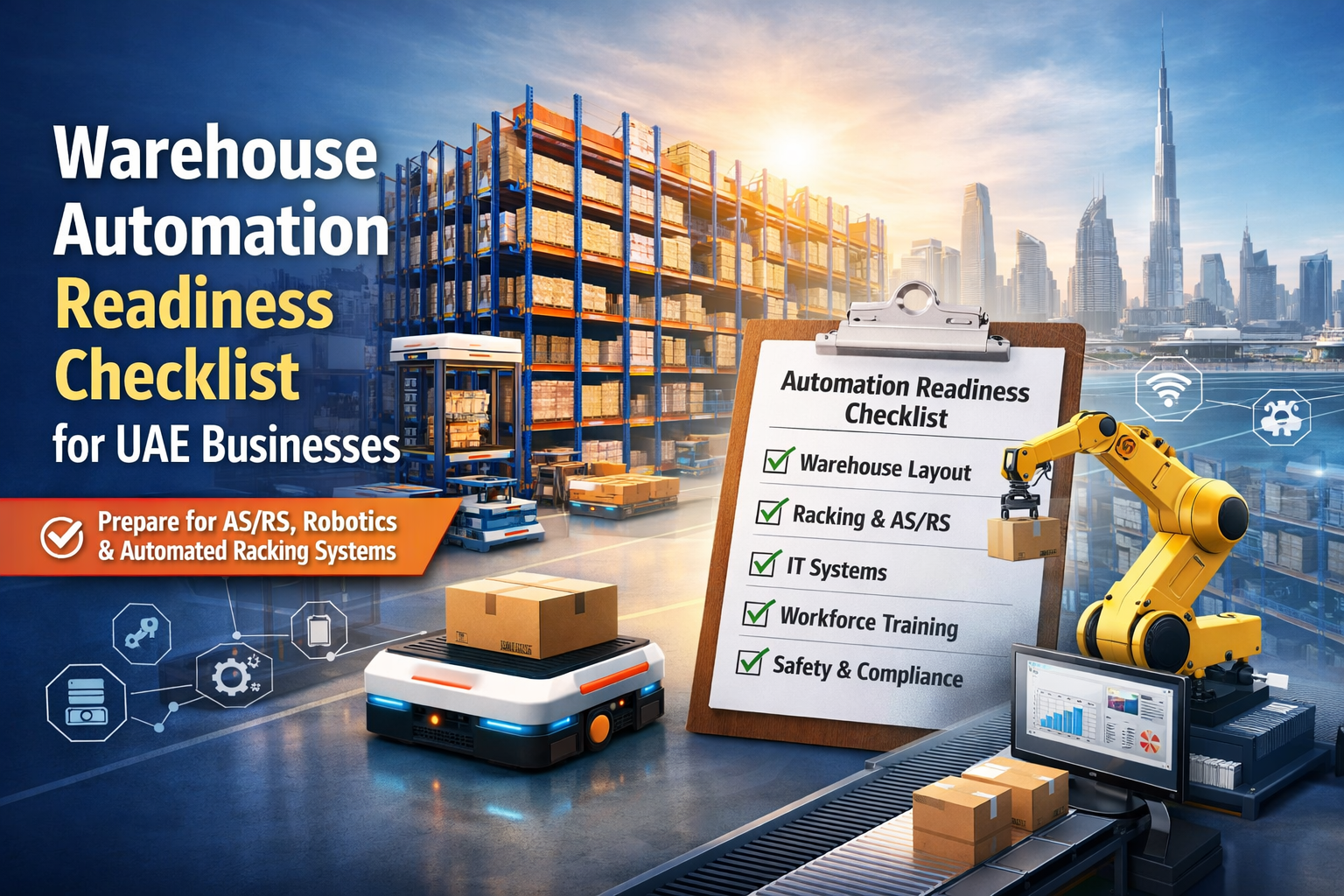
Why Warehouse Automation Readiness Matters in the UAE
Warehouse automation in the UAE is no longer a future concept it is a competitive necessity. With Dubai and Abu Dhabi positioning themselves as global logistics hubs, businesses face growing pressure to improve speed, accuracy, labor efficiency, and scalability. Rising labor costs, limited warehouse space, and demand for same-day or next-day delivery have accelerated the adoption of automation, robotics, and AS/RS systems across the region.
However, automation is not a plug-and-play solution. Many UAE warehouses invest heavily in technology only to discover that their layout, racking, IT systems, or workforce are not ready. This results in costly retrofits, downtime, and underperforming systems.
This article provides a practical, step-by-step warehouse automation readiness checklist for UAE businesses, helping you evaluate whether your facility, infrastructure, and operations are prepared for automation success.
Understanding Warehouse Automation in the UAE Context
Warehouse automation refers to the use of mechanized, robotic, and software-driven systems to handle storage, retrieval, picking, and movement of goods with minimal human intervention.
Common Automation Technologies Used in the UAE
- Automated Storage and Retrieval Systems (AS/RS)
- Automated pallet racking and shuttle systems
- Conveyor and sortation systems
- Autonomous Mobile Robots (AMRs)
- Robotic picking and palletizing
- Warehouse Management Systems (WMS) integrated with ERP
Industries leading automation adoption in the UAE include:
- Cold chain & food logistics
- E-commerce & retail fulfillment
- Pharmaceuticals & healthcare
- Manufacturing & spare parts distribution
Warehouse Automation Readiness Checklist for UAE Businesses
1. Strategic Readiness: Defining the Business Case
Before investing in automation, UAE businesses must clearly define why automation is needed.
Checklist:
- Clear automation objectives (speed, accuracy, space optimization, labor reduction)
- ROI analysis aligned with UAE labor and real estate costs
- Long-term growth forecast (5–10 years)
- Alignment with UAE logistics vision and market expansion plans
Key Insight: Automation should support business strategy not replace it.
2. Warehouse Layout & Space Optimization
Automation systems require precision planning. Poor layouts are one of the biggest barriers to successful automation.
Checklist:
- Adequate clear height for automated racking (especially AS/RS)
- Column spacing compatible with automated systems
- Optimized aisle widths for shuttles or robots
- Clearly defined inbound, storage, picking, and outbound zones
UAE Consideration: Many warehouses in Dubai Industrial City and JAFZA were designed for manual operations and may require layout re-engineering.
3. Racking & Storage System Compatibility
Your racking system is the backbone of automation.
Checklist:
- Existing racking evaluated for automation compatibility
- Load capacities verified for automated handling
- Uniform pallet sizes and weights
- Seismic, wind, and UAE safety compliance
- Option to upgrade to automated racking or AS/RS structures
Best Practice: Purpose-built automated racking systems outperform retrofitted manual racks in the UAE’s high-throughput environments.
4. Floor Quality & Structural Integrity
Automation systems demand exceptional floor flatness and strength.
Checklist:
- Floor flatness compliant with VNA or AS/RS standards
- Load-bearing capacity validated
- Minimal floor joints and cracks
- Regular floor maintenance program in place
Critical Note: Floor remediation after automation installation is extremely costly assess early.
5. Power Supply & Electrical Infrastructure
Automated warehouses are energy-intensive.
Checklist:
- Stable power supply with backup systems
- UPS or generator support for critical automation
- Proper cable management and power distribution
- Energy efficiency analysis to manage operating costs
UAE Advantage: Solar-integrated warehouses are increasingly used to offset automation energy consumption.
6. IT Systems & Digital Integration
Automation success depends on seamless software integration.
Checklist:
- Warehouse Management System (WMS) readiness
- Integration with ERP and TMS platforms
- Real-time inventory visibility
- Cybersecurity protocols
- Data accuracy and master data governance
Automation Fails When: Software systems cannot communicate with robotics or AS/RS controls.
7. Process Standardization & SKU Analysis
Automation amplifies inefficiencies if processes are poorly defined.
Checklist:
- Standard operating procedures documented
- SKU velocity and ABC analysis completed
- Packaging standardized for automation
- Returns and exception handling workflows defined
Pro Tip: High-mix, low-volume warehouses may require hybrid automation rather than full automation.
8. Workforce Readiness & Change Management
Automation transforms jobs it does not eliminate the need for people.
Checklist:
- Workforce skills assessment
- Training programs for automation and system control
- Change management strategy
- Safety training for human-robot collaboration
UAE Reality: Multinational workforces require multilingual training and clear safety protocols.
9. Safety, Compliance & Regulatory Readiness
Automated warehouses must meet UAE safety standards.
Checklist:
- Compliance with UAE fire and civil defense regulations
- Emergency stop and fail-safe systems
- Clear pedestrian and robot segregation
- Regular safety audits
Important: Fire protection design must be integrated with automated racking from the start.
10. Scalability & Future Expansion
Automation should grow with your business.
Checklist:
- Modular automation design
- Expansion-ready racking layouts
- Software capable of handling higher throughput
- Space reserved for future automation phases
Smart Strategy: Many UAE businesses adopt phased automation to manage capital investment.
Common Automation Mistakes UAE Businesses Should Avoid
- Automating without process optimization
- Choosing technology before defining requirements
- Ignoring racking and floor readiness
- Underestimating software integration complexity
- Failing to plan for maintenance and lifecycle costs
Benefits of Being Automation-Ready in the UAE
- Faster order fulfillment
- Reduced dependency on labor
- Higher storage density in premium real estate zones
- Improved inventory accuracy
- Long-term cost efficiency
- Stronger competitiveness in regional and global markets
Future Trends in UAE Warehouse Automation
- AI-driven warehouse optimization
- Increased adoption of AS/RS in cold storage
- Robotics-as-a-service (RaaS) models
- Smart energy-efficient automated warehouses
- Integration with smart ports and free zones
Frequently Asked Questions
1. What is warehouse automation in the UAE?
Warehouse automation in the UAE involves using robotics, AS/RS, conveyors, and software systems to automate storage, picking, and material handling operations.
2. How do I know if my warehouse is ready for automation?
If your warehouse meets layout, racking, floor, power, IT, and workforce requirements outlined in this checklist, it is likely automation-ready.
3. Is AS/RS suitable for all UAE warehouses?
AS/RS is ideal for high-volume, high-density operations but may not suit low-volume or highly variable inventory warehouses without customization.
4. What is the biggest challenge in warehouse automation projects?
Poor planning and lack of integration between racking, software, and automation systems are the most common challenges.
5. Can existing warehouses in Dubai be automated?
Yes, but most require structural, racking, and floor upgrades to support modern automation systems.
6. How long does it take to implement warehouse automation?
Depending on complexity, automation projects in the UAE typically take 6 to 18 months from design to go-live.
7. Is warehouse automation expensive?
Initial costs are high, but long-term ROI through labor savings, space optimization, and accuracy improvements often justifies the investment.
8. What role does racking play in automation readiness?
Racking is critical. Automated systems depend on precision-engineered racking to operate safely and efficiently.
Automation Readiness Is a Strategic Advantage
Warehouse automation in the UAE is not just about technology it is about readiness. Businesses that assess their infrastructure, racking, systems, and people before investing gain faster ROI, smoother implementation, and long-term scalability.
By following this warehouse automation readiness checklist, UAE businesses can move confidently toward automation, robotics, and AS/RS systems that future-proof their logistics operations.