
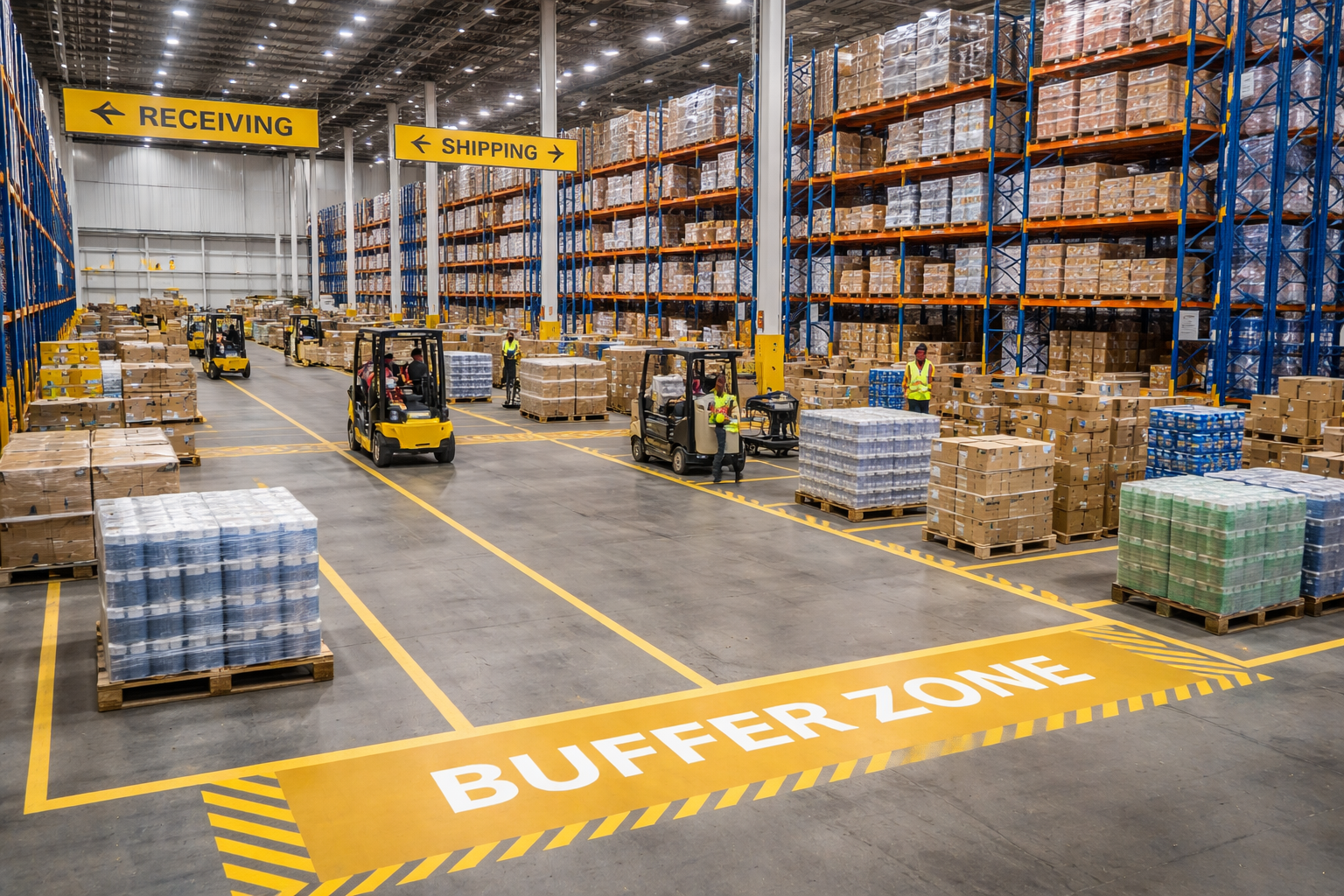
Warehouse buffer zones play a critical role in preventing congestion in high-volume warehouses where inventory velocity, order frequency, and material handling traffic are consistently high. As distribution centers scale operations to meet e-commerce, retail, and industrial demand, poorly planned flow can lead to delays, safety risks, and reduced throughput. Buffer zones offer a structured way to absorb operational variability while maintaining predictable movement across the warehouse floor.
Understanding Warehouse Buffer Zones
Warehouse buffer zones are designated areas used to temporarily hold goods between different stages of warehouse operations. These zones act as controlled staging points, separating inbound, storage, picking, packing, and outbound activities.
Unlike permanent storage locations, buffer zones are dynamic. They are designed to flex with daily volume fluctuations, equipment availability, and labor capacity.
Common Types of Buffer Zones
- Inbound buffer zones near receiving docks
- Outbound buffer zones adjacent to shipping lanes
- Picking buffer zones between storage aisles and packing stations
- Cross-docking buffer zones for fast-moving inventory
Each type supports flow continuity while preventing operational bottlenecks.
How Warehouse Buffer Zones Improve Flow Control
Absorbing Volume Peaks
High-volume warehouses often experience uneven workloads due to shipment arrivals, order cut-off times, or seasonal spikes. Buffer zones absorb these surges without disrupting downstream processes.
By decoupling operations, inbound unloading can continue even when storage aisles or pick zones are temporarily saturated.
Reducing Aisle Congestion
Without buffer zones, pallets and carts are often staged in travel aisles. This restricts forklift movement and increases collision risk. Dedicated buffer areas keep aisles clear, allowing equipment and staff to move efficiently.
Supporting Parallel Operations
Buffer zones allow multiple processes to run simultaneously. For example, picked orders can wait in a buffer while packing stations free up, preventing pickers from stopping work prematurely.
Warehouse Buffer Zones and Staging Area Design
Strategic Placement Matters
The effectiveness of warehouse buffer zones depends heavily on location. Poorly placed staging areas can create new congestion points rather than eliminating them.
Best practices include placing buffer zones:
- Close to high-traffic transition points
- Outside primary forklift travel paths
- Adjacent to docks, packing lines, or consolidation points
Size and Capacity Planning
Buffer zones must be sized according to throughput data, not floor availability alone. Undersized zones overflow quickly, while oversized zones reduce productive storage space.
Warehouse designers increasingly rely on historical order data and simulation tools to right-size buffer capacity.
Impact on Safety and Operational Efficiency
Improved Safety Outcomes
Clear separation between active travel lanes and staging zones reduces accidents involving forklifts, pallet jacks, and pedestrians. According to industry safety studies, cluttered aisles are a leading contributor to warehouse incidents.
Measurable Performance Gains
Facilities that implement structured buffer zones often report:
- Faster order cycle times
- Lower congestion-related downtime
- More predictable labor scheduling
- Improved on-time shipment rates
These improvements are particularly significant in large distribution hubs operating multiple shifts.
Technology and Buffer Zone Management
Warehouse management systems (WMS) increasingly integrate buffer zone logic into task allocation. Real-time visibility allows supervisors to redirect inventory dynamically, preventing overloading in any single area.
Some operations also use visual floor markings, RFID tracking, or automated alerts to maintain buffer discipline during peak periods.
What This Means for High-Volume Warehouses
As warehouses handle higher SKU counts and faster delivery expectations, congestion becomes a structural risk rather than a temporary inconvenience. Warehouse buffer zones offer a scalable, data-driven solution that improves flow control without major infrastructure changes.
When planned correctly, buffer zones turn unused floor space into an operational asset rather than a constraint.
Key Takeaways
- Warehouse buffer zones prevent congestion by separating operational stages
- Proper staging areas keep aisles clear and workflows predictable
- Strategic placement and sizing are essential for effectiveness
- Buffer zones support safety, throughput, and scalability
FAQs
Warehouse buffer zones are used to temporarily hold inventory between operational stages such as receiving, picking, packing, and shipping. They help manage volume fluctuations, prevent aisle congestion, and maintain continuous workflow in high-volume warehouse environments.
Buffer zones reduce congestion by keeping pallets and carts out of travel aisles. By providing dedicated staging areas, they prevent blockages, allow smoother equipment movement, and separate simultaneous operations that would otherwise compete for the same space.
Buffer zones should be located near transition points such as docks, packing stations, or consolidation areas. They should be outside main forklift paths while remaining close enough to support efficient material flow without unnecessary handling.
No, buffer zones are not permanent storage locations. They are temporary holding areas designed for short dwell times. Unlike storage racks, buffer zones support flow control rather than long-term inventory placement.
While buffer zones can function without advanced systems, many warehouses use WMS tools, floor markings, or tracking technologies to manage them effectively. Technology improves visibility, ensures capacity discipline, and supports real-time operational decisions.